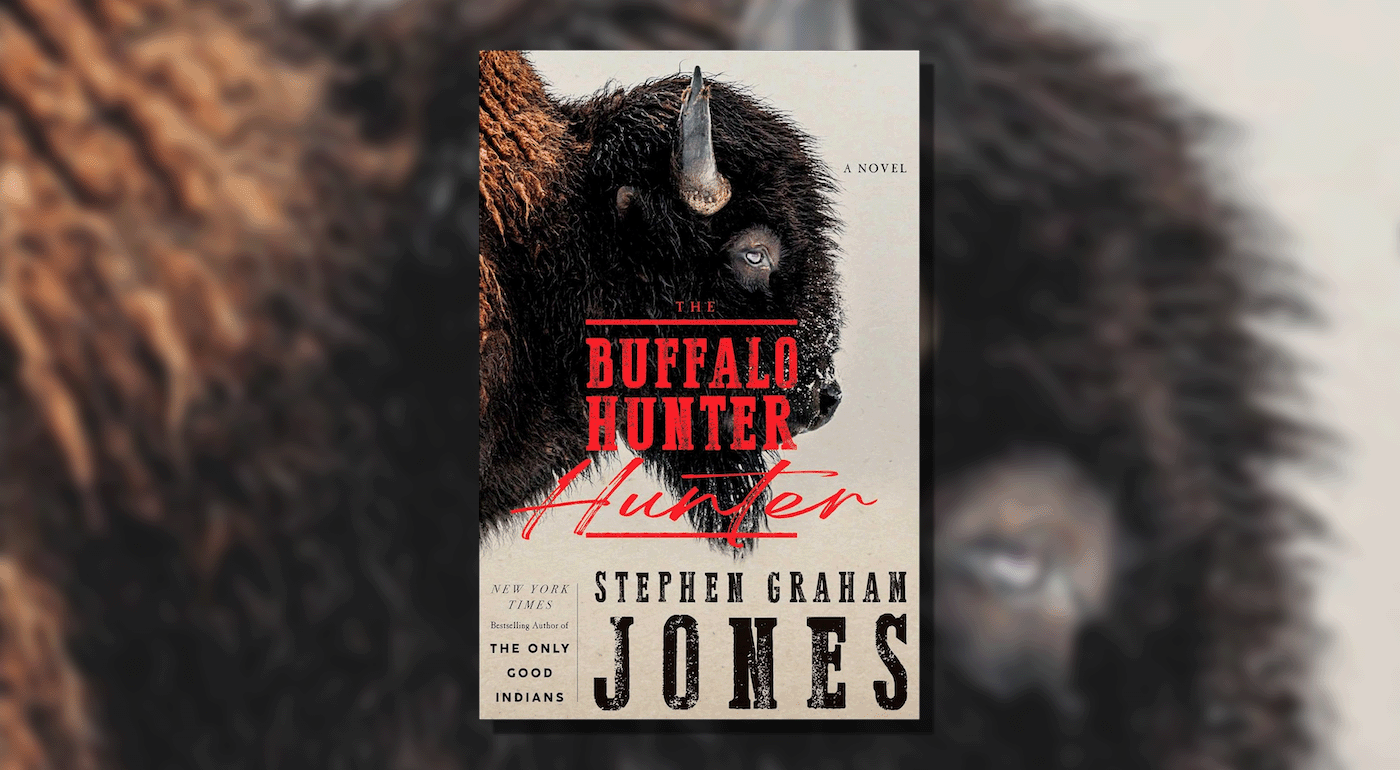
Welcome back to Reading the Weird, our ongoing expedition into the darkest corners of weird fiction, cosmic horror, and Lovecraftiana. We trace the lineage of the genre from its gothic roots to its most harrowing contemporary iterations. This week, we dissect the brutal, soul-shattering revelations found in Chapters 19 and 20 of Stephen Graham Jones’s The Buffalo Hunter (2025). As we navigate this Nebula- and Stoker-winning narrative, be warned: major spoilers lie ahead.
The Unraveling of Arthur Beaucarne
The narrative arc of The Buffalo Hunter has been defined by the slow-motion collision between two men: the pious, haunted Pastor Arthur Beaucarne and the relentless, vengeful Pikuni entity known as Good Stab.
By May 1, 1912, the "farce" of their Sunday confessionals has reached a breaking point. Arthur, fully aware that Good Stab is hunting him with supernatural precision, attempts a desperate flight from Miles City. He hides his journals—his only tether to sanity—beneath layers of sacramental wafers and wine, hoping to mask his scent. Arthur clings to a fragile delusion: that he is a "different man" than the soldier who committed the atrocities for which Good Stab seeks retribution. He prays that his disappearance will serve as a final sacrifice, an admission of guilt intended to spare the town from his own karmic debt.
Yet, as Arthur flees into the starless night, he is not just running from a monster; he is running from the inescapable gravity of his own past.
A Chronology of Confrontation
May 1, 1912: The Flight
Arthur departs Miles City on foot, infirm and undersupplied. He seeks a form of absolution that he knows is likely impossible to achieve while drawing breath. He does not intend to return, nor does he expect to survive the journey, treating his flight as a pilgrimage toward an inevitable end.
May 12, 1912: The Reckoning
Eleven days of silence follow. Within his barricaded church—windows blacked out with an inky paste of dampened Bibles—Arthur has been reduced to a prisoner of his own history. His only companion, Cordelia the cat, has fled, sensing the encroaching rot.
During his flight, Arthur’s encounter with the headless wooden statue of Christ—which Good Stab incinerated with cold, calculated cruelty—marked the end of Arthur’s illusions. Good Stab tracked him not by sight, but by the "smell" of his sins. The subsequent torture, where Good Stab clamped his teeth to Arthur’s throat to induce hypoxia, was not merely an assault; it was a ritualistic rebirthing.
When Arthur awoke, he found himself suspended in a nightmare. Good Stab had turned the chapel into a charnel house, a grotesque exhibition of the town’s prominent citizens—Sheriff Doyle, postmaster Livinius Clarkson, and the lodging house residents—all staged in the pews in various states of decay. This "congregation" was a physical manifestation of Arthur’s past, culminating in the flayed remains of the "hump" Arthur had once buried: Benjamin Flowers, and his three sons.
The Horror of Manifest Destiny: Supporting Evidence
The dialogue between Arthur and Good Stab in Chapter 20 is arguably the most devastating sequence in recent weird fiction. Good Stab forces Arthur to confront the massacre at Heavy Runner’s camp.
Arthur’s defense is a masterclass in the banality of evil. He cites orders, exhaustion, and the prevailing societal indifference toward the Blackfeet. He argues, as many architects of genocide have before him, that he was merely a tool of an inevitable historical force. Good Stab’s response is equally sharp: he reveals that the Flowers family members—whom Arthur had come to care for—were merely collateral damage in a cycle of blood that Arthur himself initiated.
Good Stab’s core demand is existential: "When will napikwans have enough of our land?" The answer, as the novel posits, is never. Arthur’s realization that they are both "mired in up to our souls" in the culmination of these devious efforts marks the final dissolution of his pastoral persona.
The "Nachzehrer" and the Mythic Dimension
In our "What’s Cyclopean" segment, we must address the nature of the antagonist. While we avoid the "two corrupt syllables" often used to describe his kind, the term Nachzehrer—the "after-devourer" from German folklore—is the only label that fits. Good Stab is not a mere monster; he is a manifestation of the trauma that the American expansionist project left in its wake. He is a literalization of the idea that the "body keeps the score."
Analysis of Themes
- Libronomicon: The use of Bibles to create a light-blocking, sacrilegious paste is a brilliant subversion of the sacred. The text is literally used to hide the atrocities committed in the name of the doctrine it preaches.
- The Seven Deadly Sins: Arthur’s alcoholism, once presented as a struggle against his nature, is revealed to be a direct, chemical attempt to drown the memory of the Heavy Runner massacre.
- The "Other" as Supernatural: Anne notes that Arthur’s denial is a defense mechanism. By categorizing his victims as "just Indians," he dehumanizes them. When he is forced to see them as human, his reality shatters, and he begins to view his own role in their destruction as a cosmic, rather than moral, failure.
Implications: The Story of America
The confession scene serves as an indictment of the "Manifest Destiny" narrative. Arthur argues that he was a "different breed of man" forging a new land, a common refrain in the mythology of American expansion. However, the novel deconstructs this by showing that such "forging" is fundamentally an act of extraction and erasure.
Ruthanna’s commentary hits the crux of the issue: Arthur wants the peace of absolution without the work of atonement. He wants to be a "reborn" man, yet he clings to the justifications that allowed him to participate in genocide. Good Stab denies him this comfort. By binding Arthur to the cross, Good Stab forces him to inhabit the role of the victim—or, more accurately, to witness the consequences of his actions as a static, permanent truth.
The harmonization of their screams—Arthur’s from the cross, Good Stab’s from the floor—is a powerful metaphor for the American condition. It is a story of two people bound by a shared, traumatic history, where the perpetrator seeks a grace that the victim cannot, and should not, grant.
Future Projections and Final Thoughts
While no official limited series has been announced, The Buffalo Hunter possesses a visual and visceral intensity that makes a screen adaptation all but inevitable. The "Redder, Deader" confession scene, with its complex makeup effects and grim staging, would challenge any production team, particularly the task of rendering the lidless, dead-eyed dogs that populate the background of this nightmare.
As we look toward the final chapters, the question remains: is there an end to this cycle? Arthur’s claim that he spared a child, Yellow Kidney, at the massacre is a pathetic, hollow defense—a final attempt to find a grain of goodness in a mountain of ash. Good Stab sees through it. The confession must continue, not because it will bring peace, but because the truth demands to be told, regardless of who remains to hear it.
Next week, we turn our gaze toward a different form of catastrophe with Matthew McDonald’s How to Deal With Fallen Gods. Until then, keep your candles lit and your eyes on the shadows. History, as we have learned, has a habit of biting back.