

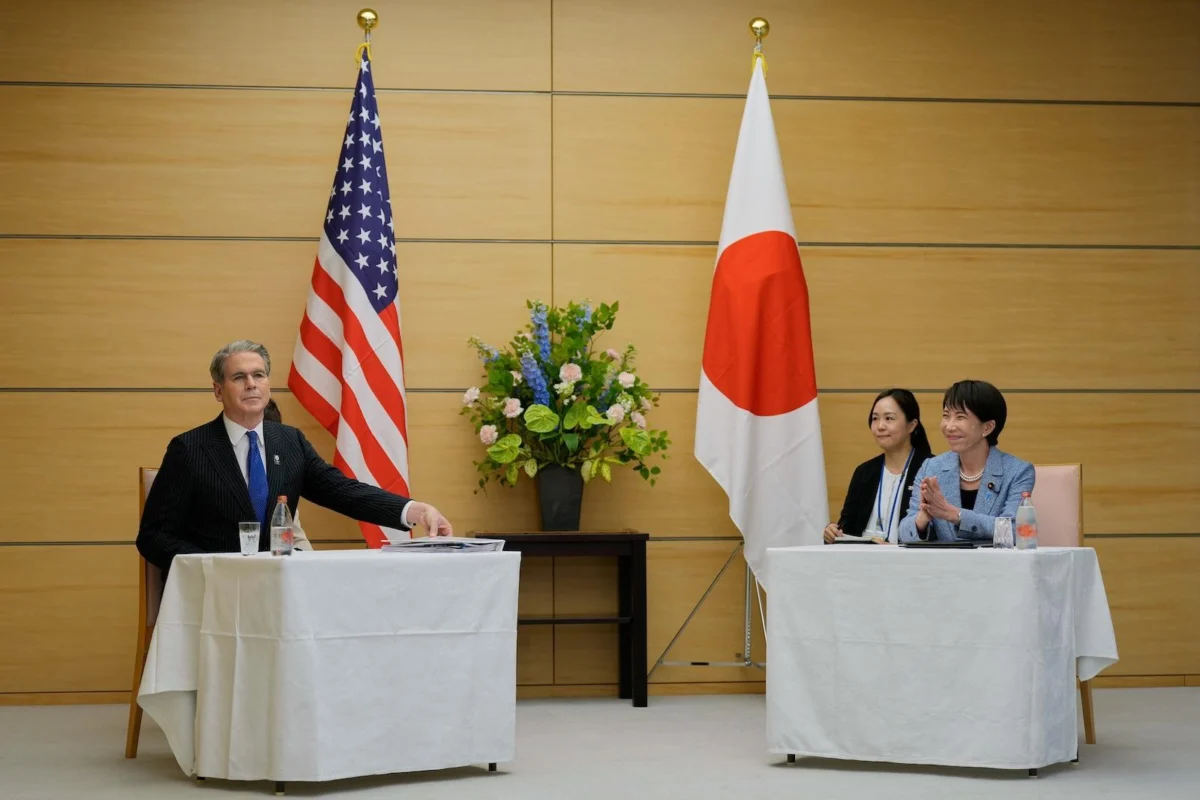
TOKYO — In a high-stakes diplomatic and economic mission, U.S. Treasury Secretary Scott Bessent arrived in Tokyo this week to solidify a united front with Japanese financial authorities. As global markets grapple with the dual pressures of Middle Eastern geopolitical instability and the rapid, often unsettling, evolution of artificial intelligence, the meetings between U.S. and Japanese officials signal a deepening of the economic security pact between the two long-standing allies.
The visit, which precedes a pivotal summit between U.S. President Donald Trump and Chinese President Xi Jinping in Beijing, has focused on three core pillars: stabilizing the yen, securing critical mineral supply chains against Chinese export controls, and establishing a defensive framework against the weaponization of advanced AI models.
The Currency Conundrum: A United Front on Intervention
The primary agenda item for Japanese Finance Minister Satsuki Katayama and Secretary Bessent was the recent, turbulent behavior of the yen. Following a strategic intervention by Japanese authorities on April 30—designed to arrest a slide that saw the yen touch the upper 160 range against the dollar—the two financial chiefs used their Tokyo summit to reaffirm their commitment to market stability.
"We are in good coordination regarding recent currency movements," Minister Katayama told reporters following her bilateral meeting at the Finance Ministry. She noted that Japan’s recent interventions, including suspected operations during the early May Golden Week holidays, have received "full support" from Washington.
Secretary Bessent echoed this sentiment, emphasizing that both nations view "excess volatility" as inherently undesirable for the global financial order. "We have been in close contact with the Ministry of Finance, and we will stay in close contact with them," Bessent stated. He further characterized the communication between the two finance ministries as "constant" and "robust."
The Fundamentals of Resilience
Despite the volatility, Secretary Bessent offered a vote of confidence in the Japanese economy, asserting that its underlying strength and resilience would eventually be reflected in the exchange rate. However, the situation remains delicate. While a weak yen historically benefits Japanese exporters by inflating the value of overseas earnings upon repatriation, the current depreciation has become a double-edged sword. For a resource-poor nation like Japan, the plummeting yen has driven up the costs of fuel and raw material imports, placing an undue burden on domestic households and squeezing corporate margins.
Market analysts suggest that the yen’s weakness is also tied to the Bank of Japan’s (BOJ) cautious approach to monetary policy. Having ended a decade of unorthodox easing in March 2024, the BOJ has been hesitant to hike rates aggressively. When queried on whether the BOJ’s pace of normalization was discussed, both Katayama and Bessent maintained a degree of separation, with Bessent expressing "great confidence" in BOJ Governor Kazuo Ueda’s stewardship.
Geopolitical Friction: The Critical Mineral Crisis
As the G7 finance ministers prepare to convene in Paris next week, the issue of supply chain security has moved to the forefront of the Tokyo-Washington dialogue. The two nations are increasingly concerned about China’s tightening grip on critical minerals, a move perceived as a direct challenge to the economic sovereignty of Western allies.
Minister Katayama was blunt in her assessment of China’s recent actions. "The measures it has taken against Japan are terrible and unfair," she stated, confirming that the U.S. has pledged to continue raising these concerns in its upcoming high-level talks with Beijing.
The friction is part of a broader diplomatic row, exacerbated by tensions over Taiwan. Beijing has responded to these geopolitical shifts by tightening restrictions on the export of dual-use items—technologies that serve both civilian and military functions. Given the vital role these minerals play in the production of semiconductors, batteries, and defense hardware, Japan and the U.S. are now moving to accelerate the diversification of their supply chains to minimize reliance on Chinese sources.
The AI Frontier: Preparing for the "Mythos" Threat
Perhaps the most forward-looking aspect of the discussions involved the emerging threat posed by sophisticated AI models. The conversation specifically addressed the risks associated with advanced systems like Anthropic’s "Claude Mythos" model, which intelligence reports suggest possesses the capability to map and identify vulnerabilities in critical infrastructure, including national financial systems.
"Frankly speaking, China can catch up in developing such models in a matter of six months or a year," Katayama warned. The Minister emphasized that the rapid proliferation of such technology necessitates a cohesive Western strategy to ensure these tools are not "weaponized by those who are not our allies."
This sentiment was mirrored in discussions with Prime Minister Sanae Takaichi, who underscored the need for Japan and the U.S. to harmonize their regulatory environments regarding advanced AI. Both governments recognize that the speed of AI development is currently outpacing traditional regulatory mechanisms, creating a security vacuum that requires immediate, bilateral coordination.
Chronology of Recent Economic Tensions
- March 2024: The Bank of Japan officially concludes its decade-long policy of negative interest rates, signaling a shift toward monetary normalization.
- April 30, 2024: Faced with the yen approaching the 160-per-dollar threshold, Japanese authorities initiate a major currency intervention to stem the decline.
- Early May 2024: Reports emerge of follow-up yen-buying operations conducted by the Japanese government during the Golden Week holiday period.
- May 2024: U.S. Treasury Secretary Scott Bessent travels to Tokyo for high-level meetings ahead of the Trump-Xi summit in Beijing.
- Next Week: G7 finance ministers are scheduled to meet in Paris to finalize a strategy regarding supply chain reliance and critical minerals.
Implications: A New Era of Economic Security
The meetings in Tokyo represent a structural shift in how the U.S. and Japan conduct diplomacy. The era of focusing strictly on trade balances and tariff schedules has been supplanted by a broader, more defensive "economic security" framework.
Strengthening the Bilateral Fabric
Beyond the Treasury-Finance Ministry axis, Secretary Bessent engaged with a wide spectrum of the Japanese government to ensure policy alignment:
- Prime Minister Sanae Takaichi: Focused on long-term supply chain resilience and the mitigation of AI-related risks.
- Economy, Trade and Industry Minister Ryosei Akazawa: Agreed to intensified cooperation in energy security and the procurement of rare earth elements.
- Foreign Minister Toshimitsu Motegi: Concentrated on the integration of economic policy with national security objectives, specifically regarding export controls.
The Road Ahead
The upcoming summit between Donald Trump and Xi Jinping in Beijing will be the true litmus test for these discussions. The U.S. is expected to present a unified front with Japan, pushing for a more transparent and fair trade environment. However, the challenge remains significant. With China’s domestic focus on technological self-sufficiency and its readiness to utilize export controls as a diplomatic lever, the "constant" and "robust" communication between Tokyo and Washington will likely remain a fixture of global geopolitics for the foreseeable future.
As Minister Katayama concluded, the goal is not merely to react to crises—be it currency fluctuations or AI vulnerabilities—but to build an architecture of stability that can withstand the pressures of a shifting global order. Whether this alliance can successfully de-risk the global supply chain without triggering a full-scale economic decoupling from Beijing remains the defining question of the current financial year.












No comments yet. Be the first to join the conversation!