

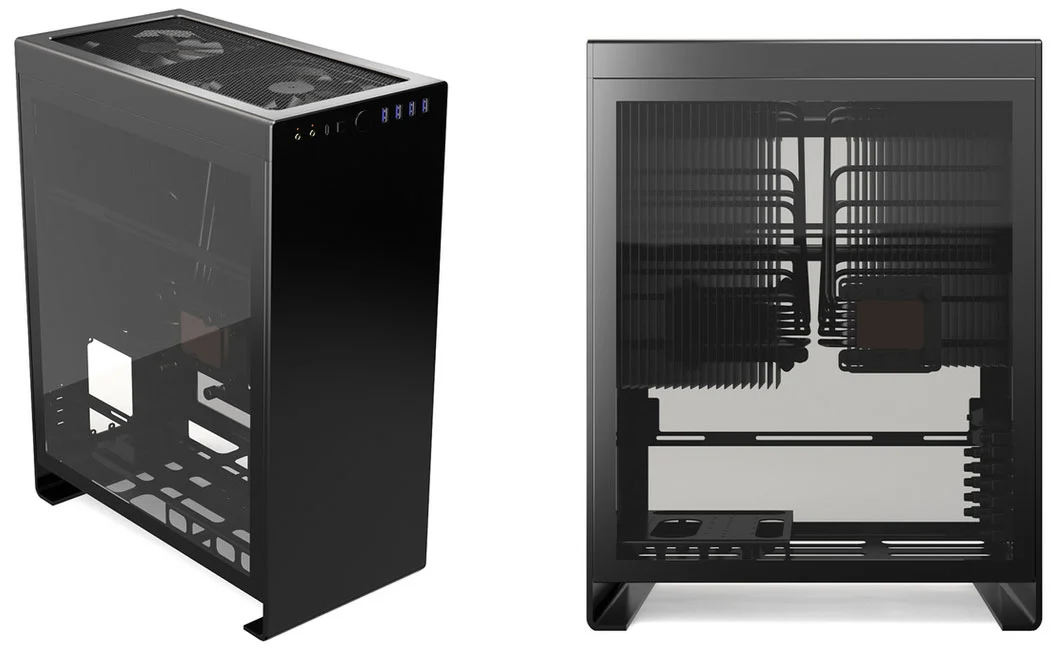
The pursuit of the "zero-decibel" computing experience has long been the holy grail for PC enthusiasts. For years, the trade-off for total silence was catastrophic thermal throttling or the limitation of hardware to entry-level, low-TDP components. However, French boutique manufacturer MonsterLabo has spent the better part of the last three years challenging this paradigm. With the launch of the updated iteration of its flagship chassis, "The Beast," the company is once again proving that high-end gaming and silent, passive cooling are not mutually exclusive—provided one has the budget and the patience for a truly bespoke build.
Main Facts: A New Chapter for Passive Cooling
MonsterLabo has officially launched an updated version of its signature fanless PC case, The Beast, via a new Indiegogo campaign. The announcement marks a significant maturation of a product that has been teased and tested in various forms since early 2021.
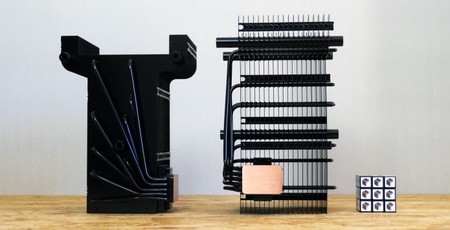
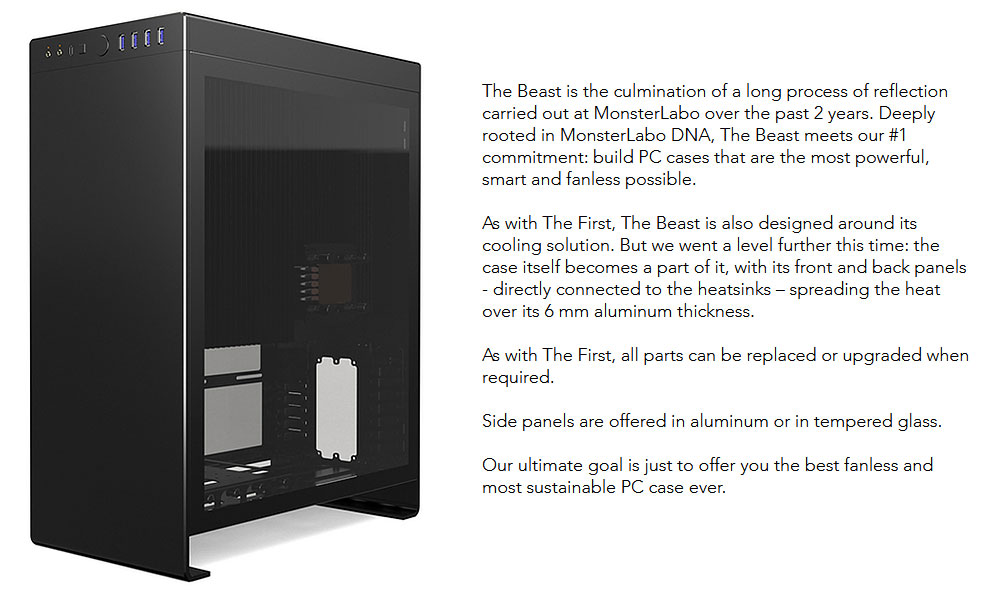
At its core, the system remains a feat of thermal engineering. The case features "The Heart²," a massive, dual-section heatsink assembly that occupies roughly half of the internal chassis volume. This cooling block is bifurcated: one side is dedicated to drawing heat away from the CPU, while the other handles the GPU, utilizing the massive metal surface area to dissipate heat through convection alone.
The updated design aims to resolve previous compatibility bottlenecks. MonsterLabo has broadened support for a wider array of modern graphics cards, a crucial update given the volatile physical dimensions of current-gen GPUs. Furthermore, the company is leaning into the boutique aspect of its brand, offering Indiegogo backers exclusive customization options, including custom color finishes and laser-engraved logos. For those wary of the assembly process—which is notoriously complex in a passive, high-density chassis—MonsterLabo is now offering professional pre-built machines and an assembly service where the company builds the system from user-supplied parts, complete with "fanless optimization" tweaks.
Chronology: From Concept to Consumer Reality
The journey of The Beast has been a gradual evolution marked by public demonstrations that pushed the limits of passive thermal physics.
- March 2021: The project gained significant industry traction following a series of public demos. In one notable test, a prototype of The Beast—outfitted with an AMD Ryzen 3800X and an Nvidia GeForce RTX 3080—was tasked with running Microsoft Flight Simulator 2020. The results were staggering for a fanless build: at 1440p resolution on an ultrawide display, the CPU maintained a stable 75°C, while the GPU held steady at 65°C.
- Late 2021: MonsterLabo refined the architecture, introducing "The Heart²." This updated cooling module replaced the original, though internal specifications remained largely similar, suggesting that the "Generation 2" designation refers more to mounting flexibility and compatibility than a complete overhaul of the cooling geometry.
- October 2021 – Present: The launch of the current Indiegogo campaign marks the move from prototype to production. With shipping windows spanning from December 2021 to April 2022, the company is transitioning into a broader retail phase, complete with a specialized "Brass Edition" for high-end collectors.
Supporting Data: Thermal Management and Technical Hurdles
To understand the efficacy of The Beast, one must look at the data provided by independent testers, most notably the deep dive performed by Optimum Tech.
When tasked with cooling an Intel Core i9-10900K—a notoriously hot-running processor—the system demonstrated the limits of physics. Under a sustained all-core load (4.5GHz at 1.13V), the i9-10900K settled at 89°C. While toasty, it remained well within operational limits for a fanless environment. The GPU performance was equally impressive; by applying an undervolt and a slight base clock reduction of 150-200MHz in MSI Afterburner, the RTX 3080 was successfully reined in to maintain a sub-80°C temperature under heavy load.
A critical component of this success is the partnership with EKWB. MonsterLabo has integrated specialized heatspreaders for memory and for GPUs with a TDP exceeding 220W. This collaboration is essential; without active airflow, the passive heat spreaders must be perfectly mated to the silicon to maximize conductive efficiency. Furthermore, experts emphasize the importance of the motherboard selection. A board with "overspecced" VRMs (Voltage Regulator Modules) and robust factory-fitted heatsinks is not optional; it is a requirement. Without the benefit of case fans to push air over the motherboard components, the ambient heat radiating from the CPU and GPU heatsinks can cause VRMs to throttle if they are not designed to dissipate heat independently.
Official Responses and Service Philosophy
MonsterLabo’s shift toward a "white-glove" service model is a direct response to the difficulty of building a passive system. The company’s official stance on its new pre-built options, which start at €2,850, acknowledges that the "Beast" is not a standard consumer PC.
"We will take care of the painting," is the mantra for the new customization tiers. By offering custom color finishes and bespoke logo engraving, MonsterLabo is positioning The Beast not merely as a computer, but as a piece of industrial art. The assembly service, which allows users to ship their components to MonsterLabo for a professional build, addresses the "fanless optimization" challenge. Passive builds require careful cable management to ensure that internal air can rise naturally through the convection chimneys of the case; poor cable management can create thermal pockets that lead to premature failure.
Regarding the "Brass Edition," the company has noted that it will ship in the Easter 2022 batch. While enthusiasts have expressed concerns regarding the tarnishing of the raw brass finish over time, MonsterLabo maintains that the aesthetic appeal and the premium nature of the materials are intended for the most discerning of silent-PC aficionados.
Implications: The Future of High-End Silent Computing
The success of The Beast raises broader questions about the future of PC hardware design. As high-end CPUs and GPUs continue to push TDPs higher, the reliance on active cooling has become an accepted industry standard. MonsterLabo represents a defiant counter-movement.
Thermal Efficiency vs. Noise Floor
The implication for the industry is clear: if boutique manufacturers can achieve thermal stability with 300W+ components using only passive convection, why haven’t mass-market case manufacturers followed suit? The answer lies in size and cost. The Beast is a massive, heavy, and expensive piece of engineering. To achieve silent operation, one must sacrifice the compact footprints of ITX builds or the cheap plastic aesthetics of budget towers.
The "Undervolting" Mandate
Perhaps the most significant implication for the average enthusiast is the normalization of undervolting. The performance achieved by The Beast is largely dependent on the user’s willingness to "tweak" their hardware. By sacrificing 5–10% of raw clock speed, users can achieve a 20–30% reduction in heat output. MonsterLabo is effectively evangelizing the benefits of efficiency over raw, out-of-the-box power.
Conclusion: Is the Beast for You?
For the average user, the answer is likely no. The financial barrier to entry—starting at €790 for the chassis alone, rising to nearly €3,000 for a pre-built system—places The Beast in the realm of luxury hardware. However, for the professional who requires an environment devoid of fan noise, or the enthusiast who views the "hum" of a PC as a failure of design, The Beast is currently the most viable path forward.
As we look toward the April 2022 delivery window, the market will soon see if this niche concept can scale. With its focus on high-quality materials, professional-grade assembly, and an uncompromising stance on silence, MonsterLabo has succeeded in turning the "fanless PC" from a DIY science project into a refined, high-performance computing platform. Whether or not it remains a novelty or sparks a trend toward more efficient, lower-noise thermal designs in the mainstream market remains to be seen, but for now, The Beast stands alone in the silence.












No comments yet. Be the first to join the conversation!