Asep Darmawan
In the landscape of modern independent gaming, where high-fidelity photorealism and procedural generation often dominate the discourse, there occasionally emerges a project so stylistically singular that it defies traditional categorization. HEAVYDELIC is one such anomaly. Emerging from the singular vision of its creator, the game presents a hallucinogenic, hand-drawn tapestry that feels less like a product of the 2020s and more like a fever dream recovered from a lost 1970s comic book archive.
As of this week, HEAVYDELIC has officially entered Early Access on Steam. Priced at a point accessible to almost any gamer—essentially the cost of a premium cup of coffee—it invites players into a "Slavic Synthpunk" reality that is as bewildering as it is beautiful. Yet, beneath the aesthetic allure lies a project defined by an extraordinary, long-term commitment: the developer has signaled a roadmap that stretches all the way to February 2030.
The Core Concept: A Transmission from an Alternate Timeline
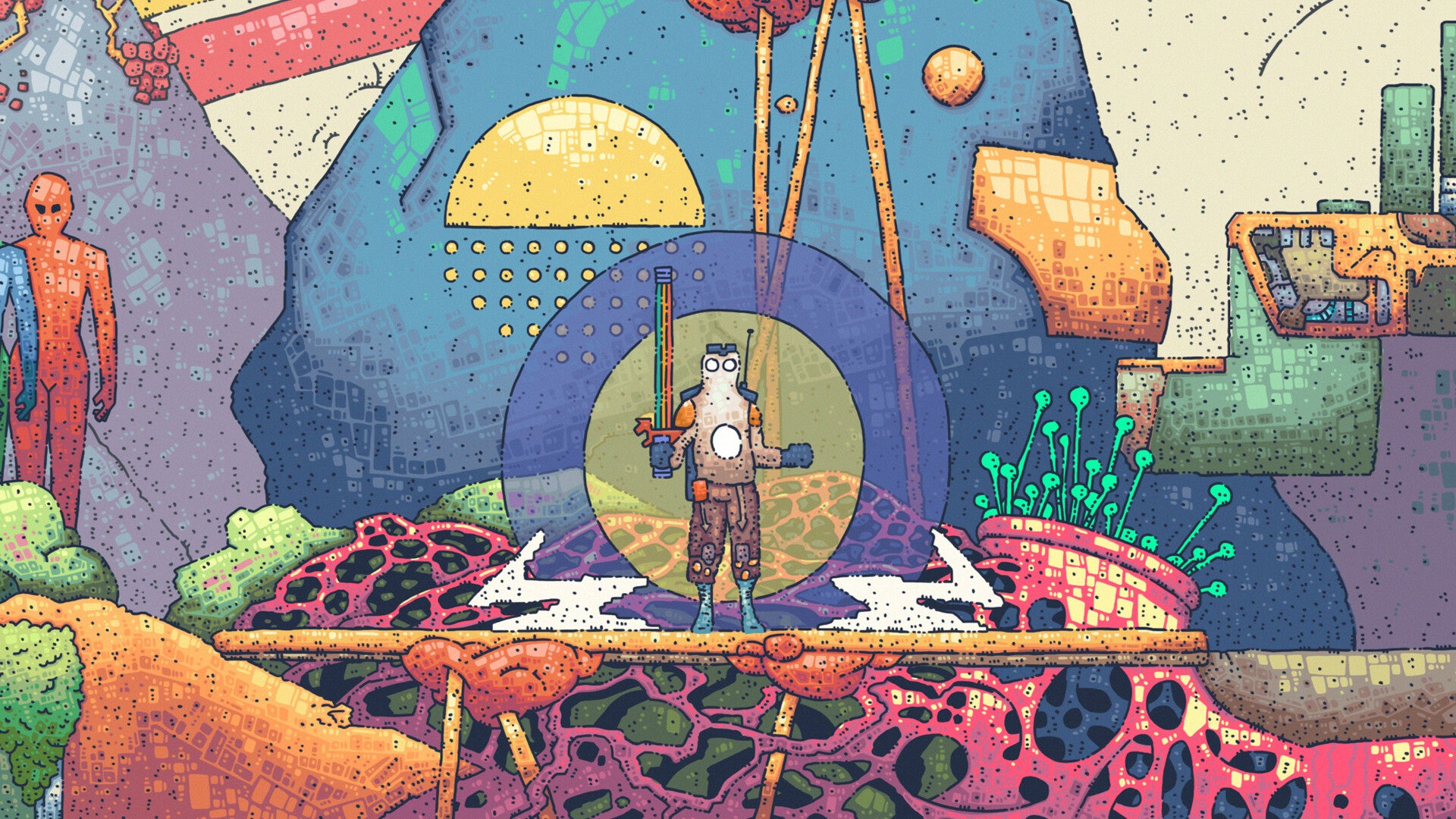
At its most fundamental level, HEAVYDELIC is a 2D platformer, but that description feels woefully inadequate. The game’s premise is rooted in a fractured, alternate-history reality where the future arrived much later than expected. It is a world saturated with the aesthetics of psychedelia, VHS-era distortion, analog decay, and robots reconstructed from the remnants of Slavic mythology.
The narrative framework, insofar as it is presented, is purposefully opaque. The world is divided by a mysterious toxic incident into two distinct human factions: the "carriers," individuals who lack a signal, and the "overload transmitters," whose heightened intelligence—a hyper-awareness—has effectively caused their internal circuits to combust.
Much like the cult-classic RPG Hylics, HEAVYDELIC eschews conventional exposition. It does not hold the player’s hand or provide a prologue to explain the bizarre logic of its universe. Instead, it drops the player directly into the environment, operating on the assumption that you are a native of this strange, synthetic world. The storytelling is environmental, communicated through the grotesque and gorgeous details of the background art, the collection of in-game paintings, and the rhythmic, surreal movement of the protagonist through the 2D plane.
Chronology: A Roadmap to 2030
Perhaps the most startling aspect of HEAVYDELIC’s launch is the developer’s transparency regarding the timeline. In an industry obsessed with "crunch" and rapid-fire content cycles, the creator of HEAVYDELIC has charted a course that spans nearly six years.
The Early Access Genesis
The current build, released this month, is admittedly slim. By the developer’s own admission, the initial Early Access experience offers approximately five minutes of core gameplay. While some may find this duration dauntingly brief, it serves as a "proof of concept" for the visual and mechanical identity of the game. It is a sandbox for players to experience the art style and the core traversal mechanics in a controlled setting.
The Multi-Year Development Cycle
The roadmap is ambitious, aiming for a final, full release in February 2030. This duration is necessitated by the nature of the production:
- Artistic Integrity: Every single asset in the game—every frame of animation, every background, every sprite—is hand-drawn by a single individual. The level of detail required for this specific aesthetic is immense, precluding the use of outsourced assets or automated tools.
- The Scope of Content: The final vision for the game includes 15 distinct, hand-crafted levels. Each level is intended to be a visual feast, functioning as a standalone work of art within the larger narrative.
- The Tiered Pricing Model: The developer has confirmed that the price of HEAVYDELIC will increase incrementally as new batches of levels are added. This incentivizes early adoption, rewarding those who support the project during its nascent stages while establishing a fair value proposition as the game approaches its final, more feature-complete state.
Supporting Data: The Mechanics of Surrealism
While the visual style is the primary draw, the gameplay loop—though currently limited—reveals a focus on kinetic, side-scrolling platforming. The player navigates through industrial and mystical landscapes, engaging in combat with robotic adversaries.
The "Slavic Synthpunk" moniker is not merely a marketing gimmick. It describes a specific collision of high-tech anxiety and ancient, folklore-inspired design. The robots encountered in the game are not the sleek, sterile droids of modern science fiction; they are rusted, jagged, and imbued with the aesthetic of Slavic mythological entities. This marriage of the archaic and the futuristic creates a sense of "analog ruins" that permeate every pixel.
Data regarding the game’s performance in its first few days indicates a niche but intensely passionate audience. Because the game relies on a "show, don’t tell" philosophy, it has found a natural home among fans of avant-garde art games who prioritize atmosphere and unique visual languages over traditional narrative structure or mechanical complexity.
Official Responses and Developer Philosophy
In an era where many developers remain behind a wall of corporate PR, the creator of HEAVYDELIC has maintained a refreshingly blunt communication style. The Early Access FAQ is notably candid, addressing the short playtime and the long wait for the full release with a directness that borders on deadpan.
The developer’s position is clear: HEAVYDELIC is an artistic labor of love. By positioning the game as a long-term project, the developer avoids the common trap of rushing production to meet quarterly expectations. This autonomy allows for the preservation of the game’s unique vision, ensuring that the "hand-drawn" quality remains consistent throughout the planned 15 levels.
When asked about the slow pace of updates, the developer has consistently pointed to the sheer volume of artistic labor involved. "Quality over speed" is the unspoken mantra. For a one-person team, the challenge is not just coding, but the continuous creation of a complex, consistent, and deeply weird visual language that must hold up for the duration of the player’s experience.
Implications for the Indie Sector
The existence and release of HEAVYDELIC carry significant implications for the independent gaming industry:
The Return of the "Auteur" Game
HEAVYDELIC represents a resurgence of the "auteur" model in indie development. It proves that a single developer, armed with a distinct style and a long-term plan, can capture the public imagination without the need for massive marketing budgets or extensive dev teams. It highlights the power of visual identity as a primary selling point in a crowded digital marketplace.
Challenging the Early Access Paradigm
Early Access was originally designed as a way for developers to refine games with community feedback. However, it has often been criticized as a way to sell unfinished, broken products. HEAVYDELIC challenges this by being overtly honest about its incompleteness. By setting a timeline that extends for years, the developer shifts the expectation from "this game is almost done" to "this game is a long-form experience in progress." This transparency creates a different kind of relationship between the creator and the player—a partnership of patience.
The Sustainability of Independent Art
The pricing model—where the cost scales with the content—offers a potential blueprint for other solo developers working on long-term passion projects. It allows the developer to sustain themselves financially while acknowledging the "work in progress" nature of the product. It is a sustainable model that avoids the "burnout" often associated with one-person projects, as the developer is not pressured to finish a massive game in a short window.
Final Reflections
HEAVYDELIC is, at this moment, a promise. It is a promise of a future, hand-drawn world that will eventually unfold into a full-scale exploration of Slavic-inspired synthpunk. Whether it will achieve the heights it aspires to remains to be seen, but the initial offering is enough to pique the interest of anyone tired of the homogeneous nature of modern gaming.
As we look toward 2030, the project serves as a reminder that gaming is, first and foremost, a medium of expression. Sometimes, that expression requires a decade of work, a cup of coffee, and a refusal to conform to the industry’s standard pace. For those willing to join the transmission, HEAVYDELIC is waiting on Steam, offering a glimpse into a world where the future is always arriving, just a little bit late.


 Asro
Asro
 Muslim