Azzam Bilal Chamdy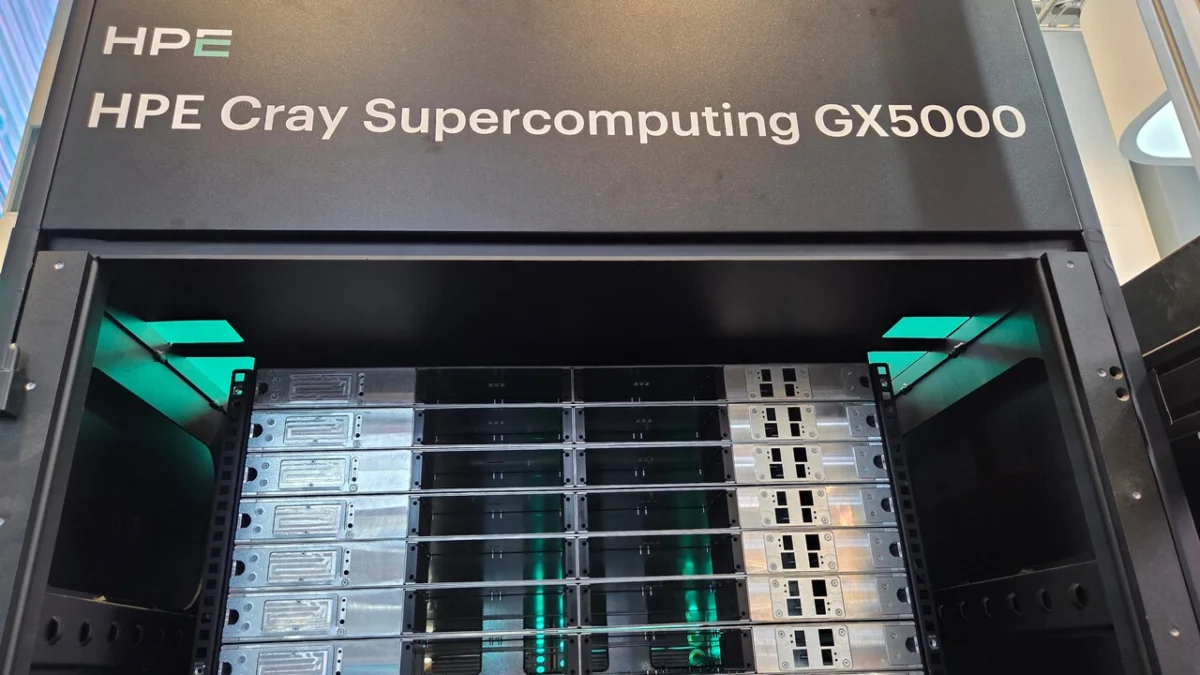
In the high-stakes arena of High-Performance Computing (HPC), where density and thermal management define the boundary between success and obsolescence, Hewlett Packard Enterprise (HPE) has unveiled a new milestone. At the International Supercomputing Conference (ISC) 2026, the company showcased the latest iterations of its Cray GX5000 platform, now supercharged by AMD’s next-generation "Venice" Epyc processors. With a staggering 81,920 CPU cores packed into a single rack, the GX5000 has effectively moved into a league of its own, far outpacing even the most aggressive density configurations previously proposed by industry rivals like Nvidia.
The Core Facts: A New Benchmark for Density
The primary headline from the ISC 2026 presentation is the sheer arithmetic scale of the new GX5000 configuration. By utilizing the GX250 compute blade, HPE has created a server rack capable of housing 40 blades, each equipped with eight AMD "Venice" processors. With each Venice CPU delivering up to 256 cores, the resulting density is unprecedented.
The math is simple but staggering: 40 blades × 8 CPUs per blade × 256 cores per CPU yields a total of 81,920 cores. When accounting for Simultaneous Multithreading (SMT), this translates into 163,840 threads within a single floor-standing unit. This configuration consumes power at an immense scale, with each Venice chip operating at a thermal design power (TDP) of 600 watts, demanding advanced liquid-cooling infrastructure to maintain operational stability.
Chronology: The Evolution of the GX5000
To understand the magnitude of this achievement, one must look at the rapid evolutionary path of the GX5000 architecture, which has transitioned from a concept to a dominant industry benchmark in less than two years.
The GTC 2026 Foundation
The journey began at Nvidia’s GTC 2026, where HPE first teased the GX5000’s potential. The original reveal focused on the "Vera" CPU, Nvidia’s proprietary ARM-based powerhouse. At that time, HPE demonstrated a configuration packing 16 Vera CPUs into a single blade, totaling 640 CPUs per rack. This resulted in 56,320 Olympus ARM cores—a figure that already comfortably exceeded Nvidia’s own reference rack design, which was limited to 256 processors.
The Pivot to AMD Venice
Following the GTC announcement, the focus shifted to the versatility of the modular chassis. HPE recognized that a "one size fits all" approach was insufficient for the diverse workloads of modern data centers, which require a mix of pure CPU throughput and GPU-accelerated AI/HPC tasks. By the time of the ISC 2026, HPE had refined the GX5000 to serve as a platform-agnostic powerhouse capable of hosting both the AMD Venice/Instinct ecosystem and the Nvidia Vera/Rubin ecosystem.
Roadmap to Deployment
The current roadmap indicates that system assembly for various blade configurations will begin in February 2027. Market analysts expect the first operational units to reach data center floors by Q2 2027.
Supporting Data: Modular Architecture and Power Constraints
The GX5000 is not merely a box; it is a thermal and structural engineering feat that challenges traditional data center standards.
Modular Flexibility
HPE’s modular approach allows for two primary specialized configurations:
- The HPC Hybrid (CPU/GPU): This model utilizes 28 GX350a blades per rack. Each blade pairs a 600W Venice processor with four AMD Instinct MI430X accelerators, resulting in a total of 112 Instinct GPUs per rack. This provides a balanced profile for simulation and generative AI workloads.
- The Pure CPU Compute (All-Venice): This configuration utilizes 40 GX250 blades, prioritizing core density. As noted, this reaches the 81,920-core mark, designed for massive parallel processing tasks where GPU overhead is not required.
The "OpenU" Standard
Physical constraints have forced HPE to move beyond standard rack form factors. The GX5000 cabinets are significantly taller, wider, and deeper than the industry-standard 19-inch server racks. Furthermore, HPE has implemented the "OpenU" (OU) measurement, where each slot measures 48mm in height, slightly larger than the traditional 44.4mm (1U). This extra space is essential for accommodating the massive cooling plates and power delivery modules required by 600W-plus processors.

Power Scaling
The current entry-level configuration is designed for a 400-kilowatt (kW) power envelope. However, HPE’s engineering roadmap is already looking forward. They have explicitly defined upgrade paths for 600kW, 800kW, and 1,000kW racks. To sustain these figures, the power delivery systems must be completely overhauled, moving from traditional rack power distribution units (PDUs) to high-voltage busbar systems integrated into the rack frame itself.
Official Responses and Strategic Vision
HPE executives at ISC 2026 emphasized that the GX5000 was designed specifically to bridge the "compute gap" created by the explosive growth of Large Language Models (LLMs) and complex scientific modeling.
"We are not just building servers anymore; we are building modular supercomputing building blocks," said a senior HPE representative during the technical deep-dive session. The strategy is to ensure that clients are not locked into a specific hardware vendor’s cycle. By designing a chassis that can accommodate AMD’s Venice/Instinct platform alongside Nvidia’s Vera/Rubin architecture, HPE positions the GX5000 as the "universal shell" for the next decade of compute.
Regarding the 1,000kW power threshold, HPE acknowledged that this is likely the ceiling for the current design. "Should we need to push beyond 1,000kW per rack, we are looking at an entirely new design philosophy—perhaps one that integrates the rack directly into the cooling loop of the data center’s chilled water plant," the representative added, noting that they expect the current architecture to remain viable for at least six to seven years before a radical redesign is necessitated by physics.
Implications: The Future of the Data Center
The arrival of an 81,920-core rack changes the economics and logistics of the data center in several profound ways:
1. Thermal Management as the Primary Bottleneck
With individual processors pulling 600W, air cooling is dead. The GX5000 proves that direct-to-chip liquid cooling is now a mandatory requirement for high-density deployments. Data center operators must now calculate "TCO per watt" more aggressively, as the cooling infrastructure accounts for a larger percentage of the physical footprint than the servers themselves.
2. The Shift in Compute Density
Traditionally, data center managers sought to balance compute with storage and networking. However, with the GX5000, the rack is the compute resource. The density is so high that traditional network switching at the Top-of-Rack (ToR) level is being replaced by high-speed optical interconnects that move data directly from the blades into the fabric, bypassing standard copper bottlenecks.
3. The "Venice" Advantage
AMD’s Venice processors are clearly aiming for the crown in pure throughput. By pushing 256 cores into a single socket, AMD is forcing software developers to optimize for massive parallelism. Applications that were previously bottlenecked by inter-processor latency will find a new home in the GX5000, where the "all-in-one-socket" design allows for significantly faster data exchange than multi-socket server configurations of the past.
4. A New Era of HPC Competition
The competition between Nvidia’s Vera-based racks and AMD’s Venice-based racks is intensifying. While Nvidia maintains a strong lead in GPU-centric AI workloads, the pure CPU power of the Venice-based GX5000 provides a formidable alternative for scientific research, weather modeling, and massive-scale data analytics. The winner will ultimately be decided by the ecosystem—which vendor can provide the most robust software stack to manage these thousands of cores effectively.
Conclusion
As we look toward the 2027 deployment window, the HPE Cray GX5000 stands as a testament to the relentless pursuit of scale. By successfully managing the heat, power, and physical footprint of 81,920 cores in a single rack, HPE has provided the backbone for the next generation of supercomputing. Whether this leads to a new era of scientific discovery or creates a massive headache for facility managers remains to be seen—but one thing is certain: the era of the 100-kilowatt rack is officially behind us, and the age of the megawatt rack has arrived.

 Asep Darmawan
 Ali Ikhwan