Layla Zulfa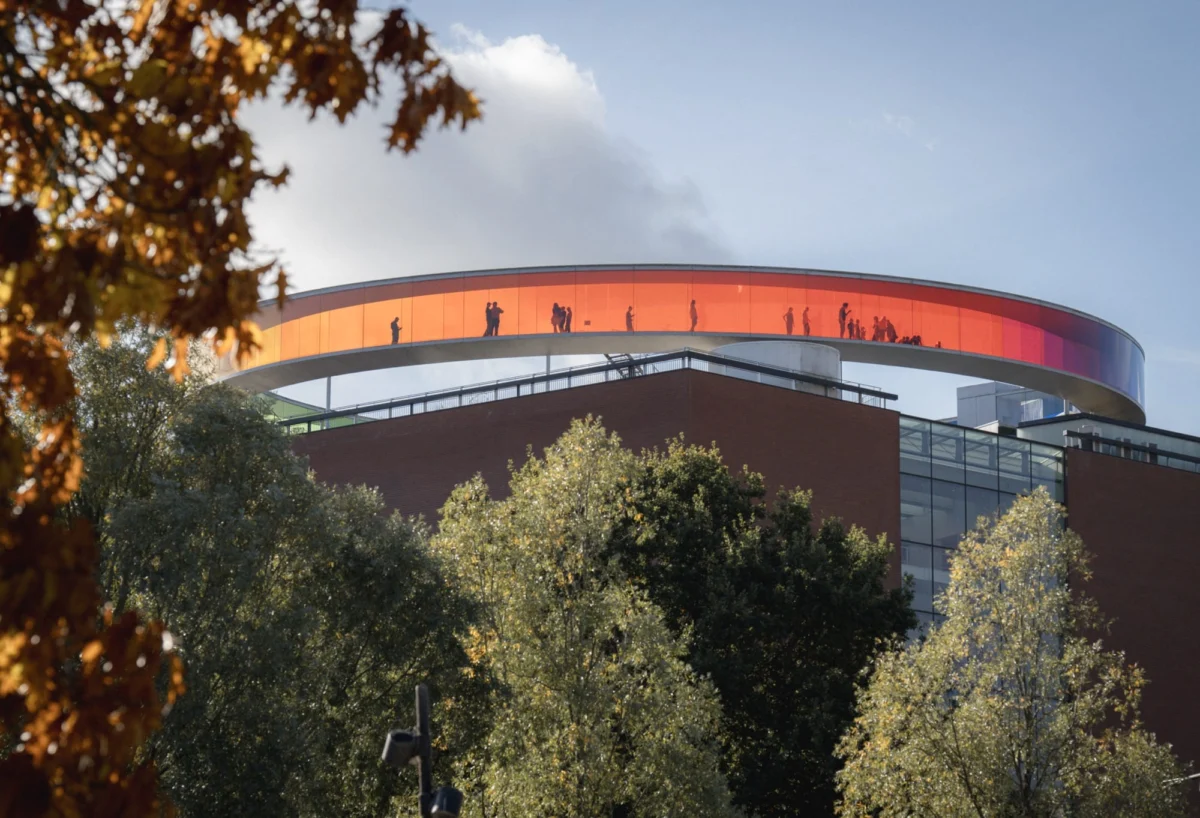
In the quiet, contemplative landscape of contemporary art, few figures command the spatial authority of James Turrell. A pioneer of the Light and Space movement, Turrell has spent decades interrogating the boundary between the viewer’s perception and the vast, unreachable expanse of the heavens. This month, that lifelong pursuit reached a landmark conclusion: the opening of his 100th Skyspace at the ARoS Aarhus Art Museum in Denmark.
Titled As Seen Below, this massive, permanent installation serves as a capstone to a career defined by the manipulation of light, volume, and the atmosphere. By turning the sky itself into a medium, Turrell has transformed architectural spaces across 26 countries into sanctuaries of stillness, inviting audiences to reconsider their relationship with the natural world.
The Main Facts: As Seen Below
The installation at ARoS is not merely a room; it is an architectural marvel that bridges the gap between the mundane and the celestial. Spanning over 50 feet in height and 130 feet in diameter, the dome creates a profound sense of scale that humbles the visitor. At the heart of the structure is a precision-engineered oculus—a circular opening that frames the sky above.

The core concept remains consistent with Turrell’s long-standing philosophy: the sky is not a backdrop, but a physical presence. Through the use of advanced LED technology and sophisticated aperture control, the Skyspace can be transitioned between two distinct states. During the "unfiltered" phase, visitors witness the sky in its raw, shifting beauty, with passing clouds and changing weather patterns appearing as if they were paintings on a ceiling. In the "color shift" phase, the oculus is sealed by a luminous canopy of light, effectively transforming the dome into an immersive, monochromatic environment that alters the viewer’s color perception of the sky that remains visible around the periphery.
This 100th iteration is a testament to the maturation of Turrell’s vision. While his early experiments were intimate and contained, As Seen Below represents a monumental fusion of engineering and metaphysics, solidifying his role as an architect of the intangible.
Chronology: A Lifetime of Looking Up
To understand the magnitude of reaching 100 Skyspaces, one must look back at the trajectory of Turrell’s career, which began long before the term "Light and Space" entered the lexicon of mainstream art history.

The Formative Years (1960s–1970s)
Turrell’s obsession with light originated in the early 1960s, heavily influenced by his training in perceptual psychology and his background as a pilot. Flying taught him that the horizon is a subjective construct and that the sky is a space that can be inhabited. His early Projection Pieces (1966–1969) utilized high-intensity projectors to create shapes of light that appeared as solid objects.
The Advent of the Skyspace (1970s–1980s)
The concept of the Skyspace evolved from these early experiments. In 1974, Turrell began work on Roden Crater, an extinct volcanic cinder cone in the Arizona desert that he has been transforming into a massive celestial observatory for over five decades. It was during this period that he refined the architectural requirements for the Skyspace—a chamber designed to bring the celestial dome into the interior space. The first iterations were small, often private, and served as testing grounds for the interplay between ambient and artificial light.
Global Expansion (1990s–2010s)
By the 1990s, museums and private collectors began commissioning Skyspaces on a global scale. From MoMA PS1 in New York to remote locations in Japan and Australia, Turrell’s work became a staple of institutional art, proving that his minimalist approach could captivate audiences regardless of culture or geography.

The Centenary (2020–2026)
The unveiling of the 100th installation at ARoS marks the culmination of a decade of intensive international collaboration. The process of reaching this milestone involved balancing the delicate environmental needs of these installations with the structural demands of modern museum architecture.
Supporting Data: The Architecture of Light
The construction of As Seen Below is a marvel of technical precision. Achieving the "Turrell effect"—the sensation that the sky is a flat, solid plane—requires absolute control over the light environment.
- Dimensions: The dome reaches a staggering 50 feet in height and 130 feet in width, making it one of the largest in the series.
- Engineering Requirements: The oculus must be perfectly calibrated to ensure that the sky remains the focal point while minimizing reflections that could break the illusion of depth.
- Global Footprint: With 100 installations across 26 countries, the project represents one of the most extensive public art deployments in history.
- The Light Array: The system utilizes custom-calibrated LED arrays that operate on a circadian rhythm, adjusting their color temperature to complement the natural lighting conditions of the Aarhus sky.
These installations are rarely static. Data collected from previous sites indicates that visitors spend an average of 45 minutes inside a Skyspace, a duration significantly longer than the typical museum gallery visit. This "slow art" engagement is precisely what Turrell intends; the work demands patience, forcing the viewer to shed their habitual way of looking.

Official Responses and Curatorial Perspectives
The unveiling at ARoS has been met with widespread acclaim from the international arts community. Museum directors and critics alike have praised the institution for its commitment to realizing such an ambitious project.
"James Turrell is not just an artist; he is a facilitator of wonder," noted a spokesperson for the ARoS Museum during the opening ceremony. "With As Seen Below, we are not simply displaying an object. We are providing a gateway to a meditative space where the boundaries of the museum dissolve into the atmosphere. It is an honor to house the 100th installation of a series that has redefined contemporary art."
Critics have also focused on the psychological benefits of the installation. Dr. Elena Vance, a scholar of perception in art, noted, "In an age of digital distraction, Turrell’s Skyspaces function as a necessary counter-movement. They force us to return to the primal act of looking. By reaching 100 installations, Turrell has effectively created a global network of ‘visual silence’ that is available to the public."

Implications: The Legacy of the Skyspace
The implications of reaching 100 Skyspaces go beyond the celebration of a milestone. The series has fundamentally shifted how architects and planners think about public spaces. Traditionally, museums have been designed as "white cubes"—neutral environments meant to house objects. Turrell’s work argues that the environment is the art.
Institutional Influence
The success of these installations has led to a surge in interest for "immersive architecture." Museums are now increasingly looking for site-specific, experiential works that offer a contemplative experience rather than a collection-based one.
Environmental Consciousness
By grounding his work in the natural cycle of the sun, moon, and weather, Turrell has implicitly tied his art to the health of the environment. One cannot visit a Skyspace without acknowledging the current state of the sky above, be it clear and blue or heavy with pollution or storm clouds. The Skyspace acts as an unintended monitor of the atmosphere, making climate change and weather patterns an inextricable part of the visitor’s experience.

The Future of Perceptual Art
As Turrell enters the next chapter of his career, the focus remains on the Roden Crater project and the maintenance of his global installations. However, the 100th Skyspace serves as a legacy project. It proves that there is a profound, universal hunger for stillness and for the simple, unadorned beauty of the sky.
In a world that is increasingly noisy, fragmented, and screen-bound, the Skyspace remains a powerful, necessary anomaly. Whether in Denmark, the United States, or Japan, the 100 Skyspaces stand as a monument to the idea that if you simply give people a frame through which to look, they will eventually see what has been there all along: the infinite, shifting, and deeply moving beauty of the world above.
For those wishing to experience As Seen Below, tickets are currently available through the ARoS Aarhus Art Museum website. As the installation is a permanent fixture, it will continue to frame the Danish sky for generations to come, standing as a quiet, glowing testament to one of the most significant artistic achievements of the 21st century.


 Nana
Nana
 Siti Muinah