Reynand Wu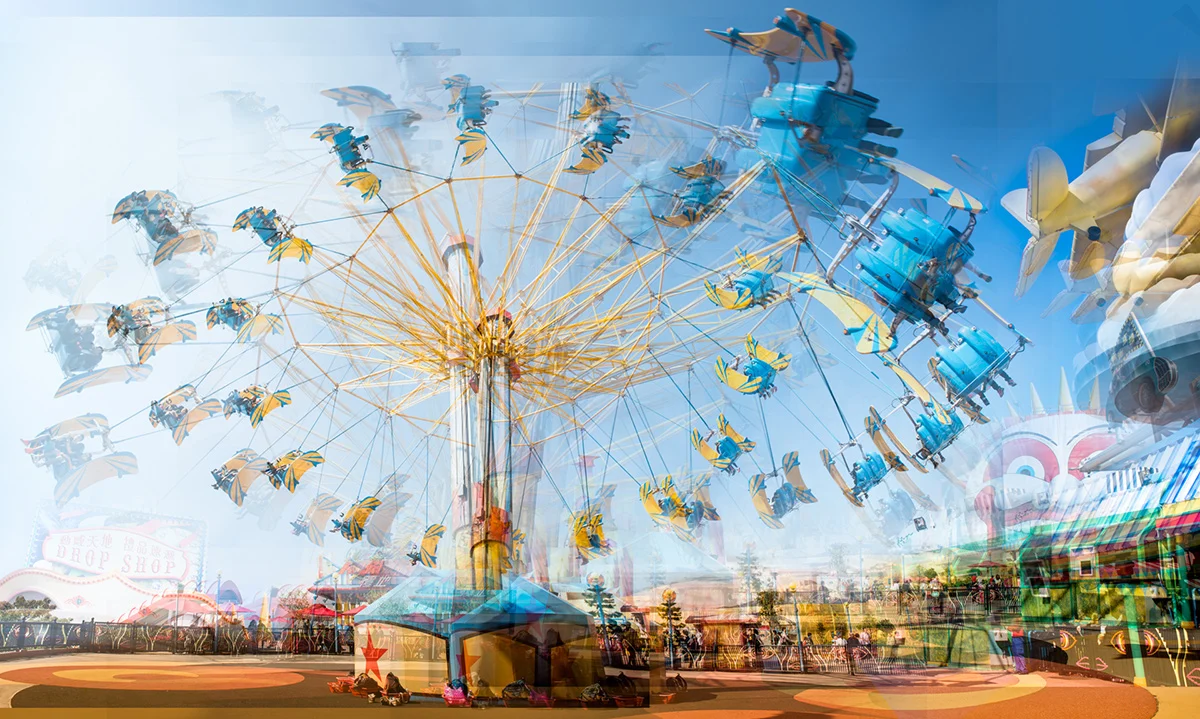
Introduction: The Architecture of Estrangement
In the contemporary landscape of lens-based art, the traditional "decisive moment"—a concept popularized by Henri Cartier-Bresson—has long served as the gold standard of photographic truth. However, for visual artist Riccardo Magherini, that single, static fraction of a second is not merely limited; it is an analytical failure. Through his expansive, multi-year project The Shape of Memories, Magherini challenges the viewer to move beyond the documentary gaze and into the fluid, often disorienting architecture of human memory.
The Shape of Memories is an ambitious, long-term body of work that documents the artist’s navigation of dense urban centers across Asia, including Tokyo, Hong Kong, Bangkok, and Hanoi. Rather than acting as a mere observer of these bustling metropolises, Magherini functions as an archivist of the ephemeral. His work suggests that to truly understand a place, one must abandon the pursuit of visual accuracy in favor of emotional reconstruction. The resulting images, which appear as complex, layered composites, represent the psychological weight of being present in a city while remaining fundamentally an outsider.
Main Facts: The Method of Assemblage
At the core of Magherini’s practice is a radical departure from conventional photography. Each image in The Shape of Memories is not a singular exposure, but a composite of hundreds of individual fragments gathered during his travels. These fragments—details of architecture, the blur of pedestrians, the play of neon light, and the texture of urban decay—are meticulously layered in the studio.
This process is not digital collage in the traditional sense; it is a labor-intensive "sedimentation" of reality. By superimposing hundreds of perspectives, Magherini seeks to replicate the way human consciousness processes a foreign environment. The resulting photographs are dense, vibrating with a kinetic energy that mimics the sensory overload of a sprawling city. The images do not merely record what the artist saw; they function as a visual manifestation of what the artist felt.
Chronology: Fifteen Years of Urban Exploration
To understand the depth of The Shape of Memories, one must look at the trajectory of Magherini’s career. For the past fifteen years, his practice has been defined by a restless movement through space and a persistent inquiry into the nature of perception.
- 2009–2014: The Formative Years. Magherini began his career operating within the confines of traditional street photography. During this period, he became increasingly disillusioned with the "frozen moment." He found that his archives of crisp, single-exposure images failed to convey the visceral intensity of his travels.
- 2015–2019: The Paradigm Shift. Transitioning away from documentary realism, the artist began experimenting with long exposures and double exposures, eventually moving into the complex layering techniques that define his current work. This period saw his first major forays into the dense urban corridors of Tokyo and Hong Kong.
- 2020–Present: The Maturity of the Process. During the pandemic, forced to work primarily in the studio, Magherini refined his methodology. He turned his vast archive of collected visual data into the cohesive narrative of The Shape of Memories. This period marked the refinement of his signature "vibrational" aesthetic, where time and space are compressed into a single, immersive frame.
Supporting Data: The Neuroscience of Memory and Perception
Magherini’s artistic intuition aligns with contemporary cognitive science regarding how humans store and retrieve memories. Research in neuroscience suggests that memory is not a video recording but a reconstructive process. When we recall a city, we do not access a high-definition photograph; we access a "sedimented accumulation of sensations."
The "vibrational" quality of Magherini’s work mimics what psychologists call "the feeling of knowing"—a meta-cognitive state where the brain synthesizes disparate inputs (scents, noises, visual cues) into a singular, emotional gestalt.
By analyzing the density of his images, we can observe the following patterns:
- Temporal Compression: Each frame contains evidence of hours, sometimes days, of observation.
- Spatial Fluidity: The lack of a fixed focal point forces the viewer’s eye to wander, mimicking the experience of walking through a crowded street.
- Emotional Saturation: The color grading and layering intensities are calibrated not to the ambient light of the location, but to the artist’s subjective mood during the visit.
Official Responses and Critical Reception
The artistic community has responded to The Shape of Memories with significant critical interest, noting its relevance in an era where "authentic" travel photography is increasingly questioned for its colonialist undertones.
Critics have lauded Magherini for acknowledging his status as an "outsider." In a statement reflecting on his practice, Magherini noted: "I realised early on that the traditional ‘frozen moment’ of photography was fundamentally inadequate to tell the truth about a place. Life in these environments does not happen in a static fraction of a second. It is a continuous, layered vibration of noise, scents, colours and the relentless flow of people."
Curators of contemporary photography have noted that Magherini’s work sits at the intersection of fine art photography and digital painting, effectively bridging the gap between historical documentation and psychological abstraction. His work has been cited as a "living space," where the viewer is invited to participate in the artist’s own disorientation.
Implications: The Future of Lens-Based Media
The implications of The Shape of Memories are twofold: for the artist, it marks a permanent shift toward subjective reality; for the audience, it challenges the authority of the camera lens.
Challenging the Documentary Truth
In an age of AI-generated imagery and deep-fakes, the "truth" of a photograph is constantly under scrutiny. Magherini’s work is refreshingly honest in its dishonesty. By admitting that his images are reconstructed, he bypasses the tired debate over photographic objectivity. He posits that the only "truth" available to an artist is the truth of the emotional experience.
The Geography of Belonging
The project forces a conversation about the nature of travel in the 21st century. As global mobility increases, the experience of being an "outsider"—of being present but not belonging—becomes a universal condition of urban life. Magherini’s work provides a visual language for this feeling. It transforms the feeling of alienation from a negative, isolating experience into a rich, productive aesthetic.
Technological Synthesis
Finally, the project serves as a masterclass in the creative use of post-production. By utilizing digital tools to "collect" reality rather than "capture" it, Magherini suggests a new path for photographers. This is not about the camera’s ability to record light, but the artist’s ability to curate sensory input.
Conclusion: Stepping Inside the Image
The Shape of Memories is ultimately an invitation. It asks the viewer to stop looking for a clear, legible subject and instead to step inside the image. In these works, the viewer finds a space where memory, emotion, and geography coexist in a state of constant, beautiful flux.
Riccardo Magherini has succeeded in creating a body of work that feels less like a series of photographs and more like a series of dreams. By documenting the disorientation of the stranger in a strange land, he has captured the most elusive element of all: the feeling of being alive in a world that is far too complex to be held in a single frame.
As he continues to explore these urban labyrinths, Magherini reminds us that while we may never fully "belong" to the cities we visit, we can always carry their fragments with us—layering them, refining them, and eventually, turning them into the shape of our own memories.


 Siti Muinah
 Nana Wu