Dwi Wanna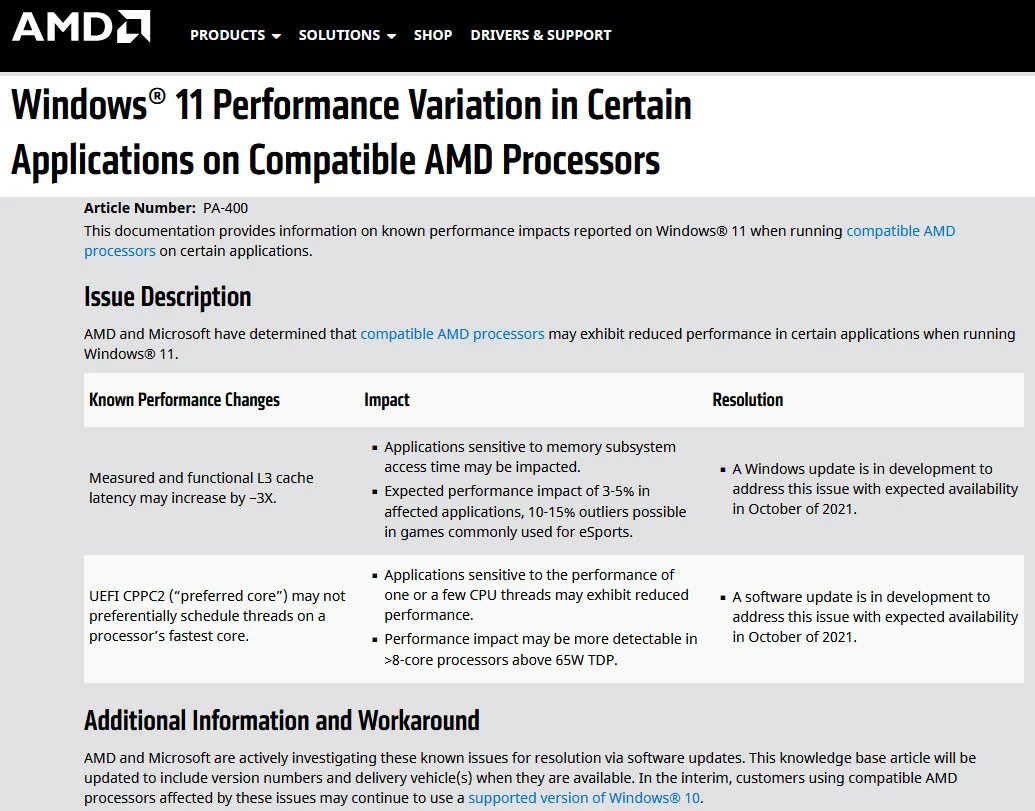
The recent rollout of Windows 11, Microsoft’s latest iteration of its flagship operating system, was intended to herald a new era of productivity and gaming performance. However, for a significant segment of the PC enthusiast community, the transition has been marred by technical hurdles. Shortly after the official launch, reports began to surface regarding notable performance degradation on systems powered by AMD Ryzen processors.
AMD has since confirmed these reports, officially acknowledging that specific hardware configurations are experiencing compatibility issues with the new OS. This article explores the technical nuances of these performance variations, the timeline of the discovery, the impact on end-users, and the road to resolution.
Main Facts: The Technical Conflict
At the heart of the current controversy are two distinct technical anomalies that have emerged since Windows 11’s debut. These issues primarily affect the communication between the operating system’s scheduler and the underlying architecture of AMD’s Zen-based processors.
1. The L3 Cache Latency Bug
The most critical issue involves the L3 cache on modern AMD processors. Under normal operating conditions, the L3 cache provides high-speed, low-latency access to data for the CPU cores. Following the installation of Windows 11, internal testing and user reports have identified that the latency of the L3 cache can effectively triple. This is a severe deviation from expected behavior, as increased cache latency directly correlates to decreased performance in memory-intensive applications.
2. UEFI CPPC2 (‘Preferred Core’) Malfunction
The second issue pertains to AMD’s UEFI CPPC2 (Collaborative Processor Performance Control) technology, often referred to as "Preferred Core" technology. This feature is designed to guide the operating system to delegate high-priority, single-threaded tasks to the processor’s fastest individual cores. In Windows 11, the scheduler is failing to consistently identify and utilize these optimal cores, leading to a situation where lighter tasks are assigned to slower cores, thereby hampering system responsiveness and throughput.
Chronology of Events
The timeline of this situation highlights the rapid discovery of these bugs by the enthusiast community and the subsequent transparency from the manufacturer.
- October 5, 2021: Microsoft officially launches Windows 11 to the general public.
- October 6–7, 2021: Within 48 hours of the launch, early adopters and power users on platforms like Reddit and tech forums begin documenting measurable performance drops in benchmarks and specific gaming applications.
- October 8, 2021: AMD officially acknowledges the reports. They publish a technical support article (PA-400) confirming that they are working closely with Microsoft to identify and resolve these issues.
- Mid-October 2021: Microsoft and AMD confirm that the remediation process is underway, with a promise of a software-level fix delivered via Windows Update.
- Late October 2021 (Projected): The anticipated arrival of the patch designed to rectify the L3 cache and scheduling issues.
Supporting Data: Quantifying the Impact
The performance degradation is not uniform; it varies significantly depending on the type of workload being processed. AMD and independent reviewers have provided a clear breakdown of where users are most likely to feel the sting of these bugs.
Memory-Sensitive Applications
For general productivity and memory-bound software, the impact is noticeable but generally manageable. AMD estimates a performance hit in the range of 3 to 5 percent. While this may be negligible in daily office tasks, it represents a measurable regression for professional workstations involved in data-heavy computing.
The Gaming Sector
Gamers, particularly those who participate in competitive eSports, are disproportionately affected. Because eSports titles often rely heavily on high frame rates and quick response times, the L3 cache latency bug can cause performance drops ranging from 10 to 15 percent. For a gamer used to a stable 144Hz experience, a 15 percent loss can be the difference between a smooth competitive edge and a stuttering, unresponsive experience.
Core-Count Dependency
The "Preferred Core" issue displays a distinct correlation with processor complexity. According to AMD, the bug is more prevalent in processors with more than 8 cores and a TDP (Thermal Design Power) exceeding 65W. The logic is straightforward: as the number of available cores increases, the performance delta between the "fastest" cores (the ones capable of the highest boost clocks) and the "slower" efficiency cores becomes more pronounced. When the OS scheduler fails to distinguish between them, the performance degradation is amplified.

Official Responses and Remediation
AMD has been swift in its communication, prioritizing clarity to prevent widespread panic among its user base.
AMD’s Stance
In their official communication, AMD has been transparent about the root cause: the Windows 11 scheduler is not properly interacting with the specific architectural nuances of Ryzen CPUs. AMD has explicitly stated that they are working in lockstep with Microsoft to push a fix. Crucially, AMD noted that these fixes will not require complex user intervention, such as updating BIOS files or motherboard firmware. The solution will be delivered as a standard Windows Update, ensuring that the remediation is as frictionless as possible.
The "Nuclear Option"
For users who rely on their machines for professional work where every percentage point of performance is critical, AMD has provided a blunt recommendation: if the performance drop is intolerable, the only current workaround is to roll back to Windows 10. While this is an inconvenient "nuclear" option, it guarantees the restoration of full hardware performance until the patch is deployed.
Implications for the Industry
The AMD-Windows 11 conflict serves as a case study in the complexities of hardware-software synergy in the modern computing landscape.
The Importance of OS-Level Scheduling
Modern processors are no longer simple linear engines; they are complex ecosystems of cores, threads, and multi-level caches that require intelligent orchestration. When an operating system’s scheduler is updated, it must be deeply aware of the hardware topology. The current situation highlights that even with extensive beta testing, the transition to a new OS architecture can lead to unforeseen bottlenecks.
Consumer Trust and Beta Testing
This incident also raises questions about the "ready for market" status of major software releases. While Microsoft’s Windows Insider program allows millions to test pre-release versions, specific hardware interactions—especially those involving highly specialized CPU technologies like CPPC2—often slip through the cracks until the wider, more diverse hardware pool of the public release is engaged.
The Ease of Future Fixes
On a positive note, the fact that these issues can be resolved via a simple Windows Update is a testament to the progress made in OS maintenance. In previous decades, a similar bug might have required a motherboard replacement or a risky BIOS flash, potentially alienating less tech-savvy users. The current mechanism, while frustrating for early adopters, demonstrates a robust ecosystem for remote troubleshooting and rapid deployment of software patches.
Conclusion: The Road Ahead
For the vast majority of users, the current performance variations in Windows 11, while unfortunate, are temporary obstacles. The collaboration between AMD and Microsoft suggests that a resolution is imminent, likely arriving before the end of the month.
Affected users are advised to "sit tight." While it is tempting to tinker with settings, BIOS, or alternative OS drivers, the most reliable path forward is to allow the automated update process to do its work. By the time the patch is released, the performance gap between Windows 10 and Windows 11 on AMD platforms should vanish, allowing Ryzen users to fully enjoy the features and interface improvements that Windows 11 offers.
In the fast-paced world of technology, launch-day bugs are a historical constant. However, the speed with which these issues were identified and acknowledged by AMD indicates a high level of accountability. As we wait for the upcoming Windows Update, the PC community remains watchful, but confident that the current performance penalty is merely a footnote in the early history of Windows 11. Until that update arrives, those who prioritize gaming performance above all else may find solace in the stability of their previous OS, but for the rest, the promise of a swift, invisible fix is on the horizon.

 Raul Delapena Setiawan
 Ali Ikhwan