Evan Lee Salim
In the ever-evolving landscape of modern superhero cinema, the shadow cast by a legacy character is often the most difficult obstacle for a reboot to overcome. For decades, Kara Zor-El—the Maid of Might—has grappled with the burden of living in the orbit of her cousin, Kal-El. In the latest installment of the James Gunn-led DC Universe (DCU), director Craig Gillespie’s Supergirl attempts to carve out a distinct identity for the character by leaning into a grittier, more nihilistic aesthetic. However, as the film navigates the precarious balance between dark, mature themes and the demands of a blockbuster franchise, it inadvertently creates a central tension: its greatest strength—a bold, rebellious departure from the traditional "boy scout" narrative—is also its most significant liability.
The Core Conflict: A Hero in Exile
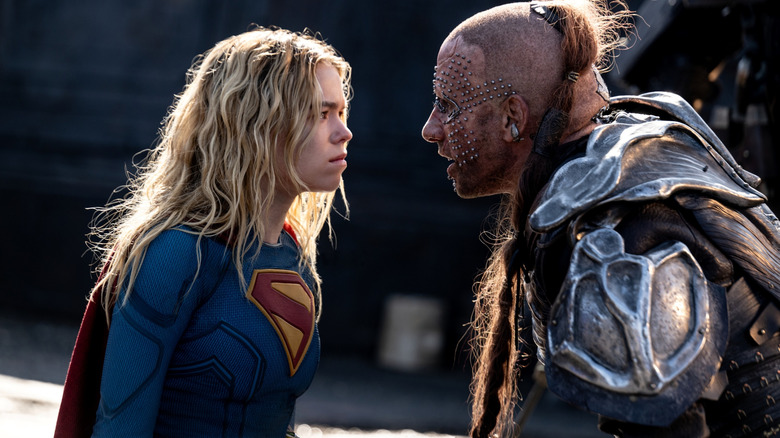
The film’s primary mission is to differentiate Kara from the wholesome, optimistic portrayal of Superman seen in last year’s franchise-restarting hit. Milly Alcock, who made a brief but impactful cameo in Gunn’s Superman, takes the lead here as a version of Kara that is fundamentally broken. Unlike her cousin, who navigated his self-discovery through a journey of hope and morality, this Supergirl is defined by her trauma, her isolation, and her penchant for self-destruction.
The narrative establishes this rift early on: while Clark Kent (David Corenswet) serves as a beacon of light, Kara is a wanderer. When we first meet her, she is drifting through the cosmos, nursing a hangover and seeking solace in the seediest alien dive bars with her loyal companion, Krypto the Superdog. The film frames the interactions between the two cousins—specifically Clark’s well-meaning, polite attempts to bring her home—as a masterclass in tonal dissonance. Kara is "piss and vinegar," a character who buries her grief beneath a layer of cosmic apathy.
While this creates a refreshing, harder-edged character study, it highlights the film’s structural instability. Supergirl is a movie that clearly wants to be a "punk-rock" alternative to the DCU’s baseline, yet it frequently falters when it attempts to ground its emotional stakes in a script that isn’t quite ready to commit to the darkness it cultivates.
Chronology of a Disjointed Narrative
The film’s structure is a series of fits and starts, oscillating between character-driven introspection and the standard requirements of an action-heavy comic book movie.

- The Introduction: We are presented with a disaffected Kara, whose galaxy-hopping lifestyle serves as a defense mechanism against the memories of Krypton.
- The Inciting Incident: The introduction of the film’s antagonist, Krem of the Yellow Hills (Matthias Schoenaerts), pushes the plot forward. Krem is established as a brutal, terrifying force leading a band of Brigands.
- The Flashback: A pivotal sequence provides the film’s most emotionally resonant moments, exploring the final days of Krypton through the eyes of Alura (Emily Beecham) and Zor-El (David Krumholtz).
- The Climax: The resolution of the conflict with Krem, which ultimately feels muted due to the film’s inability to reconcile its dark thematic ambitions with a PG-13 audience-friendly delivery.
By choosing to lean into these disparate tonal shifts, the film creates a "Supergirl-sized identity crisis." It wants to be a gritty drama about the consequences of survival, but it remains tethered to the generic beats of an origin-adjacent adventure.
Supporting Data: The Problem of "Implied Darkness"
A glaring issue in Supergirl is its reliance on "implied" trauma rather than actual narrative exploration. The most egregious example is the treatment of the Brigands, the criminal faction led by Krem. The screenplay hints at a systemic, horrific underbelly to their operations, explicitly mentioning that their agenda involves the trafficking of women and young girls.
In a more mature, R-rated film, this would be a catalyst for a profound exploration of systemic violence and the hero’s struggle against a corrupt universe. However, in Supergirl, these elements are reduced to throwaway lines. The film utilizes the threat of sexual violence as a shorthand for "darkness" and "high stakes," but it never engages with the uncomfortable realities of these plot devices. The "wives" within the Brigands’ camp are relegated to background set-pieces—victims who are never individualized, never given agency, and ultimately left as props in a story that refuses to do the heavy lifting required to address their suffering.
This creative choice creates a dissonance that the audience can feel. The film oscillates between "needle drop" fun and the grim, heavy implications of trafficking, failing to reconcile these extremes. It suggests a lack of courage on the part of the production: it wants the aesthetic of maturity without the narrative responsibility that comes with it.
Official Responses and Creative Vision
Director Craig Gillespie and screenwriter Ana Nogueira have spoken at length about their desire to make Supergirl a "standalone" experience that stands apart from the broader DCU. Their stated goal was to explore the psychological toll of being the "last survivor" of a culture that was not as idealized as we often assume.

However, the creative execution suggests a disconnect between the vision and the page. During the production, there was significant buzz regarding the film’s "Mad Max-ian" intensity. While the film achieves this in its production design and its kinetic, brutal action sequences, the screenplay often pulls back at the exact moment it should lean in.
One notable example is the handling of Zor-El’s moral culpability. The flashback sequence—arguably the best-directed and most beautifully acted portion of the film—shows the parents of Kara making the decision to save their daughter while the world around them burns. The film refuses to interrogate the morality of this decision. Why did Zor-El prioritize his child over the greater population of Argon City? A passing line of dialogue blaming Jor-El (Bradley Cooper) feels like a desperate attempt to externalize guilt, preventing the film from truly digging into the moral ambiguity of Kara’s parentage.
Implications for the Future of the DCU
The implications of Supergirl for the wider DC Universe are profound. As James Gunn and Peter Safran attempt to build a cohesive, multi-platform narrative, the success of individual character studies is vital. If Supergirl fails to hit the mark, it doesn’t just damage the character’s brand; it signals a potential weakness in the DCU’s approach to "tonal variety."
If the DCU wants to offer a spectrum of stories—ranging from the hopeful Superman to the darker, more visceral Supergirl—it must ensure that these tonal shifts are earned. The current iteration of Supergirl proves that simply adding "dark" elements is not enough to create a mature story. Maturity comes from consistency, from deep character work, and from the willingness to follow a narrative thread to its logical, however uncomfortable, conclusion.
For the DCU to move forward, it must learn from this film’s shortcomings. It needs to foster a space where directors can commit to their vision fully. If the goal is to tell a story about a broken woman in a broken galaxy, the studio must allow the film to be exactly that—even if it means embracing a level of discomfort that might alienate a portion of the casual audience.
Conclusion: A Hero Still Searching
Supergirl is a film of immense potential, buoyed by a standout performance from Milly Alcock and a director who clearly understands the power of a striking visual. Yet, it remains a fractured experience. By trying to serve two masters—the need for a dark, standalone character study and the desire to play nicely within a broader, potentially lighter franchise—it ends up satisfying neither.
The film is currently playing in theaters, and it serves as an intriguing, if flawed, case study for the future of the genre. Kara Zor-El is a hero who has spent her life defined by others—by her cousin, by her lost home, and by her tragic backstory. In this film, she is finally given the spotlight, but the movie itself seems just as lost as she is, unsure whether to be a tragedy, a pulpy adventure, or a character study. Ultimately, the film’s greatest strength—its refusal to be just another hero movie—becomes its biggest problem because it refuses to define what it is instead. For now, the Maid of Might remains a work in progress, waiting for a story that is as strong, resilient, and focused as she is.


 Dwi Wanna
 Lina Irawan