Ali Ikhwan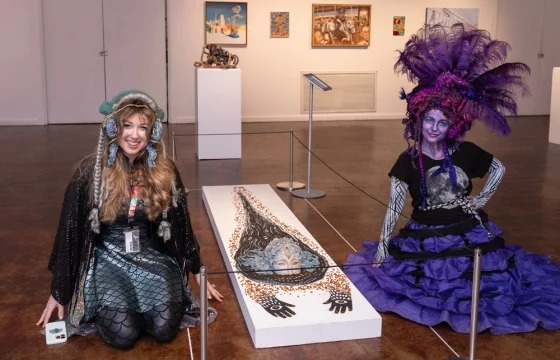
In the high-stakes world of contemporary pop surrealism, the line between the tangible and the dreamlike is often thin. Nowhere was this more evident than at this year’s Surreal Salon 18, hosted at the Baton Rouge Gallery. Among a sea of imaginative entries, one artist managed to anchor the ephemeral, capturing the attention of guest juror and iconic multimedia artist, Caledonia Curry (Swoon). That artist is River Reishi, whose haunting installation, Surface Tension, was awarded Best in Show, marking a significant milestone in her burgeoning career.
The Winning Vision: A Study in Surface Tension
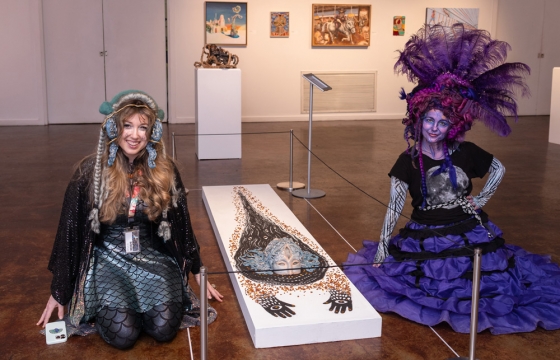
Surface Tension is more than a sculpture; it is a threshold. The piece depicts a female figure caught in a state of suspended animation, emerging from dark, obsidian-like water. Her hands reach forward, poised to break the plane of reality and enter the viewer’s space. Reishi’s technical execution relies on a subtle, internal bioluminescence that pulses softly, a detail that rewards the observant gallery-goer who takes the time to approach the work closely.
The installation is framed by a sprawling field of hand-drawn black sand and amber, a deliberate choice that introduces a visceral element of fragility. Because the sand is loose and unadhered, the piece is in a state of constant, microscopic flux. Any vibration in the room—a heavy footfall or a passing breeze—alters the composition.
"I have always been fascinated by that threshold," Reishi explains. "From land, the surface of water looks smooth, transparent, almost empty. But of course, it hides an entire world that is not ours. The installation tries to hold that exact moment where the two worlds meet." For Reishi, the piece also serves as a meditation on the Gulf Coast’s relationship with water—a force that represents both the sustaining power of life and the inherent dangers of a volatile climate.
Chronology of a Surreal Night
The Surreal Salon has earned a reputation as an unofficial kickoff to the Mardi Gras season in Baton Rouge, characterized by an atmosphere that blurs the lines between art exhibition and performance. For Reishi, the event was a transformative experience.
Having followed the Salon from afar for years, Reishi’s first in-person participation proved to be a whirlwind of unexpected interactions. The most poignant moment occurred when she encountered an attendee wearing a costume directly inspired by her sculpture. "Getting to watch him model it and explain how the sculpture influenced the design completely made my night," she reflects. "It felt like the work had briefly stepped out of the gallery and into the room."
The night took a dramatic turn when a gallery visitor accidentally brushed against the installation’s platform. The resulting shift in the sand, while initially alarming, became a defining moment for the work. As the meticulously drawn patterns collapsed, the true nature of the medium—its loose, impermanent state—was revealed to the audience. Reishi spent the remainder of the evening repairing the work in full view of the public, an act that transformed the "accident" into a piece of performance art.
The "Swoon" Effect: Jurying as Intervention
The selection of Caledonia Curry, known globally as Swoon, as the juror for Surreal Salon 18, brought an added layer of prestige to the event. For Reishi, the validation from an artist whose career is defined by public intervention and the subversion of traditional institutional spaces was deeply resonant.
Reishi traces her admiration for Swoon back to 2009, when the latter navigated the Venice Biennale with her Swimming Cities of Serenissima—a fleet of hand-built, sculptural rafts. "That gesture has always stayed with me," Reishi notes. "The willingness to claim space in a world that does not always easily offer it. Moments like that remind me that voice is not only about what you say as an artist, but about allowing yourself to say it at all."
Reishi’s own creative trajectory, which often involves "unauthorized" or ephemeral placements in public settings, mirrors Swoon’s philosophy. By creating symbolic, myth-based languages, both artists invite the viewer to participate in a shared, living mythology. Having her work recognized by a pioneer who famously brings art to the streets rather than waiting for the gallery’s permission was, for Reishi, a profound affirmation of her path.
The Anatomy of an Ephemeral Practice
Reishi’s creative process is born from practical necessity. Early in her career, the lack of a permanent, large-scale studio forced her to innovate. She began to focus on modular elements and materials that could be rapidly deployed and just as quickly reclaimed by the environment.
"I am not sure I feel comfortable in any single medium, and I think that is probably a good thing," she says. "I tend to move toward whatever material feels necessary for the idea at hand."
Her work is deeply influenced by feminine archetypes and the concept of "voice" in a male-dominated art historical canon. She cites a recent visit to the Museo Nacional de Antropología in Mexico City as a pivotal experience. The figurative ceramics of the Mayan people, she recalls, possessed a "spirit" and "presence" that pushed her to return to her own studio with renewed vigor. This reverence for ancient storytelling informs her focus on how art can act as a vessel for history, grief, and the mystical.
Implications: From Baton Rouge to Reykjavik
The win at Surreal Salon 18 is merely the beginning of an ambitious year for Reishi. Her focus now shifts to an international stage, with an upcoming residency and exhibition at Raf Gallery in Reykjavik, Iceland, scheduled for August.

The timing is auspicious. On August 12, a total solar eclipse will sweep across the Icelandic landscape. Reishi plans to channel this celestial event into a new installation that explores the myth of the birth of Baltic amber, a material that figures prominently in the local culture. The project will see her utilizing sand sourced from local shores, once again highlighting her commitment to site-specific, ephemeral works.
In a departure from traditional gallery norms, Reishi intends to end the exhibition with a communal act of de-installation. She plans to invite the public to help return the sand to the ocean, imbuing the act with personal prayers and intentions. This aligns with her philosophy regarding the lifecycle of art: "I enjoy many different contexts. My installations have appeared in galleries, museums, empty storefronts, and even city halls. But my favorite place for ephemeral work is the beach."
Reflections on the Future of the Surreal
River Reishi’s success at Surreal Salon 18 serves as a reminder that the most compelling art often exists in the space between arrival and departure. By embracing the fragility of her materials—the shifting sand, the fading light, the temporary nature of an installation—she offers a poignant critique of the permanence we often wrongly demand from art.
As she prepares to take her work to the volcanic landscapes of Iceland, Reishi remains committed to the idea that an artist’s voice is defined by the audacity to speak without permission. Whether she is in a curated gallery or on a desolate shoreline, her work demands that we stop, look closer, and acknowledge the strange, beautiful thresholds that exist right beneath our feet.
For those who missed the Surreal Salon, Reishi’s journey can be followed through her website and social media channels. However, as with all truly ephemeral art, the best way to experience her work is to be present for the moment it exists—before it is returned to the tide.


 Asro
Asro
 Reynand Wu