
 Raul Delapena Setiawan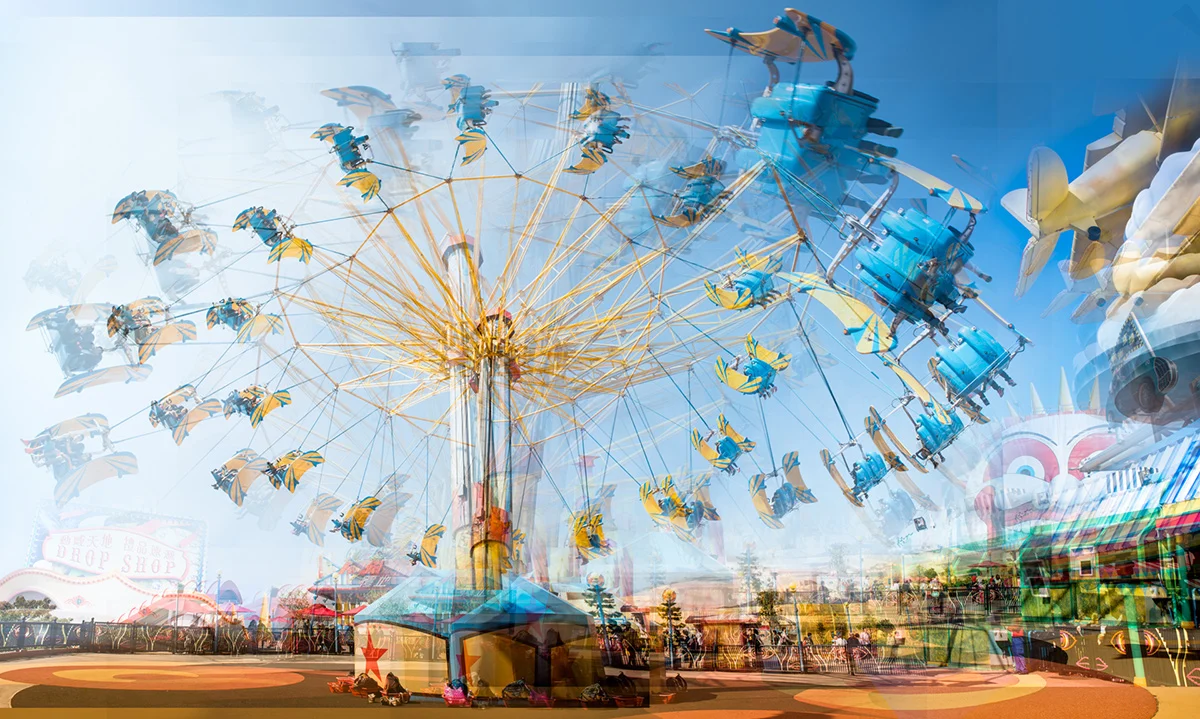
In an era defined by the immediacy of the digital snapshot—where billions of images are uploaded daily to capture the fleeting "now"—lens-based artist Riccardo Magherini is moving in the opposite direction. His latest body of work, The Shape of Memories, represents a profound departure from the traditional photographic impulse to freeze time. Instead, Magherini’s practice seeks to reconstruct the internal, psychological topography of the urban traveler. Through a complex, labor-intensive process of layering and synthesis, he invites viewers to inhabit a space where the disorientation of foreign travel meets the sedimented nature of human memory.
The Genesis of an Urban Odyssey: Main Facts
The Shape of Memories is the culmination of fifteen years of itinerant observation. Magherini has traversed some of the world’s most dense, frenetic, and visually arresting urban centers, including Tokyo, Hong Kong, Bangkok, and Hanoi. Rather than acting as a traditional street photographer, Magherini functions more like an archaeologist of the ephemeral.
At the heart of the project is a fundamental critique of the "decisive moment"—a concept popularized by Henri Cartier-Bresson that has dominated photography for nearly a century. Magherini argues that the "frozen moment" is fundamentally inadequate for capturing the visceral truth of a global city. Life in a metropolis like Tokyo or Hong Kong does not occur in a static fraction of a second; it is a continuous, layered vibration of noise, light, scent, and the unrelenting flux of human movement.
To translate this complexity into a visual medium, Magherini has developed a methodology that abandons the single-shot paradigm. Each finished piece is a composition of hundreds of individual photographic fragments, meticulously gathered and layered within the studio. The final result is not a documentary record of a city, but a psychological reconstruction of the artist’s emotional state within those spaces. It is a portrait of the "outsider," capturing the specific, haunting sensation of being present in a place while fundamentally not belonging.
A Chronological Evolution of Technique
The trajectory of Magherini’s career reflects a gradual shift from observation to synthesis.
The Early Years: The Search for the "Truth"
In the initial stages of his career, Magherini operated within the conventions of documentary photography. He sought the "perfect" shot, believing that technical precision and timing could reveal the essence of a location. However, as he began to spend more time in Asia, he encountered a cognitive dissonance: the photographs he produced felt clinical and detached, failing to capture the overwhelming sensory saturation he felt while walking through the markets of Hanoi or the neon-drenched alleys of Shinjuku.
The Mid-Career Pivot: Collecting Reality
Approximately a decade ago, Magherini began experimenting with composite imagery. He realized that his memory of a city was not a collection of crisp, singular frames, but a blurred, overlapping collage of textures and movements. He began to "collect" reality—taking hundreds of photos of a single street corner, a subway entrance, or a bustling plaza over several hours or days. This period marked a transition toward a more subjective, impressionistic style, where the focus moved away from the subject matter itself and toward the artist’s sensory reaction to that subject.
The Present: The Shape of Memories
Today, The Shape of Memories stands as the synthesis of this evolution. The current body of work is characterized by high-density compositions that evoke the feeling of "living" in a city. The images are dense, almost painterly in their complexity, requiring the viewer to spend significant time scanning the frame to find anchor points, much like one navigates a real-world urban environment.
Supporting Data: The Anatomy of an Image
The technical complexity of Magherini’s work is staggering. According to project data, a single large-format piece from The Shape of Memories can incorporate anywhere from 200 to 500 individual exposure layers.
- Data Density: Each piece acts as a time-lapse, compressing days or weeks of observational data into a single, static image.
- Color Theory: Magherini employs a distinct color palette influenced by the "emotional temperature" of the location. For instance, his work on Bangkok utilizes high-contrast, saturated tones to mirror the intensity of the humidity and the chaotic, kinetic energy of the street markets. Conversely, his Tokyo series leans into cooler, more clinical tones, reflecting the isolation and technological distance often felt in the city’s dense residential corridors.
- The "Outsider" Metric: While not a quantifiable metric in the traditional sense, the success of the work is measured by the "estrangement factor"—the ability of the work to convey the psychological state of the traveler. Studies in cognitive psychology on "place-attachment" suggest that memory is largely reconstructed based on emotional anchors; Magherini’s methodology mirrors this neurobiological process, prioritizing the feeling of a place over its architectural accuracy.
Official Responses and Critical Reception
The art community has reacted with significant interest to Magherini’s shift away from documentary realism. Curator and photography historian Dr. Elena Vance notes:
"Magherini is effectively moving photography into the realm of the post-documentary. By admitting that the camera is a liar, he has found a way to tell the truth. He doesn’t show you the street; he shows you the anxiety, the wonder, and the disorientation of being a human being moving through that street. It is a necessary evolution for the medium."
Critics have praised the work for its "atmospheric density," noting that the images possess a tactile quality that digital photography often lacks. While some traditionalists have questioned the ethics of "manipulating" reality, Magherini remains steadfast. "I stopped trying to capture reality, and began collecting it," he explains. "The image is not a historical document; it is a living space where memory, emotion, and place coexist."
Implications for the Future of Photography
The implications of The Shape of Memories are far-reaching for the future of lens-based media. As AI-generated imagery and hyper-realistic digital manipulation become the standard, Magherini’s work serves as a reminder of the value of the subjective lens.
1. The Death of the "Decisive Moment"
Magherini’s work suggests that in a hyper-connected world, the "decisive moment" is an outdated concept. We are no longer passive observers; we are participants in a constant stream of information. Photography must evolve to reflect this state of "continuous, layered vibration."
2. The Rise of "Synthetic Realism"
By moving toward a synthesis of fragments, Magherini provides a template for artists to explore the nature of memory. This approach invites a new dialogue regarding how we document our lives—not through the singular snapshot, but through the accumulation of experiences.
3. An Invitation to the Viewer
Ultimately, the project asks the viewer to change how they interact with photography. The Shape of Memories is not meant to be scrolled past on a social media feed. It is designed to be experienced. It asks the audience to "step inside" the image, to look for the ghosts of movement in the background, to feel the weight of the layers, and to acknowledge that our own memories of the world are just as fractured and beautiful as the images on the wall.
Conclusion
Riccardo Magherini’s The Shape of Memories is more than a photography exhibition; it is a profound meditation on the human condition in the 21st century. By refusing to settle for the ease of the single frame, he has captured the uncomfortable, beautiful, and chaotic truth of the global city. In doing so, he has bridged the gap between the objective exterior world and the subjective interior mind. As we navigate an increasingly fast-paced and fragmented world, Magherini’s work offers us a place to stop, breathe, and remember what it feels like to truly be present—even when we are miles away from home.


 Dwi Wanna
 Lina Irawan




