In the landscape of modern international cinema, few films have managed to capture the zeitgeist with the same kaleidoscopic, disruptive energy as Rains Over Babel. Colombia’s official submission for the 99th Academy Awards is more than just a stylistic triumph; it is a profound act of cinematic defiance. Described by critics as a queer, Latin American reimagining of Dante’s Inferno, the film weaves a complex tapestry of intersecting narratives: a debt-ridden deputy grim reaper, a drag queen who may be the second coming of Jesus, and a high-stakes mission into the heart of a hellish underground sex club.
Directed by the visionary Gala del Sol, the film functions as a "tropical punk" fever dream, guided by the fourth-wall-breaking narrators El Boticario (the Devil) and Erato (a guardian angel). As the film pushes forward in its Oscar campaign, it stands as a testament to the power of independent storytelling, proving that audiences are hungering for genre-bending narratives that challenge the boundaries of identity, religion, and the afterlife.
A Turbulent Odyssey: From Sundance to the Oscars
The path to the Academy Awards was anything but conventional. When the film premiered at the 2025 Sundance Film Festival, the climate for queer-centric, foreign-language media in the United States was exceptionally fraught. For director Gala del Sol, the journey from that initial festival buzz to global recognition was a grueling process of navigating industry skepticism.
"The whole of 2025, we did a festival circuit, showing the film at over 80 film festivals," Del Sol recalls. "While we secured theatrical distribution in 23 countries, the U.S. was not one of them. A lot of distribution companies were not interested in taking a risk on a film that was in Spanish and also queer. That’s double-niche, in their eyes."
Despite the rejection from major U.S. distributors, the film found a passionate, organic audience abroad. After a successful run on HBO Max in Europe and FILMIN in Spain, Rains Over Babel finally premiered in Colombia in April 2026. What followed defied every industry projection. The film remained in commercial theaters for 14 weeks—a feat for an independent feature—eventually forcing the very industry players who initially turned it away to take notice.

"A lot of people who told us to enjoy our one or two weeks in theaters were calling us after 14 weeks asking, ‘How did you guys do it?’" Del Sol says. "We proved that there is an audience for queer South American fantasy, and it’s not small."
The Anatomy of ‘Tropical Punk’
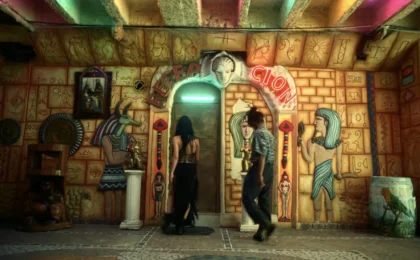
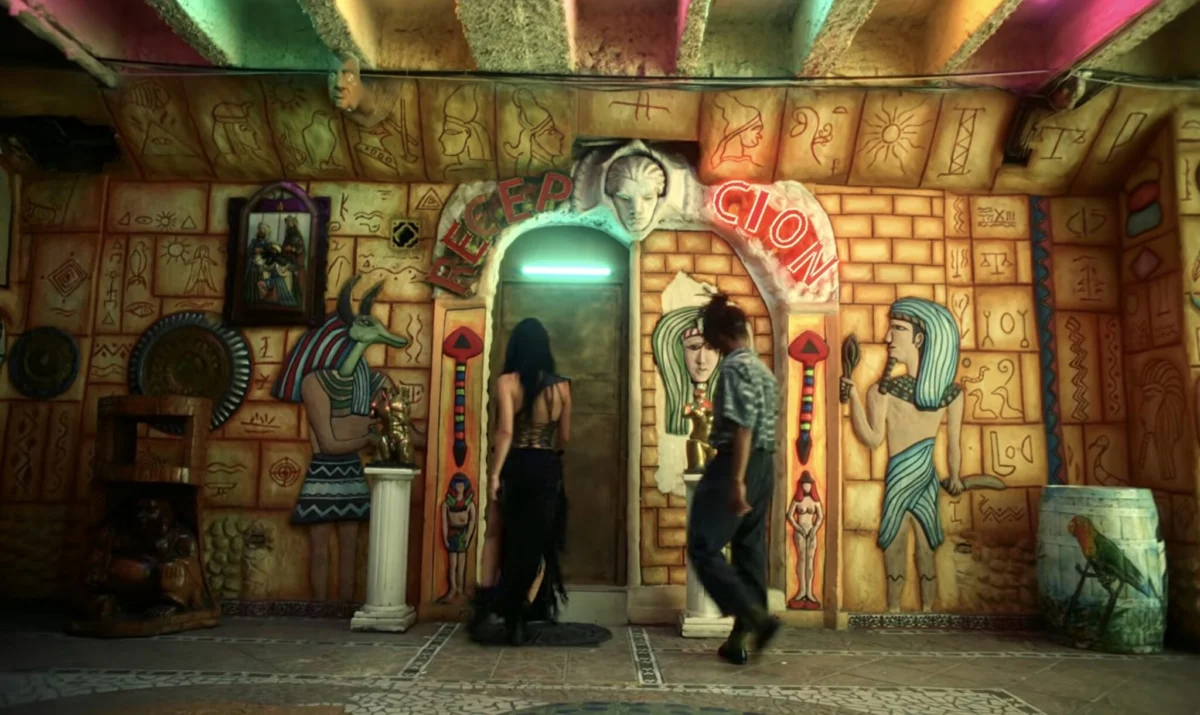
The visual language of Rains Over Babel is distinct, characterized by what Del Sol terms "retrofuturistic tropical punk" or "tropical steampunk." By blending the aesthetic of the 1970s with futuristic, anachronistic elements, the film constructs a version of Cali, Colombia, where demigods and talking animals exist alongside human characters.
This aesthetic is not merely decorative; it is deeply rooted in art history. The film’s opening sequence, featuring an alchemy workshop, serves as a direct homage to Remedios Varo’s painting Harmonia. By grounding the surreal in specific visual references, Del Sol establishes a world with its own internal logic, granting herself the poetic freedom to explore heavy themes like religious repression and queer identity through a lens of fantasy rather than traditional melodrama.
"I think the perfect example is the bouffon in medieval times," Del Sol explains. "The bouffon is the only one who can dress as the king and tell him through comedy everything he’s doing wrong. That’s what I think we can do through genre. It makes the messages more digestible."
The ‘Gala del Sol Multiverse’: Building a South American Cinematic Universe
During her press tour, Del Sol revealed that Rains Over Babel is only the inaugural entry in a much larger, interconnected narrative project. Much like the model established by major Hollywood studios, Del Sol is building a "Gala del Sol Multiverse," where future projects will inhabit the same reality, featuring returning characters, recurring locations, and shared lore.

"All of my scripts now live within that world," she says. "In future projects, you’ll keep seeing the stories of the characters you saw in Babel. Maybe it’s 100 years before or 50 years after, but we always play within the same universe."
The upcoming slate is ambitious. Next year, the team plans to shoot a lesbian vampire film set in a 19th-century sugarcane hacienda—an adaptation of the seminal gothic novel Carmilla. Following that, she is collaborating with Carlos López Estrada’s Antigravity Academy on a project centered on a labyrinthine, underground sex motel where time and identity fracture with every floor the protagonists descend. These projects, while tonally distinct, are tethered to the same surreal, high-concept world that the audience has already begun to embrace through cosplay and fan-driven word-of-mouth.
Bridging the Gap: Cultural Nuance and Global Appeal
When asked if there are elements of the film that international audiences might struggle to grasp, Del Sol is dismissive of the idea of "cultural barriers." She notes that while some slang might be lost in translation, the core themes of the film—guilt, reconciliation, and the human relationship with death—are universal.
She does, however, offer one key piece of context for international viewers: the role of the "motel" in Colombian culture. "In the U.S., motels are cheap hotels," she explains. "In Colombia, they are where you go to have sex. Cali is the city with the most motels in the world, and ironically, the most churches. So you sin, and then you go pay for it." This synthesis of sacred and profane serves as the heartbeat of the film, providing a cultural shorthand for the chaotic, beautiful environment in which her characters operate.
The Future of Colombian Genre Cinema
The success of Rains Over Babel has sent ripples through the industry, challenging the long-held "limiting belief" that South American cinema must be restricted to social realism or depictions of violence to be considered "authentic." By proving that there is a robust, global market for Latin American fantasy and sci-fi, Del Sol and her collaborators have opened doors for a new generation of creators.

The film’s impact has reached the highest echelons of the industry, including a special screening at Pixar, which Del Sol initially mistook for a scam. "It was insane," she says. "I was doing the Q&A, and they were asking me questions, and I was like, ‘I should be asking you guys questions!’"
As the film moves toward the 99th Academy Awards, it carries the weight of an entire movement. It is a film made by a group of twenty-somethings who refused to accept the limitations placed upon them by traditional gatekeepers. With its blend of camp, heartbreak, and bold imagination, Rains Over Babel is not just a contender for an Oscar—it is a blueprint for the future of independent cinema.
For the audience, the film’s message is clear: when the world is chaotic, the best act of resistance is to create a new one—one where, even in the depths of a hellish motel, there is always room for grace, transformation, and a bit of "tropical punk" magic.