

In a creative fusion of science fiction narrative and pedagogical tool, the educational platform "The Japanese Page" has launched an engaging new series titled Frank and the Obaasan. The story follows the misadventures of an extraterrestrial named Frank, who—after suffering a catastrophic ship failure during an intergalactic reconnaissance mission—finds himself stranded in the quiet, tradition-steeped prefecture of Fukui, Japan.
Designed specifically for beginner to upper-beginner students of the Japanese language, the series serves as a bridge for learners who have mastered hiragana but are looking for a context-rich environment to expand their vocabulary, grammar, and cultural awareness. By blending humor, alien fish-out-of-water tropes, and the grounded, no-nonsense wisdom of a local Japanese grandmother, the series provides a unique approach to language acquisition.

The Narrative Chronology: A Stranger in a Strange Land
The story unfolds through a series of episodes that document Frank’s desperate attempt to acclimate to Earth. His mission is twofold: secure a supply of natto (a fermented soybean dish known for its polarizing texture and flavor) and repair his spacecraft before his presence triggers an unintended interstellar conflict.
Episode I: The Encounter
The series opens with Frank’s arrival. He is discovered by "Obaasan," a formidable local grandmother who immediately steps into a caregiver role. The initial dialogue is fraught with linguistic misunderstanding, showcasing Frank’s rudimentary, often comical, grasp of Japanese.
Episode II: Mizu (Water)
In the second installment, the focus shifts to basic survival. As Frank struggles with his physical recovery, he is introduced to the concept of mizu (water). The episode explores the simple yet profound difference between merely existing and experiencing the world—and the culinary delights—of Japan.
Episode III: Sushi is Not Human
The narrative takes a turn into the absurd when Frank is introduced to sushi. Attempting to be polite, Frank tries to strike up a conversation with the food, leading to a humorous intervention from Obaasan, who must clarify that sushi is, in fact, food, not a sentient life form.
Episode IV: Sushi as Sustenance
Building on the previous misunderstanding, Episode Four delves into the ethics of consumption. Frank’s alien perspective on "eating friends" forces a comedic exploration of Japanese dietary norms and the distinction between objects and people.
Episode V: The Identity Crisis
The fifth episode serves as a climax for the initial arc. During a social visit to a neighbor, the question of Frank’s origin arises. When Frank candidly admits he is an extraterrestrial rather than an American, the resulting shock forces both characters to confront the absurdity of their situation.
Pedagogical Methodology: How the Reader Functions
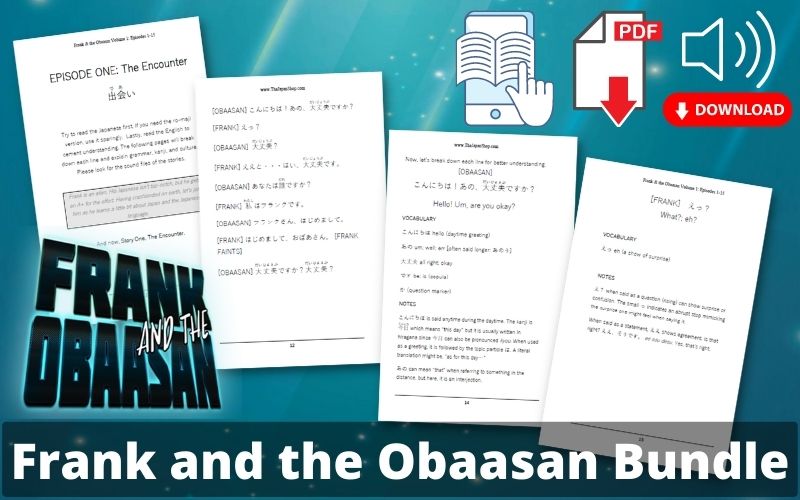
Unlike traditional textbooks that rely on dry, repetitive drills, Frank and the Obaasan utilizes a "Read-Repeat-Understand" methodology. Each chapter is structured to minimize friction for the student:
- Original Japanese Text: Learners are encouraged to read the hiragana script first, treating romaji only as a last-resort safety net.
- English Translation: A direct, contextual translation follows to ensure the learner grasps the tone and intent of the dialogue.
- Grammar and Vocabulary Breakdown: This section offers a granular analysis of sentence structures, essential kanji, and idiomatic expressions.
- Cultural Notes: The authors include insights into everyday Japanese etiquette, providing learners with a sense of "why" certain phrases are used in specific social contexts.
This approach is bolstered by the integration of the "Makoto+ Sentence Explorer," a digital tool that allows students to isolate and practice specific sentences found in the stories, reinforcing retention through active recall.
Supporting Data and Accessibility
The publishers have provided multiple pathways for students to access this content, acknowledging the varied budgets and learning styles of their audience:
- The Freemium Model: The first five episodes are available at no cost, allowing prospective students to sample the material.
- The Shogun Membership: A comprehensive subscription model via "Makoto+" that provides unlimited access to all episodes, including integrated audio files and advanced sentence-parsing tools.
- The Digital Bundle: For those who prefer a self-contained learning experience, a "Beri-Beri-Shoshinsha" (Very, Very Beginner) bundle is available for direct download.
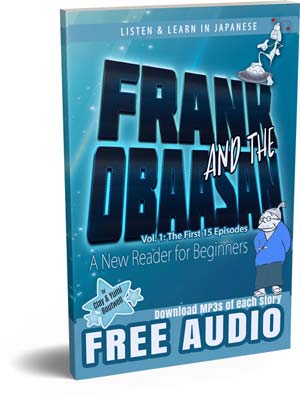
- Physical Media: For traditionalists, the series is also available in paperback format, bridging the gap between digital interactivity and the tactile experience of reading a physical book.
Official Perspective and Educational Philosophy
The creators behind The Japanese Page and The Japan Shop have long advocated for "Input-Based Learning." By placing the learner in a narrative environment, the stress of memorizing abstract grammar rules is mitigated.
In a recent statement, representatives noted that the series is designed to be "a wild ride." By using an alien protagonist, the authors have created a character who is fundamentally allowed to make mistakes. This creates a psychological safety net for the student; if Frank can accidentally try to talk to his sushi and still move forward with his life, the student should feel empowered to stumble through their own language practice without fear of perfectionism.
Implications for Language Learners
The release of Frank and the Obaasan arrives at a time when the demand for "comprehensible input"—language material that is slightly above the learner’s current level of proficiency—is at an all-time high.

Bridging the Gap
Many students of Japanese struggle with the "intermediate plateau," where the leap from basic greetings to complex literary texts feels insurmountable. By offering a narrative that is inherently engaging, the series keeps students motivated long after the novelty of learning hiragana has worn off.
Cultural Literacy
Beyond the linguistic benefits, the series provides a "soft" introduction to Japanese social dynamics. Through the interaction between Frank and Obaasan, students learn about the Japanese concept of omotenashi (hospitality), the role of the elderly in small-town communities, and the subtle ways in which Japanese people communicate hesitation or surprise.

Future Developments
The developers have hinted that future volumes are already in progress, with the promise that those who purchase the current digital bundles will receive future content updates at no additional cost. This commitment to an evolving, living curriculum suggests that Frank’s journey in Fukui is far from over.
Conclusion
Frank and the Obaasan stands as a testament to the idea that language learning should be an adventure rather than a chore. By integrating humor, a compelling story, and rigorous grammatical analysis, the project provides a comprehensive roadmap for beginners. Whether one is drawn to the story for the sake of the alien protagonist or simply to decode the complexities of the Japanese language, the series offers a unique and highly effective pedagogical experience.

For students ready to embark on this intergalactic journey, the path is clear: start with the first five episodes, leverage the digital tools provided by the Makoto+ platform, and prepare to see the Japanese language—and the world of natto and sushi—through the wide, curious eyes of a stranded alien.












No comments yet. Be the first to join the conversation!