Introduction: The Eternal Descent
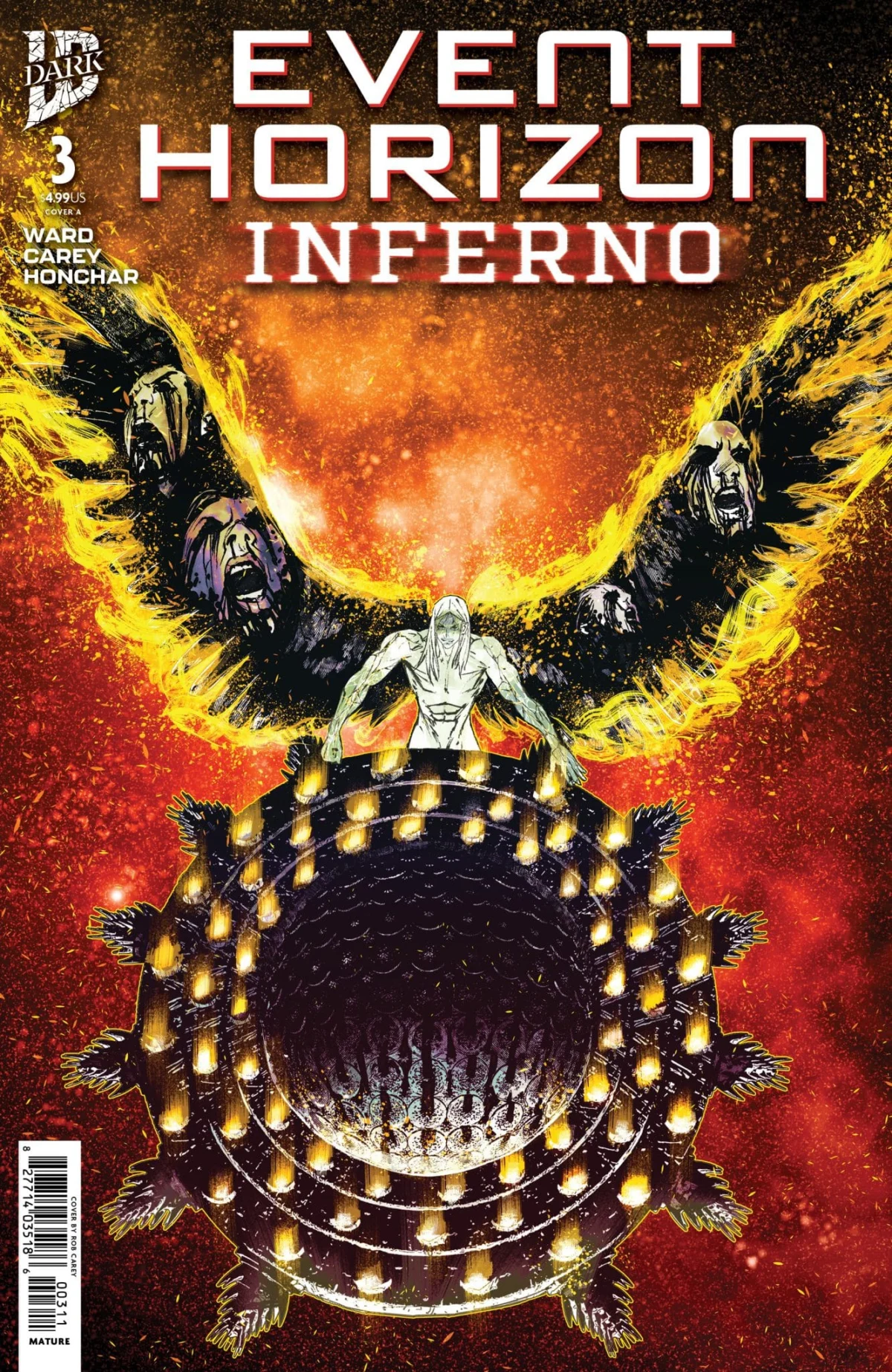
In the ever-expanding landscape of cosmic horror and science fiction comics, few properties have captured the imagination—and the visceral terror—of audiences quite like the Event Horizon franchise. Building upon the legacy of the original cinematic descent into madness, the latest installment, Event Horizon: Inferno #3, continues to push the boundaries of psychological dread. Written by the visionary Christian Ward with hauntingly detailed illustrations by Robert Carey, this third issue marks a critical turning point in the series. As the narrative reaches its midway climax, readers are forced to confront the central conceit of the book: that the ship is not merely a piece of hardware, but a sentient, inescapable cycle of suffering.
Main Facts: The Anatomy of a Nightmare
The premise of Event Horizon: Inferno #3 is as simple as it is terrifying. Two centuries have elapsed since the ill-fated vessel was last boarded by a human crew. Designed as a pinnacle of human ingenuity—a vessel intended to propel our species beyond the physical constraints of known space—the ship instead became a gateway to a dimension of pure, chaotic malevolence.

In this issue, Ward and Carey peel back the layers of the ship’s history, revealing that the crew members who remain "trapped" within its hull are not merely ghosts or survivors. They are subjects of an eternal, recursive torture. The core conflict revolves around the realization that the ship’s primary engine—a drive meant to fold space—has instead folded time itself. The inhabitants are doomed to witness their own horrific demises, only to reset and experience the terror again in an infinite loop.
Chronology: Two Centuries of Despair
To understand the gravity of Event Horizon: Inferno #3, one must look at the timeline established by the creative team. The chronology of the Event Horizon mythos is a fragmented, non-linear experience, which mirror the protagonists’ own confusion:

- Year 0: The launch of the Event Horizon, a beacon of human scientific advancement.
- Year 1: The inaugural "disappearance" of the vessel during its first warp attempt.
- Years 1–199: A period of "dark time," where the ship exists in a state of purgatory. The narrative suggests that during this time, the ship began "learning" from the trauma of its crew.
- Year 200 (Present Day): The current issue focuses on the arrival of a new, ill-fated investigative team. The narrative structure reveals that this cycle of exploration and destruction has happened countless times, with each previous team becoming a permanent, integrated part of the ship’s architecture.
Supporting Data: The Creative Synergy of Ward and Carey
The success of this series lies in the unique collaboration between Christian Ward and Robert Carey. Ward, known for his ability to craft dense, philosophical science fiction, leans heavily into the existential aspects of the script. He frames the Event Horizon not as a machine, but as a digestive system—a living, breathing organism that feeds on the consciousness of those who dare to cross its threshold.
Robert Carey’s art serves as the perfect visual counterpart to this morbidity. His use of shadow and geometric distortion creates a claustrophobic atmosphere that makes the ship feel like a character in its own right. The preview pages released by IDW Publishing underscore this: the stark contrast between the sterile, cold metallic surfaces of the ship and the grotesque, organic protrusions that seem to grow from the walls suggest a fusion of biology and technology that is profoundly unsettling. The visual storytelling confirms that the "Hell" described in the book is not a metaphorical one; it is a physical, tactile reality.

Official Responses and Industry Context
The release of Event Horizon: Inferno #3 via IDW Publishing under their "IDW Dark" imprint has been met with significant anticipation from both horror enthusiasts and comic book critics. The decision to expand the Event Horizon universe into the medium of sequential art was a calculated risk, but early sales data and reader engagement suggest that the property remains a powerful cultural touchstone.
In recent industry interviews, representatives from IDW have noted that the goal of Inferno was to provide a definitive answer to the "what happened to the crew?" question that has lingered in the public consciousness since the 1997 film. By focusing on the concept of the "loop," the creative team has managed to raise the stakes. They are no longer telling a story about a rescue mission; they are telling a story about the impossibility of salvation.

Implications: Why This Matters for the Genre
The implications of Event Horizon: Inferno #3 extend beyond the immediate plot. It represents a significant evolution in "eventized" horror comics. By utilizing a time-loop narrative, the creators have effectively removed the "safety" of the protagonist. In most stories, the reader assumes that at least one character will find a way to escape or defeat the antagonist. Here, the narrative explicitly informs the reader that there is no escape. The horror is derived from the inevitability of the outcome.
Furthermore, this series reflects a growing trend in modern science fiction—the move away from "hard" tech-focused sci-fi toward "existential" or "cosmic" horror. The vessel serves as a mirror for human hubris; we built a machine to conquer the universe, and it returned with the message that the universe is not ours to conquer, but rather a space where we are, at best, inconsequential.

Thematic Analysis: The Nature of the Loop
Central to this issue is the philosophical question of identity within a recursive environment. If a person experiences their own death for two hundred years, at what point does the "self" cease to exist? Ward’s writing suggests that the ship eventually consumes the identity of the traveler, replacing it with a manifestation of their darkest memories.
The "Inferno" in the title is not a reference to fire, but to the Dantean layers of the ship. Each section of the vessel represents a different psychological torment. By exploring these layers, the series invites the reader to engage in a deeper analysis of grief, regret, and the human compulsion to explore the unknown even when it promises our undoing.

Conclusion: A Must-Read for Horror Aficionados
As we move toward the final issues of this limited series, Event Horizon: Inferno #3 serves as a grim reminder of why we are drawn to horror. It is not to see the monsters, but to see how the human spirit—or what remains of it—persists in the face of absolute, uncaring darkness.
For those following the series, this issue provides the necessary context to understand that the cycle is accelerating. The ship is hungrier, the loops are shorter, and the boundary between the living and the dead is thinner than ever. With its masterful script and atmospheric art, the issue is a chilling highlight of the 2026 comic season. Whether you are a long-time fan of the franchise or a newcomer to this particular brand of sci-fi terror, Event Horizon: Inferno #3 is an essential, albeit harrowing, addition to your collection.

Disclaimer: This article is based on the preview and solicitations provided by Graphic Policy regarding Event Horizon: Inferno #3. For further updates, release schedules, and in-depth reviews, continue to follow Graphic Policy as we track the descent into the abyss.