Evan Lee Salim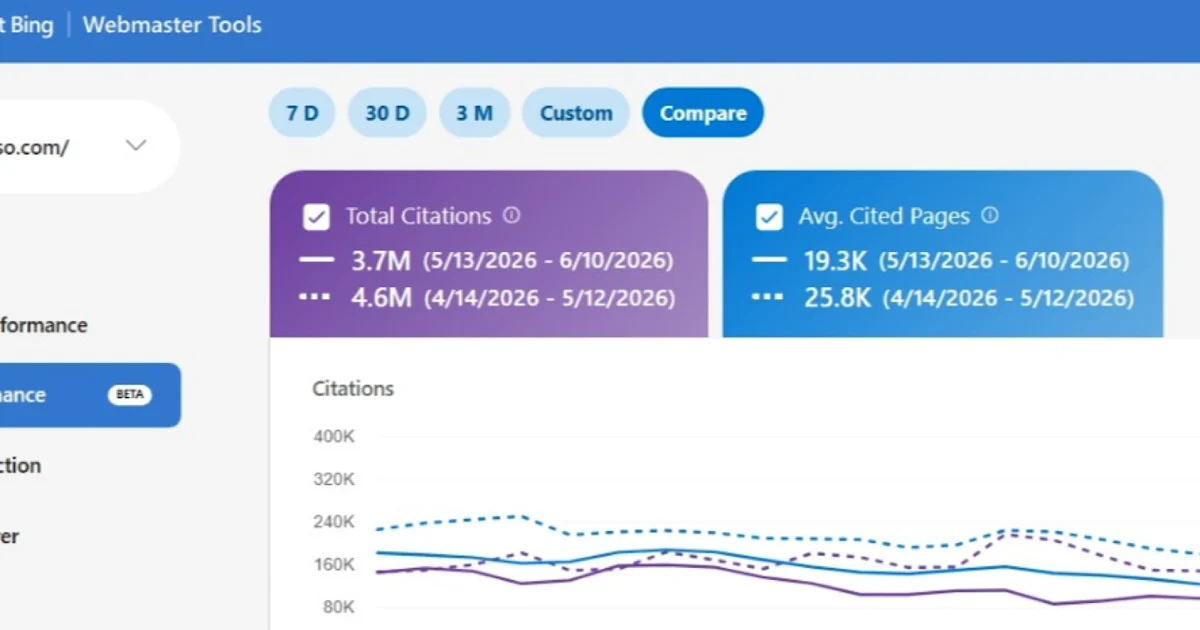
In a significant move toward transparency in the age of Generative AI, Microsoft has officially launched four major enhancements to the Bing Webmaster Tools AI Performance dashboard. Following successful previews at SEO Week, the tech giant is rolling out "Citation Share," "Intents," "Topics," and "Compare" to global users. These tools represent the next step in Microsoft’s commitment to helping publishers understand how their content is being leveraged—and cited—by Copilot and Bing’s AI-powered search experiences.
As search engines shift from traditional blue-link interfaces to answer-based AI models, the metrics for success have become increasingly opaque. Microsoft’s latest update aims to bridge this gap, offering data-driven insights into how AI models perceive, categorize, and value web content.
The Core Features: Breaking Down the Update
The update introduces four distinct analytical lenses through which webmasters can view their site’s AI footprint.
1. Citation Share: Moving Beyond Raw Numbers
Previously, the AI Performance dashboard provided publishers with raw citation counts—essentially a tally of how many times Copilot linked back to their site. While useful, these figures lacked context.
"Citation Share" introduces a relative metric. By calculating a site’s percentage of all citations for a specific "grounding query," publishers can now gauge their authority within a specific conversation. For instance, if a user asks a query and your site receives three out of ten total citations, you will now see a 30% share. Microsoft emphasizes that this is an "observational metric." It is intentionally designed to protect privacy by not revealing competitor domain names or proprietary traffic share data, focusing instead on the publisher’s performance relative to the total available citation pool.
2. Intents: Categorizing the AI Conversation
One of the most persistent challenges for SEO professionals is understanding the "why" behind a search query. Microsoft’s new "Intents" feature automatically classifies grounding queries into specific buckets: Informational, Commercial, and Research.
Instead of manually parsing thousands of individual queries, publishers can now zoom out to see the macro-trend. If a site’s content is frequently cited in "Commercial" queries, it indicates that the site is successfully serving as a source for transactional decision-making within the AI ecosystem. Conversely, heavy "Informational" citation suggests the site is being treated as an authority for educational or factual content.
3. Topics: Thematic Clustering
Individual queries can be fragmented and noisy. To solve this, Microsoft has introduced "Topics," a clustering mechanism that groups semantically related search strings. Queries such as "solar panel efficiency," "best solar installers," and "residential solar installation costs" will now be aggregated under a single "Solar Energy" topic. This allows content creators to identify thematic gaps and strengths, moving away from granular keyword analysis to a broader, more strategic view of topical authority.
4. Compare: Historical Context
Data is rarely useful in a vacuum. The new "Compare" feature allows users to overlay performance metrics across different time periods. Whether a publisher wants to measure the impact of a recent content refresh or simply track the long-term trend of their AI visibility, they can now select custom date ranges to compare current performance against previous weeks or months. This is critical for assessing whether site changes are positively or negatively impacting the likelihood of being cited by Bing’s AI.
Chronology: The Evolution of AI Performance Tracking
To understand the significance of this update, one must look at the rapid maturation of Bing’s publisher-facing AI tools over the last 18 months.
- February 2024: Microsoft launches the AI Performance dashboard in public preview. This was the first major step in demystifying how Bing’s AI models attribute sources, giving publishers their first look at the "Citation" phenomenon.
- March 2024: Microsoft adds a critical mapping feature, allowing webmasters to see exactly which pages were cited for which grounding queries. This linked AI behavior directly to specific URLs.
- June 2024 (SEO Week): Microsoft previews three of the four new features (Citation Share, Intents, and Topics) to industry professionals, soliciting feedback and refining the user experience.
- Late June 2026: The official global rollout of the expanded AI Performance dashboard commences, solidifying these features as core components of the Webmaster Tools suite.
It is worth noting that while several features were previewed at SEO Week, the "GEO-focused recommendations"—a feature intended to surface specific guidance on crawlability, structured data, and indexing for AI—remains notably absent from this release. Microsoft has not provided a timeline for the arrival of these optimization suggestions.
Implications for SEO and Content Strategy
The introduction of these tools fundamentally shifts the role of the SEO professional. For years, the objective was to "rank for keywords." Now, the objective is to "be grounded in AI responses."
Moving Toward "Grounding Optimization"
The metrics provided by the dashboard essentially function as a "Grounding Score." If a site has a high volume of traffic but a low "Citation Share," it may suggest that while the content is indexed, it lacks the specific, authoritative structure needed for the AI to prioritize it as a source of truth.
Content Strategy via Intent Mapping
By utilizing the "Intents" feature, publishers can align their content production calendars with AI requirements. If a site discovers that its "Commercial" intent citations are lagging, they can pivot their content strategy to create more product-focused guides or comparison tables that align with the queries the AI is currently prioritizing.
Thematic Authority
The "Topics" feature is a clear signal that Microsoft’s AI models are increasingly valuing topical depth. By grouping queries, Bing is telling publishers that it understands the semantic relationship between terms. This reinforces the "E-E-A-T" (Experience, Expertise, Authoritativeness, and Trustworthiness) framework that has become the gold standard in SEO.
Official Responses and Industry Outlook
Microsoft has maintained a posture of cautious optimism regarding these tools. They have explicitly stated that the "Intents" and "Topics" classification systems are "still maturing." As more data flows through the Bing index and more users engage with Copilot, the accuracy of these clusters and intent definitions is expected to sharpen.
Industry analysts have praised the move as a necessary step for transparency. With Google also testing AI visibility reports in Search Console, the competition between search engines is moving beyond raw traffic and into the domain of "AI influence." However, it is essential to remember that these two ecosystems operate differently. Google’s AI Overviews and Bing’s Copilot utilize different large language models (LLMs) and, consequently, value different types of data. Publishers should avoid treating these dashboards as interchangeable.
The Road Ahead: What’s Missing?
While this update is a massive leap forward, the absence of "GEO-focused recommendations" leaves a gap in actionable advice. Currently, the dashboard tells you what is happening, but it does not yet tell you how to fix a lack of visibility.
Publishers are still left to hypothesize about the technical requirements for AI citation. Does specific schema markup improve citation probability? Does the length of an article correlate with a higher Citation Share? These questions remain open.
As the AI landscape continues to evolve, the expectation is that Microsoft will eventually bridge the gap between "observational data" (what the dashboard currently provides) and "prescriptive guidance" (the missing GEO recommendations).
Conclusion
The expansion of the Bing Webmaster Tools AI Performance dashboard is a clear indicator that the "black box" era of AI search is coming to an end. By providing publishers with data on citation shares, intent categorization, and thematic performance, Microsoft is fostering a collaborative environment where content creators can optimize their work for the next generation of search.
For those in the digital marketing and SEO space, the message is clear: the future of visibility is not just in being found; it is in being cited. As these tools continue to mature, the sites that leverage these insights to build authority, intent-alignment, and topical depth will be the ones that thrive in the AI-augmented search environment of the coming years.



 Iffa Jayyana