Lina Hope
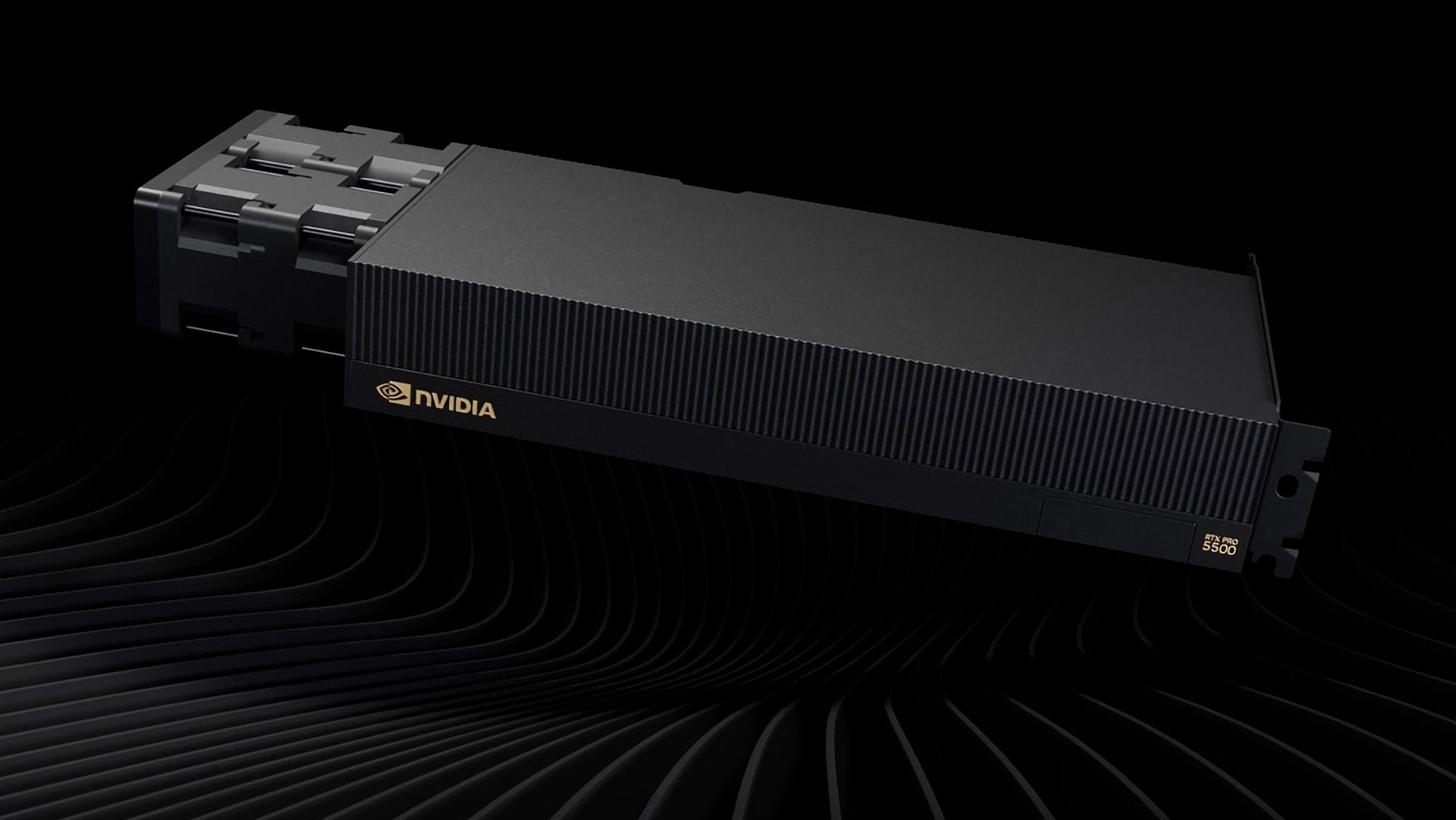
In the rapidly evolving landscape of professional-grade computing, Nvidia continues to solidify its grip on the artificial intelligence and workstation market. Following the massive success and widespread adoption of the GeForce RTX 5090, the semiconductor giant has unveiled a specialized iteration designed specifically for the professional sector: the Nvidia RTX Pro 5500 Blackwell Workstation Edition.
By leveraging the formidable GB202 silicon—the same powerhouse die underpinning the flagship RTX 5090—Nvidia has created a hybrid powerhouse that effectively bridges the performance and memory-capacity chasm between its existing professional offerings. With a massive 84GB of GDDR7 memory, the card is poised to become a staple for data scientists, AI developers, and workstation professionals who require high-end computational performance without the extreme price tag of the top-tier RTX Pro 6000.
The Evolution of the Blackwell Architecture: Main Facts
The RTX Pro 5500 is not merely a rebadged consumer card; it is a strategic maneuver by Nvidia to capture the "middle market" of the enterprise sector. While the consumer-focused GeForce RTX 5090 is heralded as one of the best graphics cards ever produced, the professional market demands specific features—most notably, vast amounts of Video Random Access Memory (VRAM) to handle massive Large Language Model (LLM) training and complex rendering tasks.
The Pro 5500 is built on the TSMC 4N process, utilizing the GB202 die. Key technical highlights include:
- Streaming Multiprocessors (SMs): 170 enabled units (out of 192 total).
- CUDA Cores: 21,760, matching the GeForce RTX 5090.
- Memory Capacity: 84GB of GDDR7, representing a 2.6x increase over the standard 32GB found on the GeForce RTX 5090.
- Bus Width: 448-bit memory interface.
By repurposing the GB202 silicon, Nvidia is able to maximize yield efficiency. Rather than discarding chips that do not meet the stringent requirements for the flagship Pro 6000, Nvidia binning allows them to utilize these high-performance dies in the 5500, offering professional users a robust alternative that sits between the RTX Pro 5000 (72GB) and the top-of-the-line RTX Pro 6000 (96GB).
Chronology and Market Strategy
Nvidia’s strategy regarding the Blackwell rollout has been characterized by a tiered release schedule. The initial launch of the RTX Pro 6000 series set the stage for ultra-high-end workstation performance. However, the market quickly identified a gap: users who needed more than 32GB of VRAM but could not justify the extreme cost of the 96GB flagship models.
The release of the RTX Pro 6000D—a China-exclusive variant—served as a testing ground for the 84GB memory configuration. Seeing a viable market for an 84GB card outside of restrictive regulatory environments, Nvidia moved to normalize this capacity with the Pro 5500. This development signals a shift in Nvidia’s product segmentation: they are no longer just selling "cores"; they are selling "memory footprint" as the primary value proposition for AI researchers.
Technical Deep Dive: The Memory Subsystem
The most impressive aspect of the RTX Pro 5500 is its memory configuration. Nvidia has implemented a sophisticated clamshell layout, utilizing 28 GDDR7 memory chips. Each chip offers 3GB of capacity, totaling the 84GB footprint.
While the industry-standard speed for GDDR7 packages is currently 28 Gb/s, Nvidia has chosen to downclock the modules in the Pro 5500 to 25 Gb/s. This tactical decision likely serves several purposes:
- Thermal Management: Running 28 high-density memory modules at full speed generates significant heat. Downclocking ensures the card remains within a stable Total Board Power (TBP) envelope of 600 watts.
- Product Tiering: By limiting the bandwidth to 1,400 GB/s, Nvidia prevents the Pro 5500 from cannibalizing the sales of the flagship RTX Pro 6000, which operates at the full 28 Gb/s speed, offering 1,792 GB/s of bandwidth.
- Market Positioning: Despite the downclock, the 84GB of VRAM provides a massive advantage for memory-bound tasks. In AI training, the size of the model often dictates the need for VRAM more than raw clock speed, making the Pro 5500 a highly efficient "AI workhorse."
Comparative Specifications Table
| Feature | RTX Pro 6000 | RTX Pro 6000D | RTX Pro 5500 | RTX 5090 | RTX Pro 5000 |
|---|---|---|---|---|---|
| SMs | 188 | 156 | 170 | 170 | 110 |
| CUDA Cores | 24,064 | 19,968 | 21,760 | 21,760 | 14,080 |
| VRAM | 96GB | 84GB | 84GB | 32GB | 72GB |
| Bus Width | 512-bit | 448-bit | 448-bit | 512-bit | 384-bit |
| Bandwidth | 1,792 GB/s | 1,400 GB/s | 1,398 GB/s | 1,790 GB/s | 1,344 GB/s |
Industry Implications and Official Responses
Nvidia’s decision to remain quiet on the official MSRP for the Pro 5500 has led to widespread speculation among industry analysts. Given that the RTX Pro 6000 currently commands a staggering price point—often north of $15,000—and the RTX Pro 5000 (72GB) sits at roughly $9,200, the Pro 5500 is expected to land in the $11,000 to $12,500 range.
When approached for comment, representatives from both Nvidia and major board partner PNY declined to provide specific pricing or launch dates. This silence is typical for enterprise hardware, where pricing is often negotiated through volume contracts and systems integrators rather than standard retail channels.
The implications of this launch are clear: the "AI Gold Rush" has forced hardware manufacturers to prioritize VRAM capacity over absolute speed. For the average consumer, this means the high-end GPU market is becoming increasingly bifurcated. The GeForce RTX 5090 remains the king of gaming and prosumer tasks, while the "Pro" line (including the 5500) has transitioned into a dedicated toolset for the enterprise AI sector.
Future Outlook: A New Standard?
The emergence of the 84GB memory tier suggests that 32GB of VRAM is quickly becoming the "entry-level" requirement for serious AI development. By providing a bridge product like the Pro 5500, Nvidia is effectively forcing the hand of competitors. Companies like AMD and Intel are currently scrambling to offer competitive memory configurations, but Nvidia’s software ecosystem (CUDA) combined with their aggressive hardware tiering makes them the clear leader in this space.
Furthermore, the utilization of the GB202 die for the Pro 5500 confirms that Nvidia’s Blackwell architecture is exceptionally versatile. Whether in a consumer PC as an RTX 5090 or in a server rack as an RTX Pro 5500, the underlying silicon is proving to be a highly profitable asset. For the professional user, the 5500 offers the best of both worlds: the raw compute power of the 5090 and the memory capacity of an enterprise-grade card.
As the industry moves into the next phase of LLM development, where the ability to load larger models into local memory becomes a critical competitive advantage, the RTX Pro 5500 will likely become the go-to card for mid-sized research labs and high-end creative studios. It is a pragmatic, profit-driven, and technically impressive solution to one of the most pressing bottlenecks in modern computing: memory.
In conclusion, while the average gamer may look at the RTX Pro 5500 as an overpriced workstation curiosity, those in the industry recognize it for what it truly is: a calculated expansion of Nvidia’s enterprise dominance, designed to keep their hardware relevant in an era defined by the insatiable appetite of artificial intelligence.

 Asro
Asro
 Nana Wu