Nana
Nana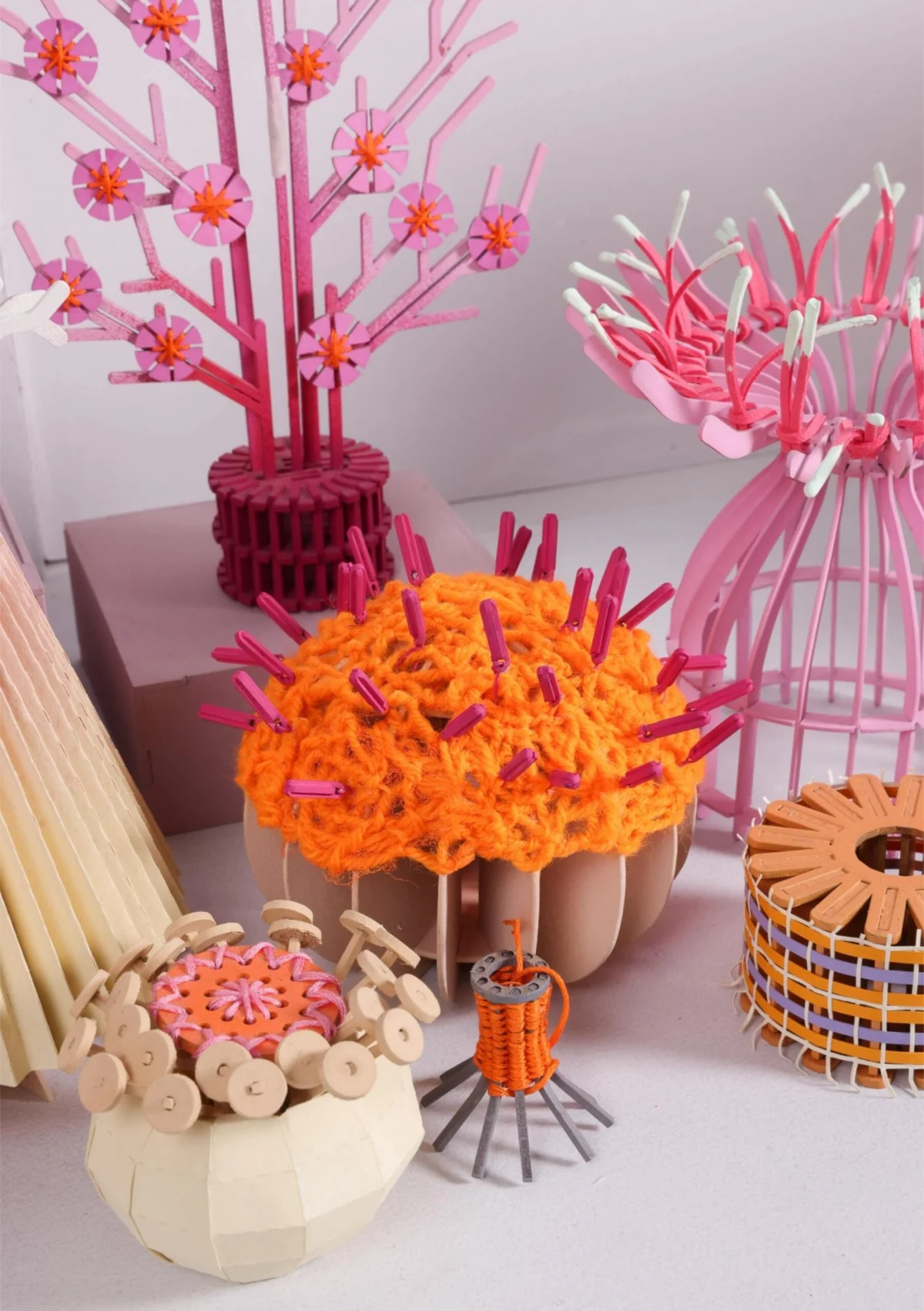
The intersection of biology and art has long been a fertile ground for creative exploration, but few artists bridge this gap with the delicacy and structural precision of Bristol-based sculptor Diana Beltrán Herrera. Known for her hyper-realistic recreations of flora and fauna, Herrera has spent the better part of the last decade pushing the boundaries of papercraft. By integrating unconventional materials such as industrial paperboard, structural thread, and reclaimed cardboard, she has moved her practice from mere craft into the realm of complex, large-scale structural engineering.
In her most recent body of work, Herrera has turned her lens toward the mesmerizing, mathematical complexity of coral reefs. These creations serve as a testament to her technical evolution, demonstrating a sophisticated command of form that mimics the fractal and hyperbolic geometry found in nature. As she prepares for a major exhibition at the Deutsches Museum in Munich, her work stands as a poignant commentary on the intersection of human-made artifice and the organic world.

The Architecture of Nature: A Chronology of Artistic Evolution
To understand the current trajectory of Herrera’s work, one must look at the foundation upon which it was built. Her early career was defined by an obsessive attention to detail, primarily focusing on avian subjects. During this period, she mastered the art of color manipulation, paper layering, and precision cutting to replicate the anatomy of birds.
The Shift to Structural Complexity
Several years ago, a pivotal shift occurred in her studio. The limitations of traditional craft paper prompted Herrera to experiment with more robust mediums. The introduction of paperboard provided the rigidity required for larger, more imposing structures, while the incorporation of thread began to function not just as a decorative element, but as a load-bearing, connective tissue for her sculptures.

The Coral Phase
In the last 18 months, this technical progression has culminated in her focus on coral reef ecosystems. Coral, for an artist preoccupied with geometry, offers a unique challenge. Unlike the static structure of a flower, coral growth follows specific biological algorithms—fractal patterns that repeat at different scales. By meticulously constructing these shapes out of paper and reinforcing them with thread, Herrera is essentially "growing" her own reefs, one tentacle at a time. This phase represents her most ambitious work to date, requiring a level of patience and mathematical foresight that elevates her from an illustrator to a sculptural architect.
Supporting Data: The Mathematics Behind the Medium
The fascination with coral reefs is not merely aesthetic; it is rooted in the rigorous study of natural patterns. Coral reefs are one of nature’s most perfect examples of hyperbolic geometry. In mathematics, a hyperbolic surface is one that curves away from itself at every point, allowing for the extreme ruffling and folding seen in many species of coral.

Structural Integrity Through Textile Techniques
Herrera’s reliance on embroidery is not a stylistic choice; it is a structural necessity. By applying techniques traditionally reserved for textiles to her paper structures, she creates a hybrid medium that is both flexible and durable.
- Tensile Strength: The use of thread allows Herrera to create complex, branching skeletons that would be impossible to achieve with paper alone.
- Geometric Precision: Each piece of coral is the result of dozens of iterations, each slightly modified to capture the subtle variations in tentacle shape and skeletal density.
- Material Synergy: The contrast between the matte, porous quality of paper and the sheen of the thread adds a layer of visual depth, mimicking the organic bioluminescence and textural variety of deep-sea life.
Insights from the Studio: A Conversation with the Artist
In a recent correspondence, Herrera reflected on the philosophy driving her current series. "When working with embroidery, I am particularly interested in how paper can borrow techniques traditionally associated with textiles," she noted. "Thread becomes a way of drawing, connecting, and constructing forms."

For Herrera, the thread acts as a bridge between the physical and the conceptual. It serves as the "veins" of her sculptures, providing the invisible tension that holds the complex paper skeletons together. Her process is deeply meditative; she describes the act of constructing these reefs as a way of "drawing in three dimensions."
This transition toward more abstract, environmental subjects—like coral reefs and lotus leaves—suggests a maturation in her practice. She is no longer just reproducing the visual likeness of a subject; she is attempting to replicate the logic of its growth. By moving away from the singular subject (like a bird) to the complex ecosystem (the reef), Herrera is challenging her audience to consider the interconnectedness of all living things.

Global Impact and Institutional Recognition
The global demand for Herrera’s work has grown in tandem with her technical proficiency. Her sculptures are no longer confined to the private studio; they have become objects of scientific and aesthetic interest for major cultural institutions.
The Deutsches Museum Exhibition
This month marks a significant milestone in her career as she unveils her latest collection at the Deutsches Museum in Munich. This exhibition is part of an installation focused on "Planetary Health," a fitting context for an artist who spends her days meticulously recreating the most fragile aspects of the natural world.

The museum’s interest in her work is telling. Scientists and curators alike have recognized that her paper reefs serve a dual purpose: they are beautiful objects of art, but they also function as tangible educational tools that help the public visualize the intricate, endangered structures of our oceans. By placing her work in a scientific setting, the museum acknowledges that art can play a vital role in environmental advocacy.
Implications for the Future of Paper Art
Diana Beltrán Herrera’s evolution invites us to rethink the hierarchy of artistic materials. For centuries, sculpture has been dominated by bronze, marble, and clay—materials associated with permanence and weight. By choosing paper—a medium historically associated with ephemera and fragility—Herrera is making a radical statement about the nature of existence.

The Fragility of the Subject
Her choice of medium is inherently linked to the state of the natural world. Coral reefs are rapidly disappearing due to climate change and ocean acidification. There is a profound irony in using paper—a substance derived from wood—to recreate the delicate skeletons of dying reefs. The sculptures are, by their very nature, temporary, mirroring the precarious status of the real-world reefs they represent.
A New Vocabulary for Sculpture
Looking ahead, it is likely that Herrera’s work will continue to influence a new generation of artists. Her synthesis of traditional craft (paper cutting) and industrial techniques (structural embroidery) provides a blueprint for others to follow. She has successfully moved paper art out of the category of "hobbyist craft" and into the "fine art" conversation, proving that with enough technical rigor and conceptual depth, any material can be transformed into a masterpiece.

As she continues to expand her practice, we can expect to see more collaborations between her studio and scientific organizations. The bridge between biology and art is becoming more defined, and Herrera is at the center of it, using her needle and paper to knit together a vision of a world that, while fragile, remains infinitely complex and worthy of our protection.
For those interested in following her ongoing projects, her work remains accessible via her official Instagram account, where she frequently documents the painstaking process behind each new "family" of sculptures. As she prepares for the Munich opening, one thing is certain: Diana Beltrán Herrera has fundamentally altered the landscape of contemporary paper sculpture, ensuring that her work will remain as enduring as the natural subjects she seeks to immortalize.

 Suro Senen
 Laily UPN