

The action RPG landscape is bracing for a seismic shift as Grinding Gear Games (GGG) prepares to launch Path of Exile 2: Return of the Ancients. While much of the community’s attention has been fixated on the sweeping overhauls to the endgame, the developers have quietly invested significant resources into a massive quality-of-life (QoL) initiative. With the arrival of patch 0.5 and the new "Runes of Aldur" league, GGG is moving to strip away the friction that has historically defined the genre’s most complex title, ensuring that the gameplay loop flows with unprecedented fluidity.
Main Facts: A New Era of Accessibility
The Return of the Ancients update represents a paradigm shift in how players interact with the game’s dense systems. GGG has introduced a suite of tools designed to reduce "menu fatigue" and cognitive load. Chief among these are a sophisticated Atlas search engine, an automated, one-click trade market price checker, and an expansive new Fragment stash tab designed to accommodate the game’s increasingly complex item economy.
Perhaps the most significant addition is the integration of in-game build guides. By bridging the gap between external community resources and the game client itself, GGG is effectively dismantling a decade-long barrier to entry. New players can now follow step-by-step progressions without constantly alt-tabbing to browsers, while veteran buildcrafters can import their specialized plans to optimize their leveling and endgame efficiency.
Chronology: The Path to Version 1.0
The trajectory for Path of Exile 2 has been one of iterative growth. Since entering early access, the game has undergone several major revisions, each refining the core combat loop.
- Initial Early Access Launch: Introduced the base mechanics and the shift to the new, more deliberate combat philosophy.
- Version 0.4: Focused on mechanical stability and initial feedback regarding boss difficulty and loot scarcity.
- Version 0.5 (Return of the Ancients): The current turning point. This patch marks the completion of the massive endgame rework, transforming the Atlas into a more navigable, user-friendly experience.
- The Future (November 2026): ExileCon is scheduled for November 7-8, which will serve as the launchpad for the 1.0 release.
- End of 2026: GGG has explicitly stated that patch 0.5 is the final early access league before the full, free-to-play 1.0 transition.
Supporting Data: Innovations in Navigation and Trade
The Atlas Search Revolution
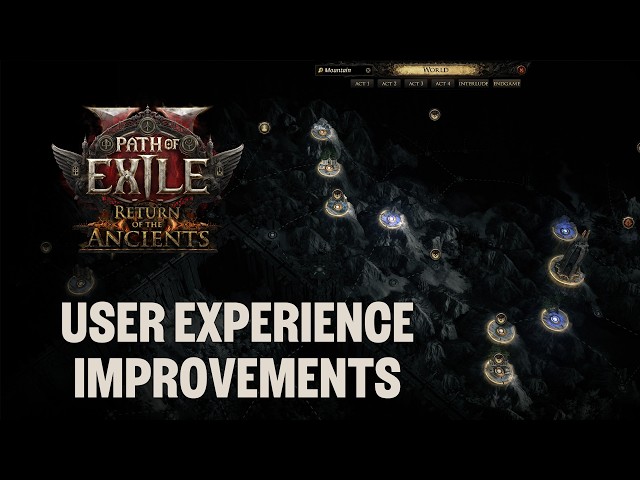
The rework of the Atlas is not merely visual; it is functional. With the new live-search filter, the vast web of endgame maps becomes immediately searchable. Players simply type their criteria—whether it be a specific map name, a desired biome, or the presence of a specific pinnacle boss—and the UI intelligently darkens non-matching nodes, highlighting the path to the desired content.
Coupled with the new quest tracking system, which resides on the right-hand side of the UI, players are never left wondering what their next objective should be. This system acts as a guided tour through the game’s complex mechanics, walking players from the basic introductory stages all the way to the pinnacle boss encounters.

Trade Market Integration
One of the most requested features in the history of the Path of Exile franchise has been an integrated price-checking tool. In patch 0.5, this becomes a reality. By holding "Shift + Alt" and left-clicking an item in the inventory, players can instantly query the trade market. The game applies the appropriate filters, allowing users to see the current market value of their drops in seconds. The ability to toggle individual modifiers on and off provides deep control, helping players identify whether a specific affix is driving an item’s value or if it is simply noise.
The Fragment Stash Tab
The introduction of the new Fragment stash tab addresses the growing inventory crisis. This storage solution is gargantuan, featuring:
- Boss Fragment Slots: Dedicated space for all endgame encounter keys.
- Tablet Storage: Six pages for every league mechanic type, totaling 54 pages of storage.
- Trial Materials: Specialized space for Djinn Baryas and Inscribed Ultimatums.
While this is a premium offering, GGG has ensured it is accessible. Players who already own the equivalent tab in the original Path of Exile will find it carries over, and those who purchased the early access build of PoE 2 have been granted enough microtransaction points to acquire it immediately.
Socketables Overhaul
The existing Socketables stash tab has also seen a significant expansion. To accommodate the incoming "Runes of Aldur" items, the tab now features distinct, dedicated pages for standard Runes, Kalguuran Runes, Soul Cores, Idols, and Ancient Augments. This ensures that even the most meticulous crafter will have a place to organize their hoard.
Official Responses and Balance Philosophy
Game Director Jonathan Rogers has been transparent regarding the intent behind these changes. "We want the complexity to exist in the builds and the boss encounters, not in the inventory management," Rogers noted in a recent developer diary.
The balance team has also been active, ensuring that the 0.5 patch remains fair despite the increased accessibility. Last-minute adjustments have been made to the Ancestral Bond keystone, a staple for totem-based builds, to ensure it aligns with the new power curves. Furthermore, a long-standing bug affecting minion damage has been addressed, effectively providing a buff to summoner archetypes that many players felt were underperforming in the early stages of the league.
Implications: The Road to the Free-to-Play Transition
The implications of Return of the Ancients are significant for both the developer and the player base. By lowering the barrier to entry through in-game guides and better UI, GGG is positioning Path of Exile 2 to capture a wider, more casual audience than the original title ever did.
The decision to make the game free-to-play from May 29 to June 1 is a bold marketing move. It allows potential players to experience the high-fidelity combat and the improved endgame loop without financial risk. Crucially, all progress made during this window is persistent. Should a player decide to purchase the game, or wait until the 1.0 launch at the end of 2026, their character and gear will be waiting for them.
This strategy suggests a company that is confident in its product. By focusing on quality-of-life, GGG is betting that once players experience the streamlined, high-octane endgame, they will be hooked for the long haul.
As we look toward the 1.0 launch following the ExileCon event in November 2026, it is clear that Path of Exile 2 is no longer just a sequel—it is an evolution. The game is shedding its reputation for being impenetrable, replacing it with a depth that is supported by, rather than obscured by, its systems. For both the weary veteran looking for a more efficient grind and the newcomer intimidated by the genre’s reputation, Return of the Ancients offers a compelling invitation to enter the world of Wraeclast.
Whether these changes will satisfy the most hardcore "min-maxers" remains to be seen, but the consensus among the community is one of cautious optimism. The game is faster, smarter, and more accessible than ever before, marking a definitive step toward what GGG hopes will be the new gold standard in the action RPG genre.










No comments yet. Be the first to join the conversation!