

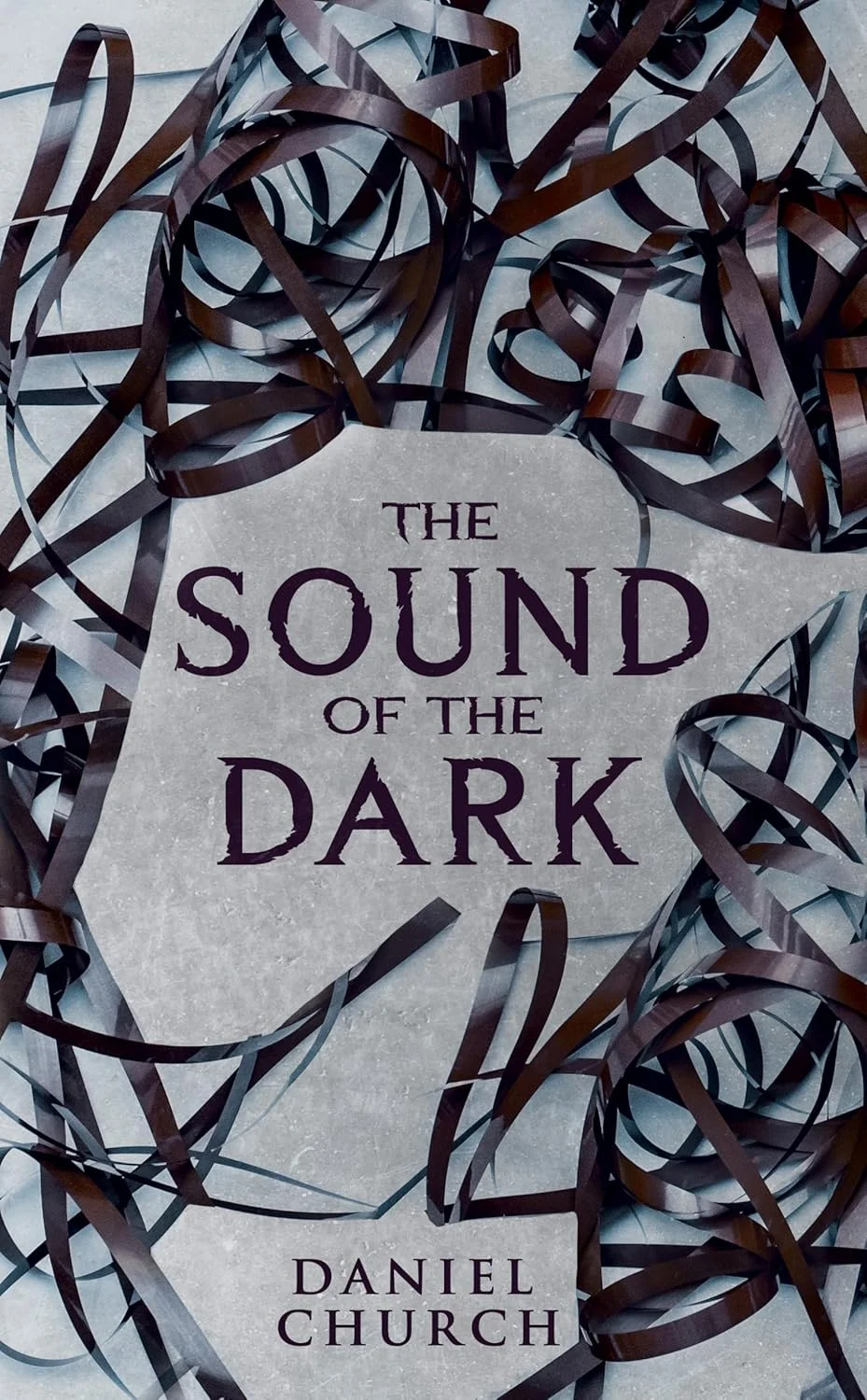
In the landscape of contemporary horror, few novels manage to bridge the gap between the grounded investigation of true crime and the unfettered chaos of cosmic dread. Daniel Church’s latest offering, The Sound of the Dark, achieves this volatile synthesis with remarkable confidence. By anchoring a descent into otherworldly madness within the relatable framework of a modern true-crime obsession, Church delivers a chilling exploration of how history—and the echoes it leaves behind—can consume the present.
The Premise: A Legacy of Silence and Static
The narrative centers on Cally Darker, a protagonist struggling with the crushing weight of depression and an unfulfilling life in Manchester. Her anchor is a failing relationship with Dereck, a partner who views her mental health struggles and her fascination with true crime not as a legitimate path, but as a flight from reality.
The inciting incident is as classic as it is haunting: an anonymous tip regarding a decades-old family homicide. In 1983, Tony Mathias, a mild-mannered experimental artist, attempted to construct an installation based on the sonic textures of Warden Fell, an abandoned RAF base. Shortly after immersing himself in the base’s desolate acoustics, Mathias returned to his family’s caravan and systematically executed his wife, his two children, and finally, himself.
The mystery is not who committed the crime—the act was witnessed and documented—but why a man defined by his gentle nature would succumb to such sudden, apocalyptic violence. Cally’s decision to abandon her life in Manchester and retreat to the countryside to investigate this cold case serves as the novel’s foundation, setting the stage for a collision between human trauma and something far more ancient.
Chronology of an Investigation
Phase I: The Leisurely Descent
The first quarter of the novel operates with the deliberate pacing of a classic whodunit. Cally engages in a series of "boots-on-the-ground" interviews with those who knew the Mathias family: the artist’s sister, his former agent, and the local landlady. These sequences evoke the atmosphere of Agatha Christie’s darker, more atmospheric yarns. While the narrative occasionally leans into repetitive accounts of Tony’s "gentle soul," these sections succeed through Church’s sharp ear for characterization and regional UK dialects.
Phase II: The Sonic Contagion
The narrative gears shift sharply at the halfway point, punctuated by the novel’s tagline: "DON’T PRESS PLAY." When Cally finally listens to the recovered tapes from Warden Fell, the book sheds its investigative skin and emerges as a full-blooded horror novel. The recordings, which Tony Mathias initially feared would ruin his art project, reveal a clear, terrifying presence of the paranormal. As Cally enlists the help of her friend Griff—a character whose presence signals a mounting sense of dread—to digitize the audio, the contagion begins to bleed into her own reality.
Phase III: Cosmic Climax
The final act is an unchained descent into Lovecraftian terror. As Cally’s nightmares bleed into her waking life, the investigation culminates in a confrontation at the site of the original horror: Warden Fell. The climax is less a battle of wits and more a struggle for the survival of sanity itself, mirroring Cally’s internal battle with her own mental health.
Supporting Data and Narrative Observations
While the novel is a masterclass in atmospheric escalation, it is not without its structural eccentricities. Church’s prose is vivid, particularly when describing the bodily and cosmic manifestations of the curse. However, the book relies heavily on long stretches of exposition.
One notable quirk is the author’s tendency to utilize "info-dumps." For example, the pivotal shift from mystery to horror is triggered by a Skype call with an ephemeral character who disappears from the narrative as quickly as he arrives. Similarly, the climax relies on a dream-sequence meeting with a shaman to explain the mechanics of the evil at Warden Fell. While these moments risk breaking the immersion, they are balanced by the sheer intensity of the horror.
Furthermore, the novel avoids the "fourth-wall breaking" trap that plagues much of modern horror. Rather than explicitly telling the reader they are cursed, Church relies on the unsettling suggestion that the reader, by witnessing the story, has become a conduit for the same auditory infection that destroyed the Mathias family.
Implications: The Ethics and Aesthetics of Modern Horror
The Sound of the Dark serves as a commentary on the true-crime genre itself. Cally’s podcast acts as a framework, a scaffold for the story rather than a deep exploration of the ethics of "murder-tainment." By keeping the podcast in the background, Church allows the horror to take center stage, suggesting that our obsession with the tragedies of others is, in itself, a gateway to darkness.
The book’s structure also invites a meta-fictional question: would this have functioned better as a fictional podcast? The reliance on audio tapes, voice recordings, and investigative interviews suggests a medium that thrives in the auditory space. Yet, in written form, Church manages to translate the visceral terror of sound into a tangible, written experience.
Thematic Parallels
- Mental Health as a Portal: The novel mirrors Cally’s depression with the cosmic decay at Warden Fell. It posits that trauma creates a vacuum—a space that, if not filled with healing, will be occupied by something else entirely.
- The Modern Lovecraftian Lens: Unlike the 1930s-era horror of H.P. Lovecraft, Church updates the "unspeakable evil" trope for the digital age. The horror is not just found in forbidden books or ancient cults; it is found in the static of a tape recorder, in the files on a hard drive, and in the isolation of the countryside.
- Atmospheric Pacing: The transition from a "cozy" mystery to "gonzo" horror creates a jarring, effective contrast. The reader is lured in with the promise of a puzzle, only to find the pieces are made of something far more dangerous than cardboard.
Conclusion: A Leap of Faith
Daniel Church has crafted a novel that is as ambitious as it is disturbing. While the reliance on exposition-heavy dialogue and secondary characters may test the patience of some readers, the payoff is substantial. The Sound of the Dark is a rare example of a story that does not deflate once the veil is lifted.
The novel succeeds because it understands that the most terrifying aspect of any curse is not the monster itself, but the lingering suspicion that it has already taken hold of you. It is a wild, unpredictable ride that demands the reader’s full attention and perhaps, in the quiet moments after finishing, a careful consideration of the sounds in the dark. For those seeking a blend of classic investigative intrigue and modern, cosmic dread, Church’s work is an essential—and haunting—addition to the genre.










No comments yet. Be the first to join the conversation!