

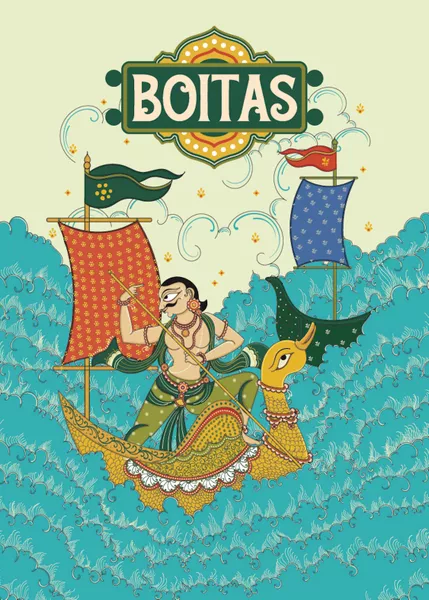
In an era where the hobby board game market is saturated with complex engine-builders and sprawling miniatures games, the humble trick-taking genre remains a steadfast pillar of tabletop gaming. While many titles in this category rely on tired tropes of European royalty or abstract mathematical puzzles, Boitas—the latest release from publisher Kheo Games—charts a bold new course. By blending the classic mechanics of trick-taking with the strategic depth of set collection and market management, Boitas offers a refreshing, culturally rich experience that honors the maritime legacy of the Sadhaba traders of ancient Odisha.
Designed by Sidhant Chand and brought to life through the evocative, vibrant artwork of Janki Bavle, Boitas proves that a game does not need a massive footprint to leave a lasting impression. With a play time of just 15 to 30 minutes, it manages to pack significant tactical tension into a compact package, making it a compelling addition to any gaming library.
The Facts: At a Glance
- Designer: Sidhant Chand
- Artist: Janki Bavle
- Publisher: Kheo Games
- Player Count: 2–4 players
- Playtime: 15–30 minutes
- Mechanics: Trick-taking, Set Collection, Market Planning
- Target Audience: Fans of modern trick-taking games, families seeking a step up from traditional card games, and history enthusiasts.
A Chronology of Play: How Boitas Unfolds
The gameplay of Boitas is structured into four distinct rounds, each serving as a microcosm of the ancient maritime trade expeditions. The structure is designed to be intuitive, yet it offers enough modular depth to ensure that no two games feel identical.
The Phases of the Trade
Each round in Boitas is subdivided into two primary segments: the Trick-Taking Phase and the Market Phase.
During the Trick-Taking Phase, which consists of three individual tricks, players compete to secure the most valuable goods tokens. The mechanics here deviate from traditional "climbing" games. Each round introduces a rotating trump suit, which forces players to constantly re-evaluate their hand management. The game introduces specific nuances, such as "port values" that allow lower-numbered trump cards to override superior cards under certain conditions. Furthermore, the inclusion of "Elephant" cards—powerful assets that dominate the board—adds a layer of risk-reward management. The winner of a trick secures the first pick of available goods, while the second-place player claims the remainder, and those who fail to take a spot are compensated with "cowries," the game’s historical currency.
Following the three tricks, players transition into the Market Phase. Here, the tension shifts from the table to the purse. Players spend the cowries they accumulated during the trick phase to purchase stronger, more specialized cards for subsequent rounds. This introduces a "hand-building" element that allows players to course-correct their strategy based on the changing tides of the game.
Scoring and Victory
The game concludes after four rounds, and the scoring system is where Boitas truly rewards long-term planning. Players have two distinct paths to victory: they may choose to collect the highest-value token from every goods category, or they may specialize, focusing their efforts on maximizing only two specific categories. This dual-path scoring ensures that every card played—and every cowrie spent—carries weight.
Supporting Data: Strategy and Interaction
The success of Boitas lies in its delicate balance between accessibility and depth. It avoids the aggressive "take-that" mechanics found in many competitive card games, favoring a system of reactive observation.
The Psychology of the Trick
In Boitas, the "interaction" is psychological rather than confrontational. Because every card played affects the board state, players must constantly monitor their opponents’ scoring trajectories. A player might intentionally lose a trick—or sacrifice a powerful card—to hoard cowries for a crucial purchase in the market. This creates a fascinating meta-game where players are not just fighting over the current trick, but are actively manipulating the future market.
Why the Pacing Works
One of the most common complaints regarding trick-taking games is the potential for "analysis paralysis." Boitas circumvents this by keeping the action flow rapid. Because players are typically limited to choosing and revealing one card at a time, the 30-minute runtime is rarely exceeded, regardless of the player count. This efficiency allows the game to function as a "filler" for serious gamers or a main event for families, maintaining a high level of engagement without the bloat of excessive rules or bookkeeping.
Official Perspective: Cultural Identity and Design
A standout feature of Boitas is its commitment to its source material. The game draws heavily from the history of the Sadhaba sea traders, who navigated the Indian Ocean from the coast of ancient Odisha. By grounding its mechanics in this historical context, Kheo Games has provided more than just an abstract numbers-and-suits experience.
Balancing Theme and Abstract Mechanics
While Boitas remains, at its core, an abstract card game, the thematic integration of ports, imported goods, and maritime currency provides a necessary bridge. In an official statement regarding the design, the team at Kheo Games emphasized that the goal was to create a game that felt distinct from its Western-centric counterparts.
"We wanted to honor the maritime history of our region while ensuring the mechanics felt modern and tight," the designers noted. While the game does not radically transform the trick-taking genre in the vein of a title like Wherligig, it occupies a unique space: it is thematic enough to feel like an adventure, but abstract enough to ensure the gameplay remains the primary focus.
The Production Quality
The physical components further reinforce this thematic commitment. Janki Bavle’s artwork is both vibrant and functional, ensuring that all cards are easily readable even in low-light environments. The "chunky" cardboard tokens provide a tactile satisfaction that is often missing from smaller card games. Although the card stock is thinner than premium linen-finished decks, the gloss finish ensures they hold up well to the rigors of frequent play.
Implications: The Future of Modern Trick-Taking
Boitas arrives at a pivotal time for the hobby. With the rise of "modern" trick-takers like The Crew or Cat in the Box, players are increasingly looking for games that retain the classic "feel" of the genre while introducing modern design sensibilities.
Is Boitas Right for You?
For the seasoned veteran of card games, Boitas offers a robust, high-replayability experience. The revolving trump suits and shifting market values ensure that the game feels fresh upon the hundredth play. However, it is important to note the limitations: if the fundamental loop of trick-taking—managing hands, predicting opponent intent, and manipulating hierarchies—does not appeal to you, Boitas is unlikely to change your mind. It is a refinement of a genre, not a reinvention.
The Gateway Potential
For families, Boitas serves as an ideal bridge. It is accessible enough to be taught to younger players or those unfamiliar with modern gaming, yet it possesses enough tactical depth to keep the competitive spirits of veteran gamers engaged. It is a rare game that manages to be both "family-friendly" and "gamer-friendly" simultaneously.
Final Assessment
Boitas is a triumph of balance. It succeeds because it understands its constraints and operates within them with total confidence. By marrying the intellectual challenge of set collection with the timeless appeal of trick-taking, Kheo Games has delivered a product that is poised to become a staple in the "fast-paced strategy" category.
As the gaming community continues to look for titles that are easy to learn, quick to play, and hard to master, Boitas stands as a glowing example of how to execute a concept perfectly. Whether you are a fan of historical themes or simply a lover of elegant card play, Boitas is a voyage worth taking. It is a clever, culturally rich, and highly polished game that earns its place in any rotation. With an 8.0/10 rating, it is a testament to the fact that sometimes the best innovations don’t come from changing the rules, but from mastering them.












No comments yet. Be the first to join the conversation!