Asep Darmawan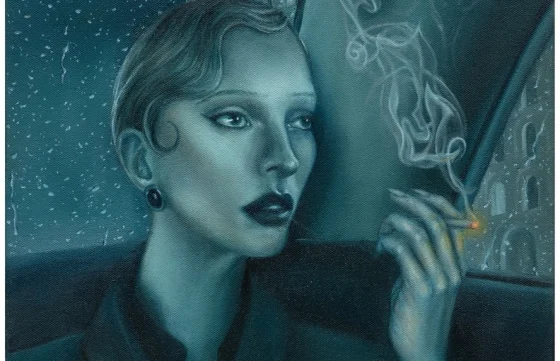
Introduction: A Chromatic Enigma
In the hushed, cavernous spaces of Harper’s gallery, a new, singular vision has taken hold. Prussian Blue, the inaugural solo exhibition by New York-based artist Sophia Huitema, marks a significant milestone for both the artist and the institution. On view through April 25, 2026, the exhibition presents a collection of seven new oil paintings that serve as a masterclass in atmospheric tension, psychological depth, and art-historical synthesis. Through a restricted palette and a recurring cast of ethereal, watchful female figures, Huitema invites the viewer into a realm where the boundary between the decorative and the dangerous dissolves entirely.
The Chemistry of Ambiguity: A Conceptual Anchor
At the heart of the exhibition lies the pigment itself: Prussian Blue. Known scientifically for its origin in the chemical processes related to cyanide, the pigment holds a storied history that oscillates between the toxic and the medicinal. Historically, while it is a byproduct of lethal compounds, it has also been utilized as an effective antidote for heavy-metal poisoning.
Huitema harnesses this duality as the conceptual backbone of her work. The pigment does not merely serve as a color choice; it functions as a metaphor for the subjects she paints. Much like the substance—which can simultaneously kill and cure—Huitema’s female figures exist in a state of suspended moral ambiguity. They are emotionally guarded, their expressions veiled in a cool, moody harmony of blues and greens. By bathing her interiors in these dimly lit, cerulean tones, the artist effectively translates the chemistry of her medium into the psychology of her subjects.
Chronology and Evolution of the Work
While Huitema is a relatively new name to some, Prussian Blue is the culmination of years of rigorous, self-directed studio practice. Eschewing formal academic training, the artist has spent the last several years refining a visual vocabulary that is entirely her own.
The progression leading to this exhibition highlights a deliberate shift toward more complex, cinematic staging. In her earlier experiments, Huitema focused on the human form in isolation; however, the works presented at Harper’s demonstrate a transition toward "theatrical tension." The current body of work was produced over the last eighteen months, a period defined by the artist’s deep dive into the intersections of fashion history, film noir, and Surrealist interiority. This series represents her most cohesive effort to date, showing a maturation in her handling of light—or the deliberate lack thereof—to craft a narrative that feels less like a static portrait and more like a captured frame from a psychological thriller.
The Femme Fatale in the Age of Decadence
The narrative strength of Prussian Blue resides in its characters. Huitema’s women are elongated, almost spectral beings with slender necks and exaggerated limbs that suggest a deliberate departure from naturalism. They are creatures of high society, draped in the opulent, Gatsby-era finery of pearl necklaces and jewel-studded headdresses. Yet, their elegance is sharpened by a predatory alertness.
Case Study: Sleeper Car
The painting Sleeper Car exemplifies the artist’s mastery of suspense. A woman, rendered in a backless evening gown, turns her head to peer over her shoulder. Her expression is sly, almost conspiratorial. Crucially, her hand is braced—a physical tell that suggests she is prepared to strike or defend. Outside the window, rain streaks against the glass, blurring the world into a smear of indigo. The narrow aisle of the train car leads the viewer’s eye into an uncertain, dark depth. This is not merely a portrait; it is a moment of climax in a story the viewer is forced to finish. Through these compositions, Huitema captures the essence of the femme fatale: a figure who is as much a victim of her environment as she is the architect of her own escape.
Supporting Data: Art-Historical Synthesis
To understand Huitema’s work is to understand her reverence for the visual languages of the past. Her aesthetic is a deliberate pastiche that avoids becoming derivative by synthesizing disparate influences into a singular, contemporary voice.
The Influence of the Early Twentieth Century
The attenuated proportions of Huitema’s subjects echo the stylized illustrations of the early twentieth century. Specifically, the influence of Erté and the Art Deco movement is evident in the streamlined finesse of her figures. Like the stage designers of the interwar period, Huitema prioritizes poise and gesture, using the curve of a body or the placement of an accessory to dictate the mood of the scene.
Symbolism and Surrealism
Beyond fashion, the spatial configuration of these paintings owes a debt to Symbolist and Surrealist traditions. The interiors in Prussian Blue are rarely "coherent" in the architectural sense. They are compressed, shallow, and often dreamlike. In the Surrealist tradition, these rooms function as psychological landscapes rather than physical ones. They represent the subconscious—a place where objects, like a pearl necklace or a glass of wine, take on an outsized, symbolic weight.
Official Responses and Gallery Perspective
Harper’s gallery has positioned this exhibition as a foundational moment for the artist. In press communications, the gallery emphasized that Huitema’s approach to image-making is defined by a "sustained studio practice" that challenges the necessity of traditional academic pedigree. By grounding her work in "close observation" rather than rigid adherence to historical doctrine, Huitema has developed a style that feels both timeless and urgent.
Critics have noted that the gallery’s decision to pair such an atmospheric, "moody" exhibition with the stark, minimalist space of the gallery serves to heighten the tension of the paintings. The curation allows the works to breathe, giving each painting the room to project its specific, quiet menace onto the visitor.
Implications: The Future of Figurative Painting
The success of Prussian Blue suggests a broader shift in contemporary painting toward the "psychological figurative." As we move further into an era of digital oversaturation, there is a renewed interest in work that requires slow, careful observation. Huitema’s paintings demand this patience. They ask the viewer to lean in, to look for the "seductive ruse" behind the eyes of her subjects, and to contemplate the toxicity hidden within the color.
Furthermore, the exhibition raises questions about the role of the "painterly language" in an age of AI-generated imagery. Because Huitema’s work is so rooted in the tactile, physical process of oil painting—and because it is so deeply informed by the artist’s own idiosyncratic journey—it offers a human-centric response to the trends of modern art. She is not merely copying history; she is remixing it to reflect the anxieties and the calculated composure of the modern age.
Conclusion: A Lingering Presence
As Prussian Blue continues its run at Harper’s, it remains a vital contribution to the current New York art scene. Sophia Huitema has successfully bridged the gap between the decorative and the dark, the past and the present. Her figures, caught in their endless, watchful state, will likely continue to haunt the gallery space long after the exhibition concludes. For those seeking a bridge between the elegance of Art Deco and the suspense of noir, Prussian Blue offers an essential, albeit unsettling, journey into the depths of the psyche.
The exhibition is not merely a collection of seven paintings; it is a testament to the power of artistic synthesis. By utilizing a single, complex pigment to anchor her visual world, Huitema has proven that the most compelling stories are often told in the spaces between the light and the dark, where beauty is a mask for the struggle, and where every gaze is a potential weapon.


 Nana Wu
 Suro Senen