

By [Your Name/Staff Writer]
June 1, 2026
The cinematic landscape has long been dominated by the towering shadow of the Jurassic Park franchise. For over three decades, the concept of "dinosaur movies" has been inextricably linked to the Universal and Amblin Entertainment intellectual property. However, the release of the official trailer for David Robert Mitchell’s upcoming sci-fi adventure, The End of Oak Street, serves as a stark, prehistoric reminder: the thunder lizards of history belong to no single studio.
Starring Academy Award winner Anne Hathaway and Ewan McGregor, The End of Oak Street promises to transport the quintessential American suburban experience into the heart of the Mesozoic Era. As the film approaches its August 14, 2026, release date, it is poised to redefine the creature-feature genre, moving away from corporate-mandated "legacy sequels" toward a more grounded, evocative, and perhaps slightly nostalgic exploration of survival.
The Premise: When the Cul-de-Sac Meets the Cretaceous
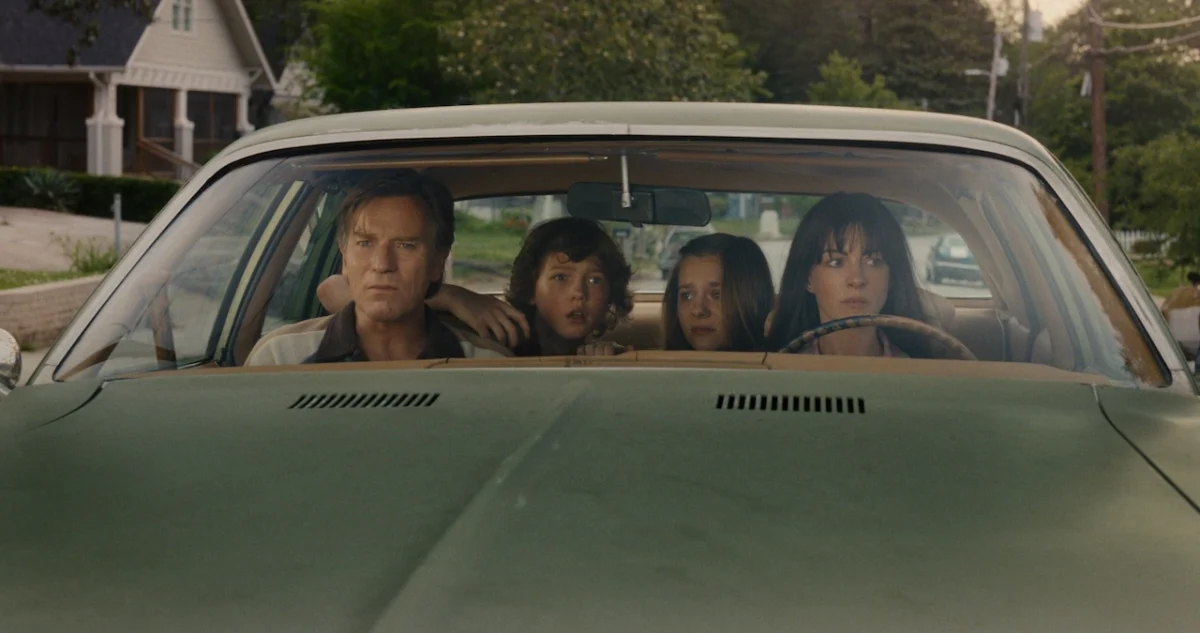
At its core, The End of Oak Street is a high-concept survival drama. The narrative follows a typical suburban family—portrayed by McGregor and Hathaway—whose quiet, mundane existence is shattered when their neighborhood is mysteriously displaced in time.
The trailer, which dropped this week, masterfully juxtaposes the comfort of the 1980s with the raw, untamed violence of the prehistoric world. We see the familiar iconography of the era: stacked cassette tape racks, kitchen booths, and a young child draped in a blanket emblazoned with Christopher Reeve’s Superman. Then, the atmosphere shifts. The familiar hum of suburban life is replaced by the primal roar of a predator, as pteranodons are seen weaving through neighborhood power lines and ankylosauruses carve deep trenches through perfectly manicured lawns.
Unlike the Jurassic World series, which often focuses on bio-engineered monstrosities or corporate espionage, Mitchell’s film appears to be playing the "dinosaur encounter" scenario with a sense of grounded realism. It is not about scientists in labs or theme parks gone wrong; it is about the ordinary citizen facing the extraordinary.
A Chronology of Anticipation: From Concept to Cinema
The journey to The End of Oak Street has been one of the most closely guarded secrets in Hollywood over the last two years.
- Early 2024: Rumors first circulated regarding a "genre-bending project" involving David Robert Mitchell, fresh off his polarizing but critically lauded work in the indie scene.
- Late 2024: Warner Bros. confirmed the casting of Ewan McGregor and Anne Hathaway. While their roles were initially kept under wraps, production leaks hinted at a period-piece aesthetic.
- Early 2025: Principal photography began in various locations across Georgia, which were heavily modified to replicate a mid-80s suburban aesthetic.
- June 2026: The official trailer launch confirmed the film’s premise, sparking a viral reaction across social media platforms, specifically for its deliberate, nostalgic tone.
- August 14, 2026: The scheduled wide theatrical release.
The film’s development marks a departure for Mitchell, who is best known for his psychological horror and mystery work, such as It Follows and Under the Silver Lake. By pivoting to a large-scale creature feature, Mitchell is signaling an intent to inject the same "metatextual playfulness" that defined his earlier works into a summer blockbuster framework.
The Spielbergian Shadow and the Quest for Authenticity
The visual language of The End of Oak Street is heavily indebted to the 1980s. The trailer’s use of a slowed-down, melancholic rendition of Billy Joel’s "My Life" immediately evokes the spirit of 1980s suburban cinema—a time when filmmakers like Steven Spielberg and Joe Dante were defining the "family in peril" trope.
However, industry analysts suggest that Mitchell is doing more than merely engaging in empty nostalgia. In his previous filmography, Mitchell has demonstrated a unique talent for dissecting the tropes of popular culture. He does not simply reference the past; he interrogates it.

"Mitchell isn’t interested in just replicating the tropes of E.T. or Poltergeist," says film historian Dr. Elena Vance. "He is looking at the motifs that shape our collective imagination. By placing a 1980s family into a dinosaur scenario, he is effectively pitting the peak of American suburban optimism against the harshest reality of the natural world. It is a clash of eras that goes beyond simple monster-movie spectacle."
Official Responses and Industry Implications
The reaction from Warner Bros. has been one of cautious optimism. While the studio is banking on the star power of Hathaway and McGregor to draw audiences, they are also leaning heavily into the "prestige" angle of the project. Unlike many modern blockbusters that rely on wall-to-wall CGI, insiders suggest that The End of Oak Street utilizes a significant amount of practical effects, lending a tactile, grounded weight to the dinosaurs that has been missing in the increasingly digital-heavy Jurassic sequels.
Critics have noted that the "Jurassic fatigue" currently plaguing the box office—exacerbated by the repetitive beats of the Jurassic World Rebirth entries—has created a vacuum. Audiences are hungry for dinosaur content, but they are tired of the same "man vs. nature" narrative cycle.
"The industry has been trapped in a loop," notes box office analyst Marcus Thorne. "Every dinosaur movie for thirty years has been measured against the original Jurassic Park. By stripping away the corporate park setting and focusing on the immediate, visceral survival of a single family unit, The End of Oak Street manages to make dinosaurs feel dangerous again. It’s a reset button that the genre desperately needs."
Implications: The Death of the Franchise Monopoly?
The success of The End of Oak Street could have significant long-term implications for intellectual property law and creative freedom in Hollywood. For years, the Jurassic franchise has effectively "owned" the cultural perception of dinosaurs on screen. By proving that a high-budget, star-driven film can succeed without the Jurassic branding, Mitchell is effectively breaking a long-standing monopoly.
If this film performs well, we may see a resurgence in independent or non-franchise creature features. It demonstrates that you do not need a multi-film cinematic universe to tell a compelling story about prehistoric creatures. You simply need a strong script, a clear directorial vision, and a willingness to explore the human element of the survival genre.
Furthermore, the film’s focus on the 1980s aesthetic serves as a commentary on our own obsession with the past. By placing these characters in a time-displaced setting, Mitchell is forcing them—and the audience—to confront the fact that no era is truly safe from the chaos of the natural world.
Conclusion: A New Dawn for Prehistoric Cinema
As August 14th approaches, the excitement surrounding The End of Oak Street continues to build. It represents a rare intersection of indie-auteur sensibilities and high-concept blockbuster spectacle. Whether the film succeeds as a box-office juggernaut or as a critical cult classic, its impact on the genre is already being felt.
For fans who grew up watching dinosaurs tear through theme parks, the prospect of seeing them tear through the quiet, familiar streets of suburbia is both terrifying and exhilarating. If The End of Oak Street achieves nothing else, it has already succeeded in proving that there is life in the dinosaur genre beyond the gates of a park.
The dinosaurs are back, and they have brought the suburbs with them. Whether McGregor and Hathaway can survive the shift remains to be seen, but one thing is certain: the era of the franchise monopoly is under threat, and the future of the genre looks, quite literally, prehistoric.











No comments yet. Be the first to join the conversation!