

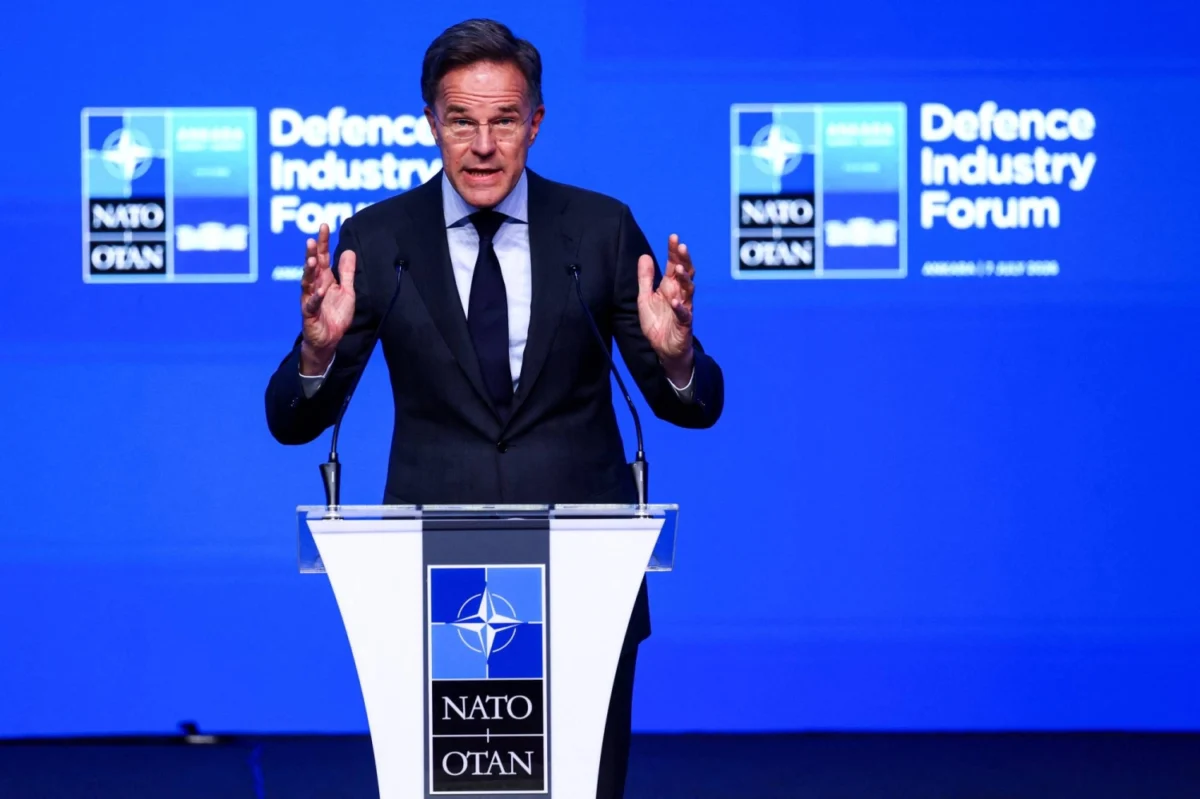
ANKARA — In a landmark display of collective industrial might, NATO allies have committed to at least $50 billion in new defense contracts, a move designed to stabilize the transatlantic alliance and demonstrate that European member states are taking significant, measurable steps toward meeting the spending demands long championed by U.S. President Donald Trump.
The announcement came on Tuesday as NATO Secretary-General Mark Rutte took the stage at the NATO Summit Defense Industry Forum in Ankara. Surrounded by the leaders of the world’s most powerful military bloc, Rutte framed the massive influx of capital not merely as a response to political pressure from Washington, but as a necessary evolution of the alliance’s industrial base in an era of heightened geopolitical instability.
The Core of the Commitment: A New Industrial Reality
The $50 billion figure represents one of the largest coordinated procurement drives in the alliance’s post-Cold War history. At the heart of this initiative is a strategic shift toward "European-sourced" hardware. While the United States remains the primary security guarantor for NATO, the recent agreements signal a desire among European capitals to achieve a higher degree of strategic autonomy.
Secretary-General Rutte, speaking to an audience of defense contractors and heads of state, emphasized that the alliance’s strength is predicated on a robust, localized supply chain. "The security of the Euro-Atlantic area requires a defense industry that is resilient, innovative, and, above all, capable of scaling rapidly to meet the demands of a complex security environment," Rutte stated.
The initial tranche of contracts, totaling $12 billion, is focused on the modernization of air capabilities. This includes advanced next-generation drones, high-altitude surveillance platforms, and state-of-the-art military aircraft designed to replace aging fleets that have struggled to maintain operational readiness in recent years.
Chronology of a Strategic Pivot
The path to this week’s announcement in Ankara has been marked by years of mounting friction regarding defense budgets.
- Early 2025: President Trump renewed his call for NATO allies to move beyond the "guideline" of 2% of GDP toward defense, suggesting that those failing to meet their obligations would face a re-evaluation of U.S. security commitments.
- Spring 2026: NATO defense ministers began quiet, high-level negotiations to consolidate procurement requests, aiming to create economies of scale that would lower costs for smaller member states while boosting European manufacturers.
- Late June 2026: In the weeks preceding the Ankara summit, intense lobbying occurred between the European Commission’s defense directorate and major aerospace conglomerates.
- July 7, 2026: On the sidelines of the summit, the final signatures were placed on the $50 billion framework, clearing the way for the Secretary-General’s announcement.
Supporting Data: The Saab Shift and the End of U.S. Dominance
The most striking development to emerge from the Ankara forum is the move by eleven NATO nations—including Germany, Poland, and the Netherlands—to abandon reliance on U.S.-made airborne radar-detection systems.
For decades, the Boeing-manufactured E-3 Sentry (AWACS) has served as the "eyes in the sky" for the alliance. However, the new $5 billion contract awarded to Swedish aerospace giant Saab to provide the GlobalEye system represents a significant shift. According to a high-ranking NATO diplomat, the decision was driven by three factors: cost-efficiency, superior sensor integration for modern electronic warfare environments, and the need to bolster the European industrial base.
"This is not a rejection of U.S. technology," the diplomat clarified on condition of anonymity. "It is an acknowledgment that Europe must possess the capability to sustain its own surveillance operations without being tethered to a single external provider. It is about redundancy and sovereignty."
The procurement statistics are telling. While the U.S. still holds the lion’s share of NATO’s heavy weapons contracts, the current trajectory shows that European defense firms are capturing a growing percentage of medium-to-high-tech military electronics and drone technology contracts.
Official Responses and Diplomatic Maneuvering
The reaction from Washington has been carefully calibrated. Sources within the U.S. delegation indicate that President Trump is "cautiously optimistic" regarding the $50 billion commitment, viewing it as a tangible result of his "tough love" approach to NATO funding.

"The President has always maintained that the United States should not be the sole bearer of the burden for Western security," a White House spokesperson noted. "These contracts prove that our allies are listening and, more importantly, acting."
Conversely, the mood in Ankara reflects a delicate balancing act. European leaders are eager to appease the Trump administration’s fiscal demands while simultaneously ensuring that their domestic defense industries—often a major source of jobs and technological innovation—remain viable.
French President Emmanuel Macron, long a proponent of "strategic autonomy," praised the move, noting that the alliance is finally moving toward a "balanced partnership" rather than a donor-recipient relationship. "We are building a NATO that is not just an insurance policy, but a collaborative defense engine," Macron told reporters.
Implications: A More Capable, Yet More Complex, Alliance
The implications of this $50 billion investment are vast and will likely reshape the landscape of the alliance for the next decade.
1. Strengthening the Eastern Flank
A significant portion of the new equipment is slated for deployment in the Baltic states and Poland. The focus on radar-detection and drone surveillance is a direct response to the ongoing security challenges posed by the militarization of Russia’s border regions.
2. Economic Impact on Defense Contractors
The shift toward firms like Saab, Rheinmetall, and BAE Systems suggests a boom period for European manufacturing. However, it also creates potential friction with U.S. firms that have traditionally enjoyed a near-monopoly on high-end NATO contracts. Economists warn that if this "localization" trend goes too far, it could lead to trade disputes and inefficiencies resulting from fragmented production standards.
3. Interoperability Concerns
One of the greatest challenges for NATO has always been ensuring that different nations’ equipment can "talk" to one another. By moving away from standardized U.S. platforms, the alliance faces the daunting technical challenge of ensuring that the new, diverse European systems remain fully interoperable with U.S. command-and-control infrastructure.
4. The Future of U.S.-NATO Relations
Ultimately, this move is a bid for survival. By demonstrating that Europe is willing to spend, the alliance hopes to insulate itself from future shifts in U.S. domestic politics. If Europe can prove it is a reliable, self-sufficient partner, the argument for American isolationism loses much of its potency.
Conclusion: A Turning Point in Ankara
As the summit concludes this week, the narrative surrounding NATO has shifted. The focus has moved from the existential dread of a crumbling alliance to the pragmatic, albeit expensive, reality of building a modern, sustainable defense posture.
The $50 billion commitment is a milestone, but it is also only the beginning. As Secretary-General Rutte noted in his concluding remarks, "Money is the fuel, but political will is the engine. Today, we have demonstrated both."
For the citizens of the NATO member states, the coming years will be defined by this transition. The alliance is no longer just a defensive pact; it is becoming an industrial powerhouse, one that is determined to secure its own borders and ensure that the "transatlantic bond" remains strong—even if that bond is now being forged in the factories of Europe rather than exclusively in the boardrooms of the American military-industrial complex.











