Video has cemented its position as the undisputed king of digital communication. Whether for viral marketing, educational content, professional brand building, or personal storytelling, video is the medium through which the world consumes information. Yet, for all its power, the traditional production process remains a notorious bottleneck. For years, creators have been shackled to complex timelines, laboring over tedious tasks like frame-by-frame trimming, manual subtitle synchronization, and the painstaking adjustment of audio levels.
Today, the emergence of AI-powered video editors is dismantling these barriers. By automating the mechanical aspects of post-production, these tools are not merely speeding up the process—they are fundamentally changing the role of the editor from a manual laborer to a creative director.
The Bottleneck: Why Traditional Editing Stifles Innovation
The greatest impediment to modern content creation is not a lack of vision; it is the workflow itself. Traditional non-linear editing (NLE) software, while powerful, is designed for technical precision rather than creative velocity.
For the solo creator or the small business marketing team, the "editing trap" is a common phenomenon. When you are responsible for scripting, filming, editing, thumbnail design, and social media distribution, every hour spent on the technical minutiae of the timeline is an hour stolen from strategy and ideation. Repetitive tasks—removing "umms" and "ahhs," silencing dead air, resizing 16:9 footage for vertical mobile formats, and manually aligning captions—are essential for a professional finish, but they offer zero creative satisfaction.

This creates a recurring crisis of consistency. Creators find themselves unable to publish at the frequency required by modern algorithms because they are buried in the "digital grunt work" of editing.
The Evolution of the AI Toolkit: A Chronology of Progress
The integration of AI into video editing did not happen overnight; it is the result of years of incremental technological advancement.
- 2018–2020: The Foundation. Early AI tools focused on single-task automation. This era saw the rise of basic automatic speech-to-text transcription services, which allowed creators to generate captions with minimal manual input.
- 2021–2023: Pattern Recognition. AI began to "understand" video content. Features like "Smart Trimming" (the ability to detect and remove silences) and basic object tracking became standard in mid-tier software, significantly reducing the time required for the first "rough cut."
- 2024–2025: Contextual Intelligence. Generative AI entered the mainstream. Systems began to understand the difference between a filler word and a meaningful sentence, and could suggest cuts based on pacing rather than just audio levels.
- 2026–Present: The Integrated Ecosystem. Today, we have reached the era of the "all-in-one" AI editor. Tools like Pollo AI allow users to move from raw footage to a polished, platform-ready video within a single interface, integrating generative effects, color grading, and audience-optimized aspect ratio adjustments.
What AI Can Actually Do: Beyond the Basic Cut
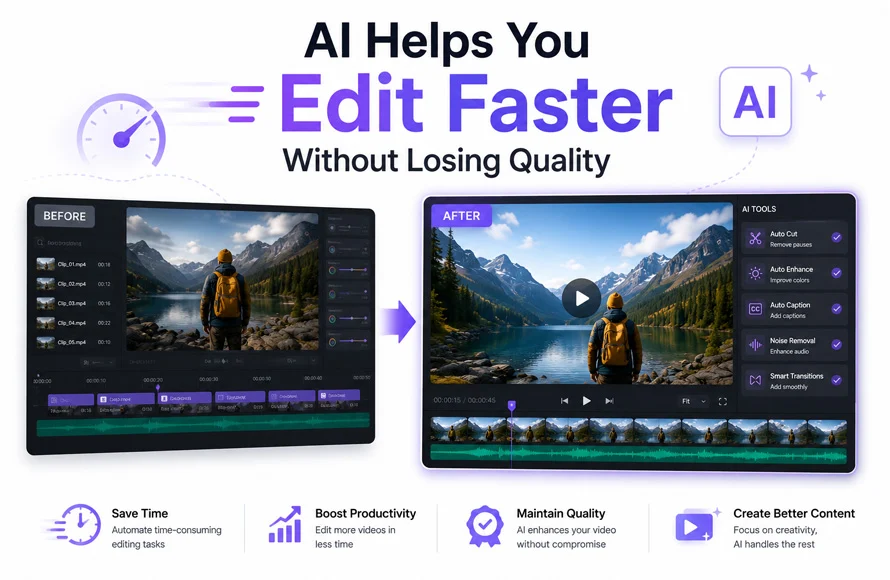
Modern AI video editors have evolved into sophisticated production assistants. While each platform differs, the standard suite of capabilities now includes:
- Smart Transcription and Subtitling: AI models now transcribe with near-human accuracy, automatically adding dynamic, stylized captions that increase viewer retention—a task that previously took hours.
- Filler Word Removal: Algorithms scan audio tracks for disfluencies (filler words) and automatically jump-cut to ensure a tight, professional pace.
- Automated Reframing: With the rise of short-form video (TikTok, Reels, Shorts), AI can now intelligently crop widescreen footage to 9:16, keeping the subject centered at all times.
- Generative Enhancements: Advanced tools can now generate B-roll, add visual effects based on text prompts, or even adjust the lighting of a scene in post-production.
- Platform Optimization: AI can analyze a video and suggest the optimal cut length, pacing, and music choice based on the platform where the content will be hosted.
The Data: Efficiency Meets Quality
A common misconception in the creative industry is that "faster" automatically implies "lower quality." Industry data suggests the opposite. According to recent surveys of content marketing teams, the implementation of AI-driven workflows has reduced production time by an average of 60–70%.

Critically, this time-saving does not result in a loss of quality. Instead, it allows for "creative re-investment." When a creator spends 30 minutes on technical editing instead of 10 hours, those nine and a half hours are redirected toward refining the narrative hook, testing multiple thumbnail variants, or iterating on the script. Efficiency, in this context, is the key to higher-value creative decisions.
Perspectives from the Industry
Industry experts and software developers emphasize that AI is an "augmented" tool, not a "replacement" tool.
"The goal of AI in video production is to bridge the gap between the professional studio and the bedroom creator," says a lead developer at Pollo AI. "We aren’t trying to build a machine that replaces the filmmaker; we are building a machine that handles the math so the filmmaker can focus on the soul of the story."
While some traditionalists express concerns regarding the homogenization of editing styles, the consensus is that AI provides a necessary leveling of the playing field. It democratizes the ability to produce high-quality media, allowing small businesses to compete with large agencies on a visual level.

Implications: The Democratization of Storytelling
The implications of these tools are profound. We are witnessing the democratization of high-end production.
- For the Individual Creator: It is now possible to maintain a daily posting schedule without professional staff, significantly increasing the probability of "breaking through" the algorithmic noise.
- For Small Businesses: Companies that previously lacked the budget for a full-time video editor can now produce high-converting social media content, educational tutorials, and internal communications in-house.
- For Personal Projects: The barrier to entry for memory-making—such as creating polished birthday tributes, travel logs, or family history reels—has vanished. AI allows anyone to turn raw, chaotic footage into a coherent, emotional narrative.
Best Practices for the AI-Augmented Editor
To leverage these tools effectively, creators must adopt a "Human-in-the-Loop" philosophy. Here are five rules for the modern editor:
- Prioritize Clean Input: AI cannot fix fundamentally bad footage. High-quality lighting and clear audio remain the responsibility of the creator.
- Delegate the Repetitive: Use AI to handle the "heavy lifting" of trimming and captioning, but don’t let it dictate the emotional arc of your video.
- Review with Intent: Never publish a purely automated draft. Always perform a human review to ensure the pacing matches your intended tone and the AI hasn’t inadvertently cut a crucial piece of context.
- Platform-Specific Customization: Use AI to generate variants, but ensure you are tailoring the final output to the unique culture of the platform—what works on LinkedIn often fails on TikTok.
- Preserve the Human Touch: The most successful AI-edited videos are those where the AI does the chores, but the creator retains final creative control over the pacing and personality.
The Future: A New Era of Accessibility
The future of video production is unequivocally faster, more accessible, and more creative. As AI models continue to learn and integrate, the technical barrier to entry will continue to drop. We are approaching a point where the only limitation to creating a masterpiece is the quality of one’s imagination.
The shift we are experiencing is not just a change in software—it is a shift in the philosophy of creation. By removing the friction of technical production, AI is inviting a new wave of voices into the digital conversation. For those willing to embrace these tools, the ability to communicate, educate, and entertain has never been more powerful. The era of the "slow edit" is behind us; the era of efficient, high-impact storytelling is here.