Suro Senen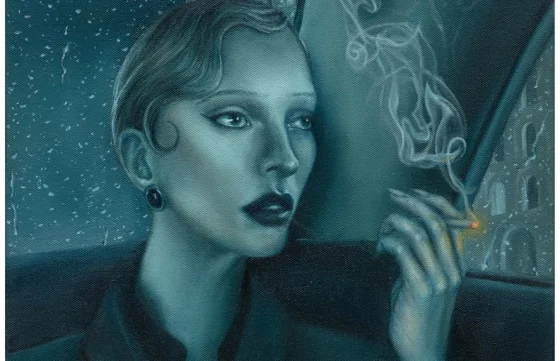
Introduction: A Chromatic Descent into the Uncanny
Harper’s Gallery has officially unveiled Prussian Blue, the highly anticipated solo debut of New York-based artist Sophia Huitema. Running through April 25, 2026, the exhibition serves as a definitive statement for the emerging painter, marking a departure from collective showcases into a singular, immersive universe. Through a collection of seven large-scale oil paintings, Huitema invites the viewer into a liminal space where the boundaries between high-society elegance and psychological peril dissolve. At the heart of this exhibition is the titular pigment—a chemical compound of profound historical and scientific duality—which acts as both the literal palette and the metaphorical heartbeat of the work.
Main Facts: The Anatomy of an Exhibition
Prussian Blue is not merely a display of technical skill; it is a calculated atmospheric intervention. The exhibition features seven new oil paintings, all unified by a restricted, icy color spectrum of blues and greens. These works depict a recurring cast of female figures—elongated, watchful, and undeniably formidable—trapped within hazy, dreamlike interiors that recall the opulence of the Gatsby era.
The figures are characterized by their exaggerated limbs, slender necks, and an air of quiet, calculating intelligence. Dressed in the trappings of early 20th-century decadence—pearls, jewel-encrusted headdresses, and backless evening gowns—these women inhabit settings that feel ripped from a noir film. The gallery presentation serves to highlight the tension between the beauty of the subjects and the menace that seems to lurk just outside the frame. By stripping away extraneous color, Huitema forces the viewer to confront the gaze of her subjects, creating an intense, one-on-one dialogue between the painted image and the audience.
Chronology: The Evolution of a Visual Language
Huitema’s trajectory toward this solo presentation has been marked by a rigorous, self-directed studio practice. Operating outside the constraints of traditional academic training, the artist has spent years refining a vocabulary that bridges the gap between historical illustration and contemporary painting.
- Formative Years: Influenced early on by the streamlined finesse of Art Deco design and the high-fashion sensibilities of early 20th-century illustrators like Erté, Huitema began to experiment with the "attenuated proportion"—the stretching of the human form to denote grace, anxiety, and theatricality.
- The Development of the Palette: Over the past several years, Huitema’s work underwent a "chromatic narrowing." She moved away from naturalistic color in favor of the emotional resonance of the blue-green spectrum. It was during this period that the historical significance of Prussian Blue became a central obsession, leading to the development of the current series.
- The Lead-up to Harper’s: The transition to this exhibition involved a shift toward narrative, specifically the construction of "psychological realms." Moving beyond static portraiture, Huitema began to compose scenes—such as the evocative Sleeper Car—that function as snapshots of cinematic suspense. The current exhibition is the culmination of this two-year period of intense, focused production.
Supporting Data: The Science of the Pigment
To understand the weight of Huitema’s work, one must understand the pigment itself. Prussian Blue (ferric ferrocyanide) is one of the first synthetic pigments, discovered by chance in Berlin in the early 18th century. Its history is inherently paradoxical:
- Chemical Origins: The pigment is intrinsically linked to cyanide, a substance synonymous with toxicity and death.
- Medical Utility: Conversely, Prussian Blue is utilized in modern medicine as an antidote for heavy metal poisoning, specifically thallium and radioactive cesium.
Huitema leverages this dual identity to inform the narrative arc of her paintings. Her figures are often depicted in states of "emotional toxicity"—guarded, defensive, or predatory—yet they possess a protective, armor-like quality in their poise and their high-fashion shields. The science of the pigment mirrors the content of the work: the color is at once the weapon and the cure.
Official Perspectives and Critical Inquiry
While the gallery has maintained a restrained stance, focusing on the immersive nature of the show, the discourse surrounding the exhibition has centered on the "theatricality" of the work. Art critics have noted that Huitema’s ability to create "compressed spaces" creates an experience akin to being on a film set.
"The figures," notes a recent curatorial brief from Harper’s, "do not merely exist within the frames; they perform." This performance is best exemplified by the work Sleeper Car. In this piece, the protagonist’s posture—head tilted with a sly, knowing smirk—is contradicted by a hand braced for impact. The background, defined by rain-streaked glass and a vanishing-point aisle, transforms the static canvas into a thriller. The gallery suggests that Huitema’s work is an inquiry into the "femme fatale" archetype—not as a trope, but as a survival mechanism in a world that is inherently hostile to the feminine gaze.
Implications: The Synthesis of History and Modernity
The significance of Prussian Blue lies in how it navigates the tension between historical art traditions and the contemporary "image-saturated" world. Huitema does not attempt to replicate the past; rather, she mines it for its emotional utility.
Bridging the Gap
Huitema’s work creates a bridge between three distinct visual traditions:
- Art Deco/Fashion Illustration: Providing the structural elegance and stylized, elongated aesthetic.
- Symbolism/Surrealism: Offering the shallow, phantasmagoric spaces that prioritize psychological states over architectural realism.
- Cinematic Noir: Infusing the work with the narrative tension and shadow-play typical of mid-century film.
By synthesizing these, Huitema arrives at a "contemporary visual language." Her work suggests that the "modern" is not merely defined by the use of digital tools or abstract expression, but by the ability to rearrange historical motifs into a new, coherent reality. Her self-directed background serves as a vital component of this; because she is not tethered to the "formal academic training" of a specific institution, she is free to borrow, blend, and subvert these influences without the weight of pedagogical expectation.
The Psychological Realm
The most profound implication of the exhibition is the shift toward viewing the canvas as a psychological vessel. The environments in Huitema’s paintings—the train cars, the dimly lit lounges, the opulent boudoirs—are not literal locations. They are, as the gallery posits, "psychological realms shaped by subconscious experience."
This approach challenges the viewer to look beyond the "beauty" of the paint and the glamour of the subjects. It demands that we ask: What is the threat? The women in Prussian Blue are constantly in a state of alert. They are either luring the viewer into a ruse or actively evading a danger that exists just off-camera. In this way, Huitema turns the gallery space into a place of active, high-stakes observation.
Conclusion: A Lasting Impression
As Prussian Blue remains on view through April 2026, it stands as a testament to the power of deliberate, thematic painting. Sophia Huitema has successfully constructed a world that is as dangerous as it is beautiful, utilizing a historical pigment to ground her explorations of power, protection, and the feminine gaze.
Whether one interprets these paintings as exercises in art history, meditations on the psychology of the "femme fatale," or simply as triumphs of atmosphere, their impact is undeniable. Harper’s Gallery has provided a stage for a young artist who, by looking backward at the aesthetics of the 20th century, has managed to create a vision that feels distinctly, and perhaps disturbingly, relevant to the tensions of the present day. Through the cool, melancholic hues of Prussian Blue, Huitema has ensured that her debut will linger in the minds of viewers long after they leave the quiet, dimly lit interiors of the gallery.

 Siti Muinah
 Asep Darmawan