Layla Zulfa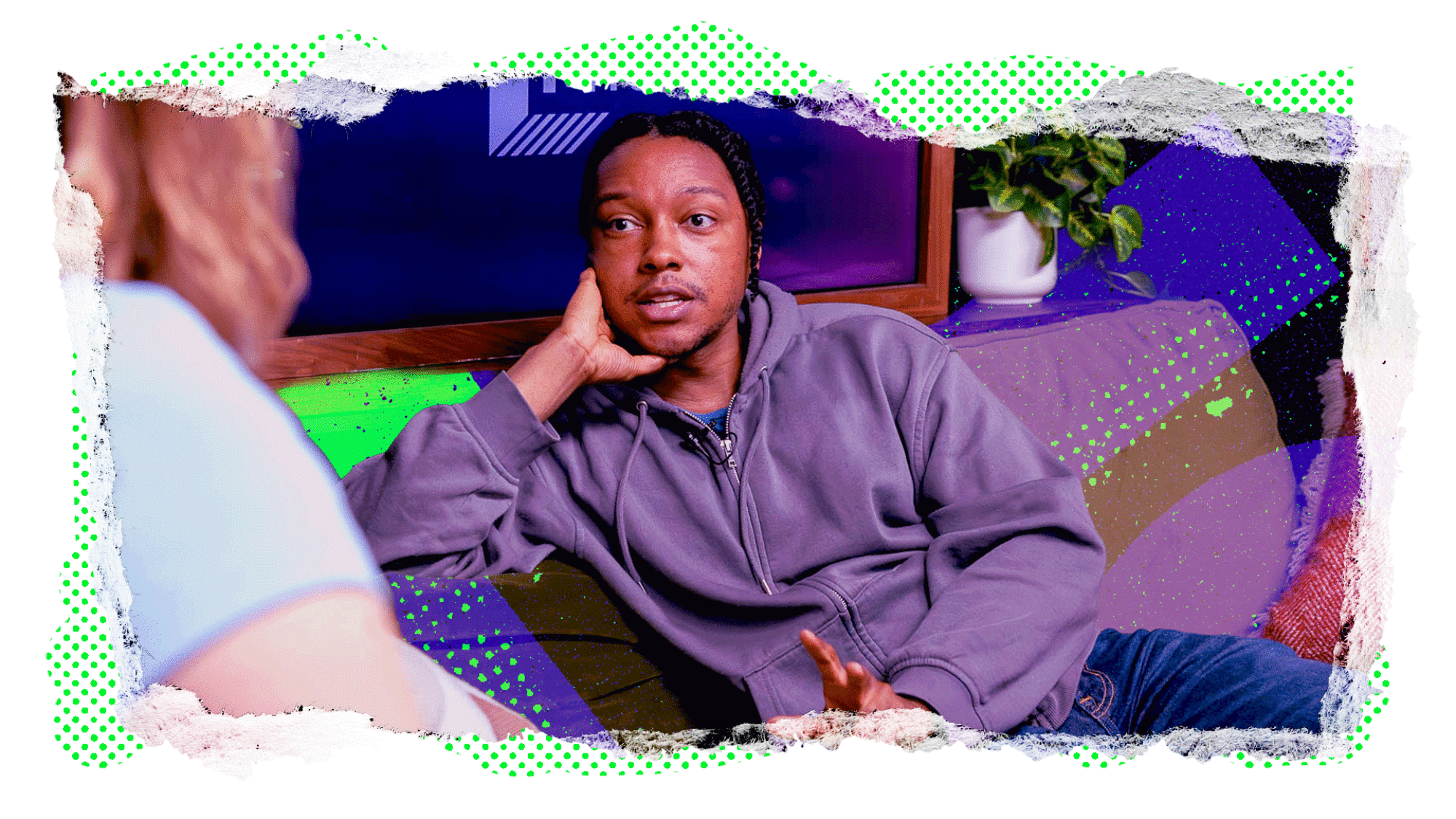
By Crystal Bell, Digital Culture Editor
In the vast, cacophonous arena of the modern internet—a space defined by rapid-fire algorithms, performative outrage, and the relentless pursuit of virality—there exists a strange, quiet outlier. Comedian Josh Johnson, a staple of The Daily Show and a titan of digital storytelling, has ascended to the top of the creator economy by doing the exact opposite of what the platform metrics demand. He doesn’t chase trends; he doesn’t shout to be heard; and he certainly doesn’t rely on high-production spectacle.
Instead, he wears a gray hoodie, sits on a couch, and tells stories.
As of mid-2026, Johnson has cultivated a digital footprint that is as vast as it is loyal: 2.5 million subscribers on YouTube, 2.7 million on TikTok, and 2.4 million on Instagram. Yet, to speak with Johnson is to realize that his massive reach is merely a byproduct of a singular, almost stubborn, dedication to the "good parts" of the internet—the parts that emphasize human connection over data extraction.

The Man Behind the Hoodie: A Study in Unpretentious Success
It is perhaps fitting that the gray hoodie has become his unofficial uniform. In our interview at the Mashable studio, Johnson—clad in, predictably, a gray hoodie—deflects the idea that his look is a calculated brand strategy. For him, the garment is an artifact of comfort, a collection of vintage and thrifted pieces that became a visual shorthand for his brand before he even realized it.
"Even when people see me out on the street, they’re like, ‘Oh, you really wear this?’" Johnson says with a laugh. "That’s the good and bad part of doing a thing; if you genuinely like it, it just becomes how you look all the time."
This lack of artifice is the bedrock of his comedy. Whether he is dissecting the absurdity of the Drake vs. Kendrick Lamar beef for an uninitiated audience or recounting the harrowing tale of catfishing the Ku Klux Klan as a teenager, Johnson operates with a rhythmic, conversational pace. He creates a "performance of getting there," where the detours and pauses are just as vital as the punchline.
Chronology: From Louisiana Libraries to Global Stages
Johnson’s trajectory suggests a life lived in parallel with the evolution of the web itself. Raised in Louisiana, he was an early adopter of the "weird" internet. While his peers were perfecting their MySpace top-eight lists, a young Johnson was haunting library computers, immersing himself in the collaborative storytelling of message boards and the niche world of Dragon Ball Z fanfiction.

- Early 2000s: Johnson cuts his teeth in digital forums, writing stories and engaging in collaborative world-building—experiences that would later inform his unique narrative pacing.
- The Chicago Era: After relocating, he refines his voice in the competitive, gritty environment of the Chicago stand-up scene, learning the importance of eye-to-eye engagement.
- 2017: Johnson joins the writing staff of The Daily Show, a pivotal move that bridges his stand-up roots with the high-stakes world of political satire.
- 2020s: He pivots to a digital-first strategy, bypassing traditional gatekeepers by posting full sets, clips, and conversational riffs across YouTube and social media.
- May 2026: His latest HBO special, Symphony, debuts to critical acclaim, marking his evolution from a "digital comedian" to a cross-platform narrative powerhouse.
Data and the Economics of Attention
The irony of Johnson’s success is not lost on him. He is a comedian who has famously called the internet "a bad idea," yet he operates as one of its most successful architects. His success provides a compelling case study in the modern creator economy, challenging the prevailing wisdom that shorter, punchier, and more outrageous content is the only path to growth.
While competitors scramble to chop their work into 15-second "viral fragments," Johnson remains committed to long-form storytelling. His metrics—millions of views on hour-long comedy specials—suggest a market correction. Audiences, he believes, are starving for depth.
"Back in the day, debate used to mean something," Johnson observes. "Now it feels like everybody is saying the most outrageous thing possible for the click. There are people who aren’t even trying to debate anymore. They’re trying to get clipped."
This "clipping" economy, which commodifies human interaction into soundbites for the algorithm, is the antithesis of Johnson’s approach. He views his digital channels not as a marketing funnel, but as a digital room. When asked about his social media strategy, he shrugs off the question of metrics. For him, the goal is simply to be heard by as many people as possible, regardless of the platform.

The Ethics of the Digital Age: Official Reflections
Johnson’s skepticism of the internet is not a rejection of progress, but a plea for humanity. During our conversation, he articulates a nuanced position on the rise of Artificial Intelligence and the erosion of digital discourse. He views the current state of the internet as an "extractive" system—one that mines human creators for content to train machines that will ultimately replace them.
"You scraped the internet and stole from us just to tell us you were going to replace us because we aren’t worthy," he says. "If we’re not worthy, why didn’t your AI make everything itself?"
This is the core of Johnson’s ethos: the conviction that lived experience is non-transferable. His comedy works because it is rooted in the specific, messy, and often painful realities of being a person. In an era where AI can generate a joke about a cat, it cannot replicate the specific vulnerability of a human being processing their own history on stage.
Implications: The Search for the ‘Good Parts’
What does the success of Josh Johnson mean for the future of digital culture? His career suggests that we may be approaching a saturation point with "optimized" content. The internet has become so efficient at delivering outrage and dopamine that audiences are increasingly seeking out "the good parts"—the pockets of the internet that prioritize empathy, genuine curiosity, and shared humanity.

Johnson points to his YouTube comment sections as evidence. He describes, with genuine warmth, how his viewers use the space to check in on one another, offering support during difficult times. These small, decentralized acts of kindness are, to him, the true promise of the internet—a promise that he believes is still within reach.
"I think we are so close," he says, reflecting on the potential for a more connective digital future. "It’s crazy how close we are."
Conclusion: A Blueprint for the Future
As we look toward the latter half of the decade, the model established by creators like Josh Johnson may well become the standard. By refusing to surrender his pacing to the algorithm and by maintaining a firm commitment to the "human" element of stand-up, he has built a career that feels immune to the shifting sands of platform policy.
He remains a paradox: a man who fears the internet’s cruelty but believes in its capacity for connection; a comedian who claims the hoodie was an accident but uses it to anchor his identity; and a storyteller who uses the most modern tools available to tell the oldest, most human stories.

Whether he is holding court in a studio or performing to a sold-out theater, Josh Johnson isn’t just looking for the good parts of the internet—he is actively building them, one story at a time. In a digital world that often feels like it’s spiraling into the void, having a voice like his—thoughtful, observant, and deeply human—is not just a luxury. It’s a necessity.


 Siti Muinah
 Dwi Wanna