

By Zoria Petkoska
Singapore—a city-state often defined by its meticulous urban planning, hyper-efficiency, and pragmatic architectural rigor—is currently undergoing a colorful, performative transformation. Across the island, the ubiquitous, bright-lettered slogan “Let’s Play!” acts as a visual subversion to the city’s reputation for stoicism. This is the heartbeat of the 49th annual Singapore International Festival of Arts (SIFA), a landmark edition that marks a fundamental shift in how the nation engages with its creative soul.
Under the fresh stewardship of Festival Director Tze Chien Chong, SIFA is shedding the skin of high-brow exclusivity. In its place, Chong is cultivating an ethos of radical accessibility, urging the public to view art not as a museum-bound artifact, but as an essential, daily utility.
The Core Mandate: Redefining Public Engagement
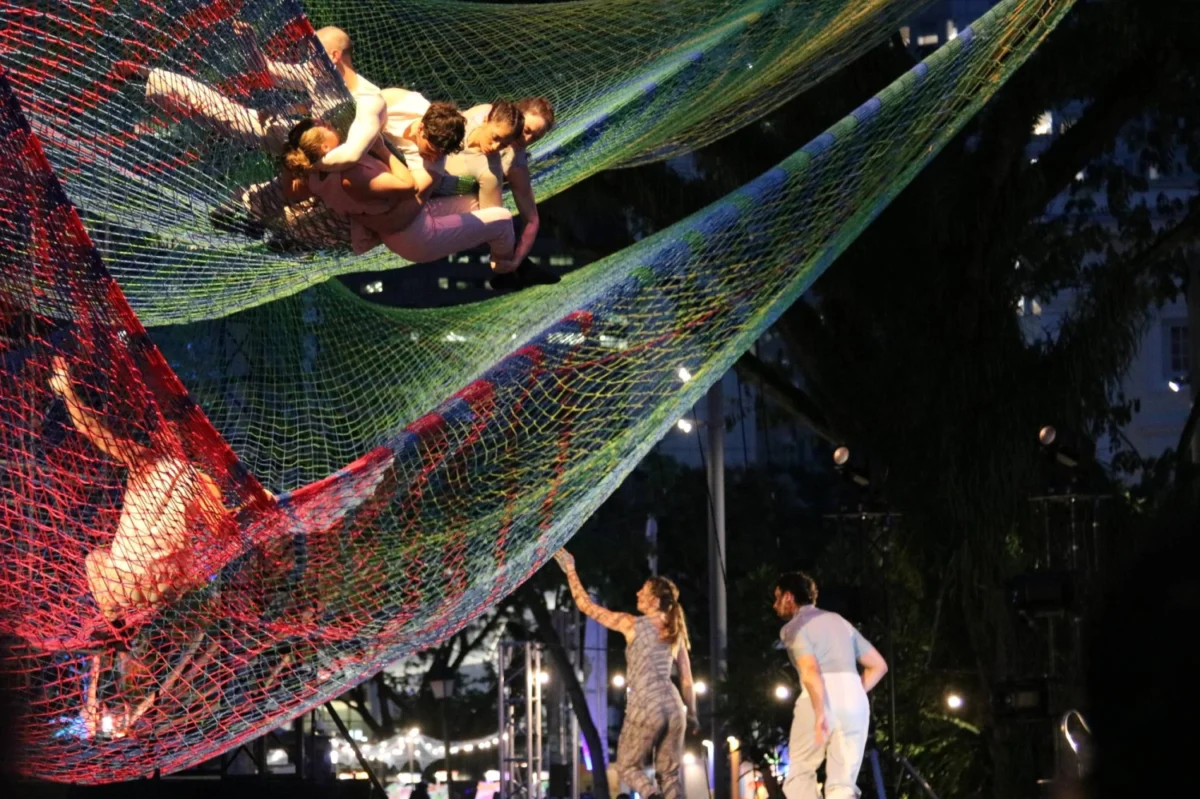
The central pillar of this year’s festival is the demystification of the artistic process. As residents navigate the Festival Village, they are greeted by installations that defy traditional boundaries. A prime example is Noli Timere, a centerpiece performance that serves as a physical manifestation of this new philosophy. By blending the gravity-defying spectacle of aerial acrobatics with the fluid emotionality of contemporary dance and the static permanence of large-scale art sculpture, the performance creates an environment that is simultaneously awe-inspiring and approachable.
“Singaporeans take themselves very seriously,” Chong observes during a recent press briefing. “They often feel that art is a separate entity—something you go to a gallery to see, or a theater to observe from a distance. They rarely think of it as an integral part of their daily lives. Our goal with this festival is to disrupt that narrative. This is an invitation for them to discover, or rediscover, their love for the arts in a way that feels less intimidating and more human.”
This shift is not merely aesthetic; it is a structural redesign of the festival’s relationship with the public. By moving performances out of the black-box theater and into open-air spaces like the Festival Village, SIFA is effectively reclaiming the public commons for the sake of imagination.
Chronology of a Cultural Shift
The evolution of SIFA into its current, more egalitarian form has been a multi-year project, though the 49th edition represents the first full-scale implementation of Chong’s vision.
- Early 2024: Following the conclusion of the 48th festival, the board of SIFA sought a new direction that could better bridge the gap between Singapore’s elite arts scene and the general public.
- Mid-2024: Tze Chien Chong was appointed as the new Festival Director. His reputation for avant-garde theater and community-centric production design made him the primary candidate to revitalize the brand.
- Late 2024 – Early 2025: The "Let’s Play!" campaign was developed, focusing on street-level marketing and community-based workshops rather than traditional print advertising.
- May 2026 (The Current Edition): The 49th SIFA officially opens, featuring an unprecedented number of free, open-air performances and interactive installations designed to encourage spontaneous participation.
Supporting Data: Why "Play" Matters
The necessity for a shift in cultural programming is supported by a growing body of data regarding Singaporean lifestyle and mental health. According to recent national surveys, while Singapore leads the region in cultural infrastructure, there is a persistent "participation gap."
Studies conducted by local arts councils indicate that while attendance at ticketed events remains stable, spontaneous engagement—the kind that leads to long-term appreciation of the arts—is significantly lower among the working-age population. The "Let’s Play!" initiative attempts to lower the barrier to entry by removing the two greatest deterrents: cost and psychological discomfort.
By providing free, open-air performances, the festival is targeting the "casual observer." Data from the first week of the 49th SIFA suggests that foot traffic in the Festival Village has increased by 35% compared to the 2025 edition, with a notable rise in families and younger demographics who were previously underrepresented in traditional theater settings.
The Director’s Vision: Official Perspectives
Tze Chien Chong’s leadership is defined by a rejection of the "ivory tower" mentality. For Chong, the stage is a laboratory for social cohesion.

“When you see a performer suspended in the air, or a dance that interprets the chaotic pace of our city, you aren’t just watching a performance,” Chong explains. “You are witnessing a dialogue. We want to facilitate a conversation where the audience feels they have a seat at the table, regardless of their artistic background. If we can make someone stop for ten minutes on their way home from work to watch an aerial performance, we have succeeded.”
The festival’s programming committee has echoed this sentiment, noting that the selection of acts for the 49th edition prioritized "kinetic energy" over "intellectual complexity." The inclusion of Noli Timere is a deliberate choice to ground the festival’s abstract concepts in physical reality, making the art tactile and visceral.
Implications for the Future of Singaporean Arts
The implications of this shift are profound. If the 49th SIFA succeeds in sustaining these levels of engagement, it may fundamentally alter the funding and programming models for future cultural events in the region.
The Democratization of Space
The success of the Festival Village proves that urban spaces in Singapore—often strictly regulated—can be repurposed for artistic expression without causing public disorder. This sets a precedent for city planners to integrate more permanent "performance pockets" into future urban developments.
The "Casual Participant" Economy
By converting passive observers into active participants, the festival is building a broader audience base. In the long term, this could lead to higher ticket sales for more complex, niche productions, as the general public becomes more comfortable with the language of contemporary art.
Resilience Against Misinformation
In an era where digital noise often drowns out nuanced human experience, the physical, shared experience of the festival acts as a form of cultural grounding. As the festival’s mission statement notes: "In a time of both misinformation and too much information, quality journalism and shared human experience are more crucial than ever." By providing a space for truth-telling through movement and sculpture, SIFA is positioning itself as a vital component of the city’s civic health.
Conclusion: A City in Motion
As the sun sets over the Festival Village and the aerialists of Noli Timere take to the sky, the true success of the 49th SIFA is visible in the faces of the crowd. There is a sense of genuine discovery—a feeling that the city is not just a place to work, but a place to experience.
Under the guidance of Tze Chien Chong, Singapore is learning that the most serious work of a nation is often done through play. By inviting the public to engage with art on their own terms, SIFA is not just hosting a festival; it is fostering a new cultural consciousness, one where the arts are not an optional luxury, but the very fabric of the city’s identity.
Whether this shift will result in a permanent change in the Singaporean cultural landscape remains to be seen. However, if the energy at the Festival Village is any indication, the experiment is already a resounding success. The 49th SIFA is a testament to the idea that when we lower the barriers to entry, we elevate the quality of our collective life.
To support in-depth reporting on the arts and culture in Singapore, consider subscribing to our digital archives. Quality journalism is essential to capturing the evolving narrative of our society.












No comments yet. Be the first to join the conversation!