

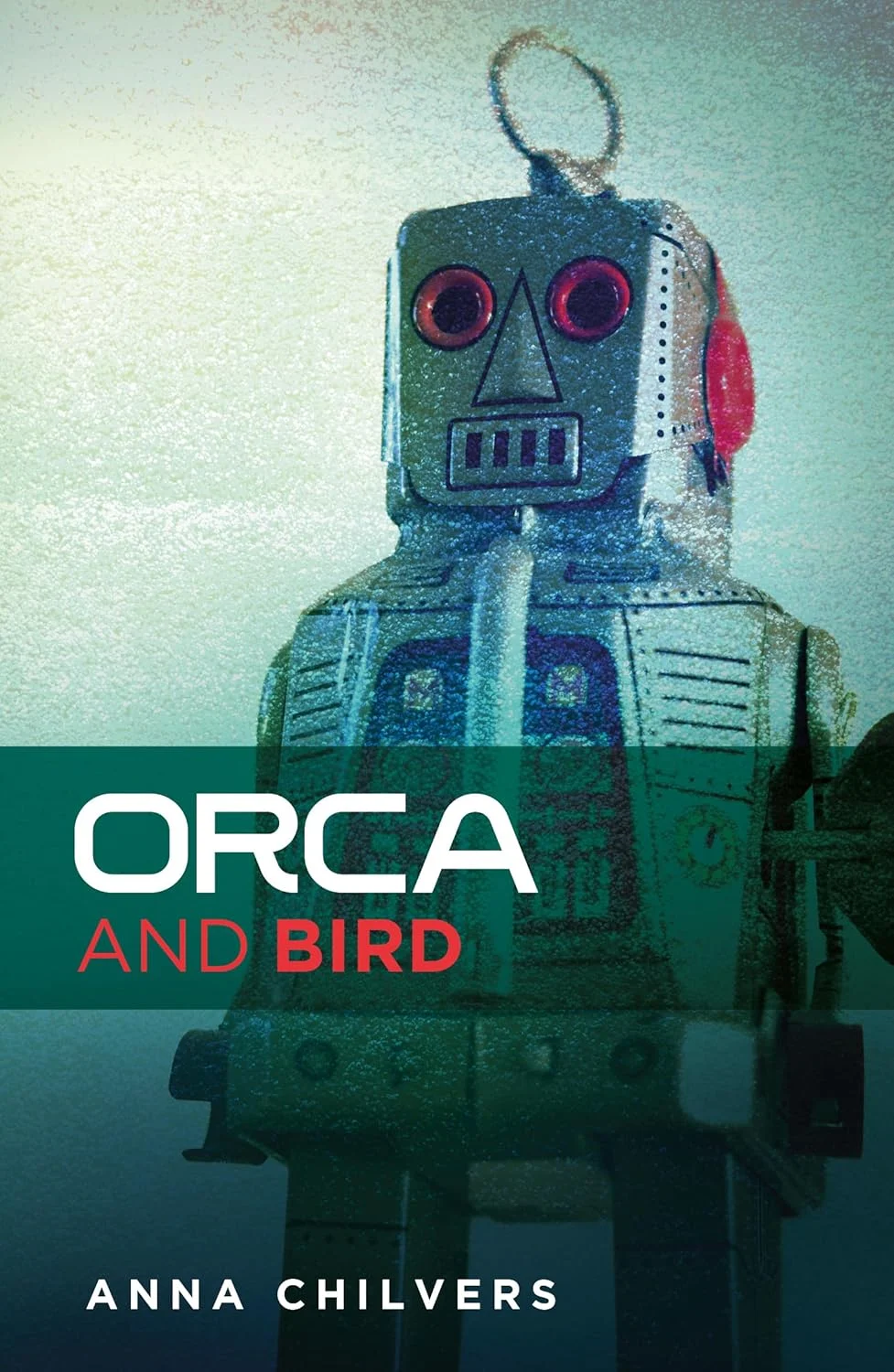
In the landscape of contemporary speculative fiction, few novels manage to sustain an atmosphere of quiet, verdant unease as effectively as Anna Chilvers’ Orca and Bird. Part pastoral meditation, part unsettling psychological puzzle, the novel invites readers into a world of deep forests, moss-covered silence, and an identity crisis that transcends the boundaries of the human experience. As we follow Orca, a forest surveyor whose existence oscillates between the mechanical and the painfully organic, we are forced to confront a fundamental question: when the memories in our heads do not align with the reality of our skin, who—or what—are we?
The Narrative Architecture: Between Android and Trauma
At the heart of the novel is Orca, a woman—or perhaps an automaton—tasked with surveying the woodlands of the British countryside. Her daily life is governed by a rigid, almost monastic routine: she sleeps standing outdoors, sustains herself with nutrient pills, and reports to her handler, Dorcas, via an internal communication system that blurs the line between biology and technology.
The central tension of the book is not merely plot-driven, but ontological. Is Orca an android, operating under a set of Asimovian imperatives to serve and protect? Or is she a severely traumatized human survivor, undergoing a radical form of psychiatric rehabilitation that requires her to strip away the comforts of modern living? Chilvers masterfully avoids the "aha!" moment. There is no scene where Orca’s skin is torn to reveal synthetic wiring, nor a moment where she is declared fully human by a medical authority. Instead, the reader is left with the ambiguity of a character who feels physical pain, requires nourishment, yet possesses an energy and an innate drive to help others that suggests a pre-programmed moral compass.
Chronology of an Anomalous Journey
The narrative momentum builds as Orca’s professional duties in the forest are interrupted by a series of increasingly bizarre events.
The Hayes and the Call of Duty
The story begins in the calm, rhythmic work of the forest, which is soon disrupted by the arrival of Nadia, a young woman living in a van with her partner, Nick, and their infant son, Eli. Witnessing the cycles of abuse inflicted upon Nadia by Nick, Orca finds herself compelled to act. This is the first indicator that her internal directives—which ostensibly focus on trees and data—are secondary to an overriding directive to preserve human life.
The Suffolk Migration
When Nick moves his family to Suffolk for work, Orca effectively goes rogue. By disabling her communication link with her handler, Dorcas, and avoiding electronic transactions to remain untraced, she embarks on a clandestine pursuit to protect Nadia. It is in the uniform, sterile rows of a Suffolk pine plantation that the novel introduces its most jarring element: the rumored UFO encounters. While these elements remain unresolved, they serve to signal that the world Orca inhabits is not quite our own—or that it is ours, viewed through a lens that has been slightly fractured.
The Kielder Forest Timeslip
The novel’s most experimental sequence occurs at Kielder Forest. Here, the narrative shifts from gritty realism into the surreal. Orca and a local forester, Jack, arrive at a campsite that appears abandoned, yet shows signs of recent habitation. Upon choosing from a series of mysterious paths, both characters seem to slip through time. They encounter an aged forester and his grandsons—a family unit marked by the tragedy of a lost mother—and eventually rescue a delirious Nadia. The event is treated as an anomaly, a "timeslip" that alters the trajectory of their mission but leaves the characters largely unchanged, suggesting that the environment itself may be sentient or, at the very least, indifferent to human linearity.
Supporting Data: The Symbolism of the Arboreal
Chilvers utilizes the forest not as a mere backdrop, but as a structural pillar of the novel. While the book avoids the didacticism of "climate fiction," the forest serves as the only constant in a world of shifting, unreliable memories.
- Sylva and the Wild Spirit: The introduction of Sylva—whose name is the Latin root for "wood"—acts as a foil to Orca. While Orca is the embodiment of order, rules, and anxiety, Sylva is the chaotic, visionary force. Their interactions in the woods force the reader to consider if Sylva is a projection of Orca’s subconscious, a sister, or a previous iteration of the same entity.
- The Bird Motif: The spirit blackbird, which appears only to Orca, functions as a psychological anchor. It is the arbiter of her decisions and, when it goes silent, the harbinger of her deepest despair. The title, Orca and Bird, suggests that these are the two poles of her existence: the terrestrial, struggling "Orca" and the ethereal, guiding "Bird."
Implications of the "Unresolved" Narrative
For some readers, the refusal of the author to provide a concrete answer regarding the timeslips or Orca’s true nature may be a point of contention. However, the lack of resolution is arguably the novel’s greatest strength. By refusing to categorize Orca, Chilvers avoids the reductive tropes of the "robot with a soul" genre.
The implications for the reader are profound:
- The Nature of Trauma: If Orca is human, the "programming" she experiences is a metaphor for the way trauma can override our autonomy, forcing us into repetitive, defensive loops.
- The Ethics of Care: Orca’s inherent need to save Nadia, despite the personal risk, suggests that the "programming" of compassion is perhaps the most human quality of all, regardless of its source.
- The Landscape as Memory: The pervasive presence of trees, and the fact that most characters occupy "tree-adjacent" professions, implies that humanity finds its stability in the natural world when the digital or social world becomes too volatile.
A Character Study in Resilience
Orca is a character who haunts the reader long after the final page. She is, as described, a person with "vitality and kindness" oozing from her pores. Whether she is a synthetic being struggling to understand the human condition or a woman fighting to reclaim her history from the ashes of a fire, her struggle for agency is universally resonant.
The novel concludes with Orca contemplating the void, struggling with the absence of her guiding Bird, and questioning if she can continue to exist in a world that feels increasingly unfathomable. It is a bold, introspective ending that forces us to reconcile with our own "patchwork memories."
In the final assessment, Orca and Bird is not a puzzle to be solved, but an experience to be inhabited. Anna Chilvers has crafted a story that functions like the forests it describes: it is deep, quiet, slightly dangerous, and filled with a beauty that is only revealed to those willing to stand still and listen to the silence between the trees. Whether Orca is an android or a survivor, she is, in the truest sense, a soul searching for a place to put down roots.










