Basiran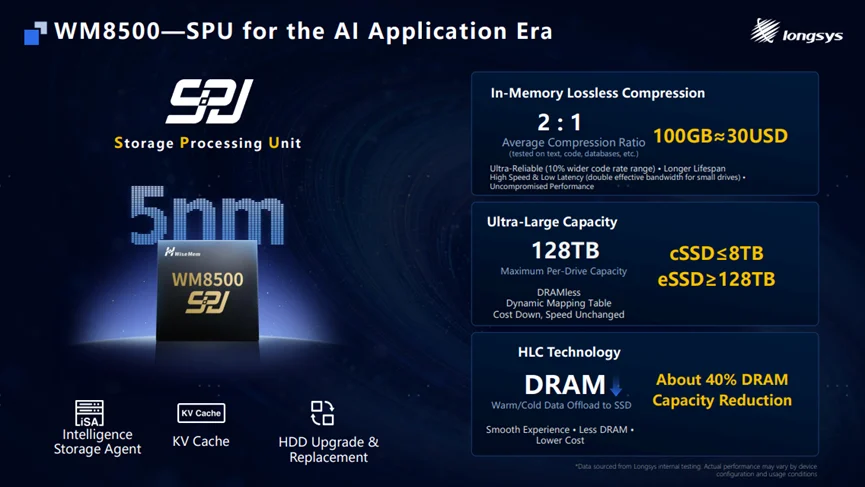
In an era where the insatiable appetite of Artificial Intelligence (AI) models is pushing data center infrastructure to its physical and financial limits, the storage industry faces a reckoning. The rising cost of NAND flash and DRAM has created a bottleneck for enterprises looking to scale their AI workloads. Enter Longsys, the world’s second-largest independent memory firm and the parent company of the ubiquitous consumer brand Lexar and the industrial powerhouse FORESEE.
Longsys has unveiled a disruptive solution: the WM8500, a 5nm Storage Processing Unit (SPU) engineered to handle on-the-fly data compression. By offloading compute-intensive compression tasks from the host processor to the storage device itself, Longsys is offering a path toward doubling effective storage capacity, potentially changing the economics of high-performance computing (HPC) and edge AI deployment.
The Genesis of the SPU: A New Paradigm in Data Management
To understand the significance of the WM8500, one must first recognize the fundamental shift it represents in architecture. Historically, SSDs have served as passive storage vessels. Even modern "SmartSSDs," such as those developed by industry giants like Samsung, typically utilize general-purpose FPGAs (Field Programmable Gate Arrays) or ARM-based CPUs to manage computational tasks. While powerful, these approaches introduce complexity and cost, often requiring significant DRAM overhead to manage the data flow.
The Longsys WM8500 moves away from this general-purpose design in favor of a specialized ASIC (Application-Specific Integrated Circuit). Because the chip is hard-wired specifically for storage management and data compression, it achieves higher efficiency than a flexible but power-hungry CPU. By performing "on-the-fly" compression, the WM8500 can effectively treat a physical storage volume as having double its rated capacity, provided the data is compressible.
A Chronology of Storage Innovation
The journey to the WM8500 did not happen in a vacuum. Over the past decade, the storage industry has been forced to innovate to keep pace with Moore’s Law in reverse—where the cost of storage capacity has struggled to drop as quickly as data generation has exploded.
- 2015–2018: The Rise of NVMe: The transition from SATA to NVMe protocols allowed storage to finally catch up to the processing speeds of modern CPUs.
- 2019–2021: The Emergence of Computational Storage: Industry research groups began exploring the idea of "moving compute to data," resulting in early prototypes of SmartSSDs.
- 2022–2024: The AI Boom: With the explosion of Large Language Models (LLMs), the demand for high-speed, massive-scale storage skyrocketed. Datacenters began struggling with the power and latency overhead of moving petabytes of data between storage and memory.
- 2025: The Longsys Breakthrough: Longsys debuts the WM8500 at the edge of the 5nm process node, specifically targeting the efficiency gap that previous, less-integrated solutions could not bridge.
Technical Architecture: Under the Hood of the WM8500
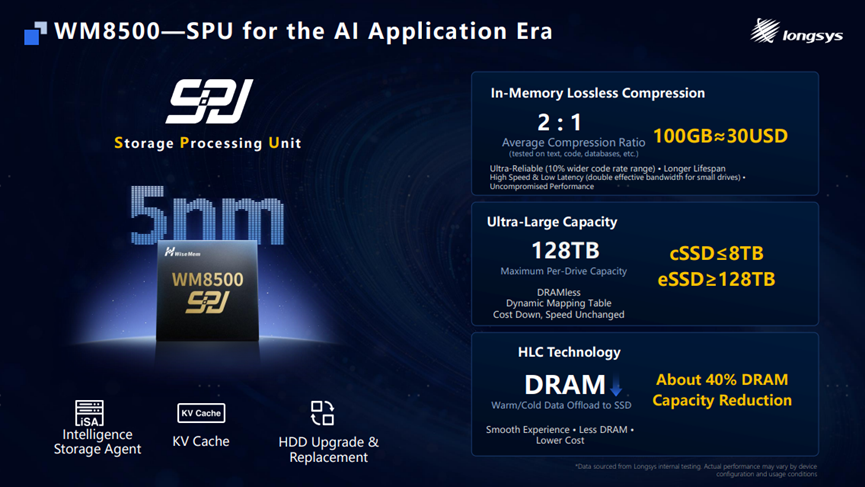
The Longsys WM8500 is more than just a compression chip; it is part of a "closed-loop software-hardware collaborative technology system." The architecture relies on three primary pillars that work in tandem to optimize the storage lifecycle.
1. The 5nm SPU ASIC
By utilizing a 5nm manufacturing process, the WM8500 benefits from extreme power efficiency and high transistor density. This allows the unit to perform complex mathematical algorithms for data compression without generating the excessive heat or power consumption typically associated with computational storage.
2. High-Level Cache (HLC) Implementation
One of the most persistent costs in enterprise storage is the requirement for onboard DRAM to map data locations. The WM8500’s HLC implementation claims a 40% reduction in DRAM requirements. This is a crucial "cost-killer," as it lowers the bill of materials (BOM) for the SSD, allowing manufacturers to offer higher-density drives at a more aggressive price point.
3. Intelligence Storage Agent (iSA)
The iSA is the software layer that ensures the hardware knows exactly what to prioritize. It acts as an intelligent traffic controller, determining which data should be compressed and which should remain in its raw state for immediate access. This collaborative approach allows the system to be "AI-aware," optimizing for the specific data structures found in training sets and inference models.
Supporting Data and Performance Metrics
While the headline figure of "doubling storage capacity" is the most eye-catching, it is critical to contextualize this metric. Longsys clarifies that 2:1 is an "up-to" ratio. The actual compression efficiency is heavily dependent on the data entropy.
- Compression Ratios: While tape drives have historically achieved 2.5:1 compression, they suffer from catastrophic latency. The WM8500 aims for a sweet spot—offering significant density gains while maintaining the low-latency profile of NAND flash.
- DRAM Reduction: The 40% reduction in DRAM requirements represents a massive shift for enterprise-grade SSDs, which typically require large amounts of high-speed memory for table mapping.
- Capacity Targets: While current hardware supports a base 128GB capacity (expandable via compression), the roadmap is focused on scaling this technology to enterprise-class drives that currently hover in the 32TB to 64TB range, paving the way for the 256TB drives anticipated later this year.
Implications for the Industry
The introduction of the WM8500 is likely to send shockwaves through the enterprise storage market, particularly for data centers struggling to manage the "data deluge" brought on by AI.
Lowering the TCO (Total Cost of Ownership)
For hyperscalers and AI firms, the cost of storage is not just the price of the drive; it is the cost of the rack space, the power consumption, and the cooling. By effectively doubling the capacity of a single drive, companies can theoretically reduce their physical footprint by 50%. In the dense environment of a modern data center, this translates to massive savings in operational expenses.
Bridging the Gap for Edge AI
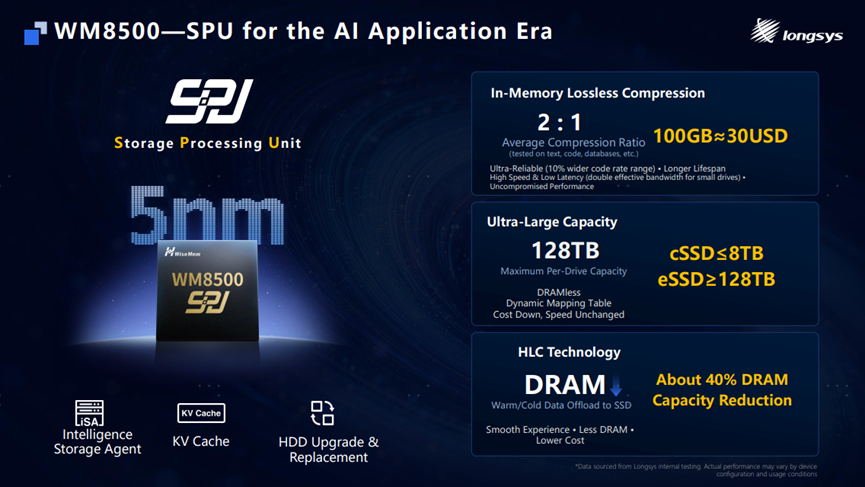
Perhaps the most exciting application for the WM8500 is in Edge AI. As AI models move from massive cloud servers to localized devices, the hardware must become more efficient. A 5nm, DRAM-less design that maximizes capacity is the "holy grail" for edge devices that lack the physical space for massive storage arrays but require the data density to run complex local AI models.
Competition and Market Positioning
Longsys is entering a space occupied by giants. With competitors like SanDisk, Micron, and Samsung pushing for massive 256TB enterprise SSDs using QLC (Quad-Level Cell) NAND technology, the race is on. However, where those competitors focus on "raw" density—packing more bits into the flash itself—Longsys is focusing on "effective" density through intelligent, hardware-accelerated processing. This differentiates them as a provider of "smart" infrastructure rather than just "bulk" storage.
Official Stance and Future Outlook
Longsys has positioned the WM8500 not as a replacement for traditional SSDs, but as an evolution of the storage controller. By integrating the SPU, iSA, and HLC into a cohesive package, the company is betting that the future of storage is not just about raw capacity, but about the intelligence of the storage controller itself.
"The AI revolution demands a rethink of the entire memory stack," noted a Longsys representative during the product’s unveiling. By focusing on the integration of hardware and software, Longsys is clearly aiming to be a foundational partner for the next generation of AI infrastructure.
As we look toward the remainder of 2025 and into 2026, the industry will be watching closely to see if the WM8500 can maintain its performance claims in real-world, high-entropy scenarios. If it succeeds, it may well force the entire storage industry to adopt similar "intelligent controller" architectures, fundamentally changing how we store, compress, and retrieve the world’s data.
In summary, the WM8500 represents a sophisticated attempt to solve the storage crisis from the inside out. By prioritizing efficiency and density at the hardware level, Longsys is providing a much-needed bridge between the current limitations of NAND flash and the explosive requirements of the AI-driven future.


 Layla Zulfa
 Nana Muazin