

In the crowded landscape of prestige television, where the "Golden Age" of mob dramas has set an almost impossibly high bar, MGM+ has entered the fray with The Westies. Created by the seasoned duo of Chris Brancato and Michael Panes—the architects behind the sleek, stylized Godfather of Harlem—the new series attempts to capture the grit, moral decay, and cutthroat ambition of 1980s New York.
On a narrative level, the series centers on the collision between the Irish-American Westies, a notorious outfit operating out of Hell’s Kitchen, and the Gambino crime family. Yet, for all its posturing about rule-breakers and lawless men, the show itself is a remarkably cautious affair. It is a production that colors strictly within the lines of genre convention, offering a viewing experience that is, in the final analysis, too competent to be dismissed as trash, but far too unimaginative to be considered art.
The Core Conflict: A Fragile Truce in Hell’s Kitchen
The series, which premieres on MGM+ this Sunday, July 12, is directed by Alan Taylor, whose pedigree in high-stakes drama is undeniable. He wastes no time establishing the tension. The setting is a mid-1980s New York where the lines between law enforcement and criminal enterprise are perpetually blurred by the neon glare of a city in flux.
The plot hinges on an uneasy peace between Eamon Sweeney (J.K. Simmons), the hardened leader of the Westies, and Paul Castellano (Ron Lea), the patriarch of the Gambino family. This isn’t a truce born of moral awakening or shared heritage; it is a cold, calculated business decision. With the construction of the Javits Center looming as a massive financial windfall, both organizations have realized that their traditional turf wars are becoming a drain on their bottom lines.
However, peace in the mob is rarely a static condition. As the bosses attempt to pivot toward corporate-style exploitation, their underlings remain tethered to the old ways of violence and impulsive territorialism. This disconnect creates the show’s primary engine of conflict: a cycle of insubordination, accidental escalations, and the brutal internal policing required to keep the rank-and-file in check.
Character Dynamics and the Performance Gap
Despite a narrative that often feels like a checklist of mob-movie tropes, the series benefits from a cast that is significantly better than the material provided. J.K. Simmons, playing Eamon Sweeney, does much of the heavy lifting. He approaches the role with a world-weary cynicism that breathes a flicker of life into a character who might otherwise be a caricature of the "old school" gangster.
Titus Welliver, portraying the morally compromised NYPD officer Glenn Keenan, brings a gravitas that suggests a deeper, more tortured history than the script actually manages to deliver. Welliver moves through the grimy streets of the city with a heaviness that conveys profound private pain, though the series ultimately fails to capitalize on this potential. As the plot unfolds, the revelation of his backstory feels less like a narrative payoff and more like an obligation to the genre’s demand for "damaged" protagonists.
The younger generation of the cast, led by Tom Brittney as the disillusioned Jimmy Roarke and Hamish Allan-Headley as an iteration of John Gotti, struggle under the weight of one-dimensional writing. Brittney’s Jimmy is positioned as the show’s moral anchor—the "smart" and "kind" gangster—a juxtaposition that feels forced rather than organic. His relationship with his girlfriend, Bridget (Sarah Bolger), is presented as a sanctuary, yet it lacks the specific, idiosyncratic textures that make television romances feel real.
Production Design: A Lived-in Facade
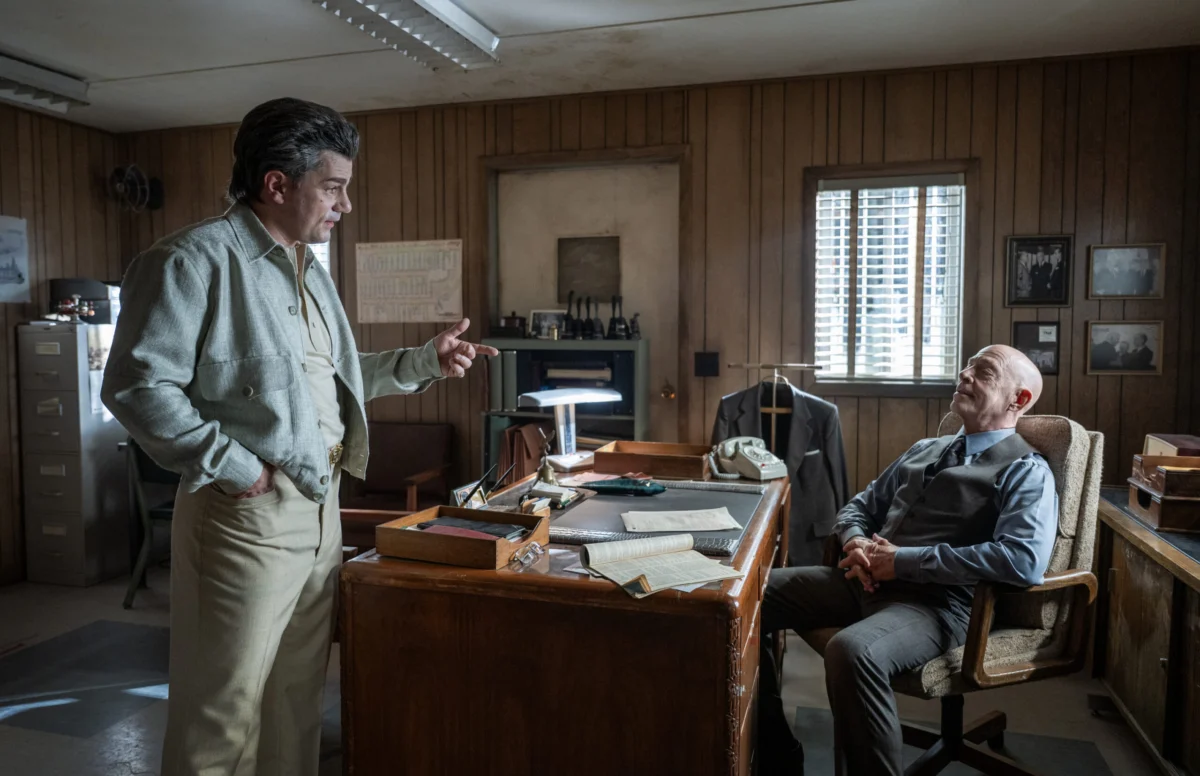
If The Westies succeeds in any singular category, it is in its world-building. Production designer Rocco Mateo has done an admirable job of rendering 1980s New York with a tactile, grimy authenticity. From the cramped, dimly lit apartments that smell of stale cigarettes to the bars that seem to hold the ghosts of decades of violence, the setting is arguably the most "honest" character in the show.
The aesthetic is one of gritty, lived-in realism. The streets feel dangerous, the offices of the bosses feel oppressive, and the visual language of the show is consistent and moody. It is an environment that suggests a deep, complex history—a stark contrast to the characters who inhabit it, who often feel like they were plucked from a template rather than born of this specific time and place.
Structural Analysis: Pacing vs. Substance
Brancato and Panes are experts at maintaining a steady rhythm. The premiere episode, and the subsequent hours of the season, move with a deliberate, even-handed pace. There is little fat on the bone here; the narrative beats follow a logical, if entirely predictable, sequence. For the casual viewer looking for a show to watch while multitasking, this structure is a strength. There is never a moment where the plot becomes impenetrable or the stakes become unclear.
However, for the attentive viewer, this efficiency reveals the show’s metatextual void. Because the plot is so focused on the mechanics of the "mob drama"—the secret meetings, the double-crosses, the impending FBI sting—it leaves no room for thematic exploration. There is no interrogation of the American Dream, no subtle deconstruction of the cycle of revenge, and no attempt to elevate the material beyond its surface-level appeal. It is a show that thinks it is "neat" when men point guns at one another, and it stops its philosophical inquiry there.
Implications: The Problem of the "Generic" Prestige Drama
The release of The Westies raises a broader question about the current state of the crime genre in the streaming era. We have seen the peak of the genre in works like The Sopranos, The Wire, and Goodfellas. These works offered more than just body counts; they provided a lens through which to view the decline of institutions, the erosion of the middle class, and the absurdity of the criminal life.
The Westies opts to retrace the steps of its predecessors without adding a new dimension. By relying on established archetypes—the hotheaded low-level thug (Mickey), the cold-blooded Italian mobster (Gotti), and the reluctant hero (Jimmy)—the show fails to create an identity of its own. It is a series of "greatest hits" moments: the scene where the gangster laughs off a threat, the scene where the cop realizes he’s in too deep, the scene where the secret lover hides a dark past.
These moments are not inherently bad, but when they are aggregated without a unique authorial voice, they feel like a copy of a copy. The inclusion of Bridget’s IRA subplot, for instance, offers a glimpse of something different—a hint of international intrigue and political complexity—but the writers treat it as an isolated curiosity, failing to weave it into the broader tapestry of the series.
Official Stance and Reception
MGM+ has high hopes for the series as it seeks to solidify its position in the competitive original-programming market. The platform is betting on the "prestige crime" formula, which has proven reliable for attracting audiences who appreciate high production values and familiar star power.
In terms of critical reception, The Westies is likely to be viewed as a "gateway" drama. It is too polished to be dismissed, and it features performances from Simmons and Welliver that demand at least a cursory look. However, the lack of narrative risk-taking will likely prevent it from entering the pantheon of must-watch television. It is a show for the middle-ground viewer—a series that satisfies the craving for a crime drama without ever challenging the audience to think, feel, or engage on a deeper level.
Conclusion: A Lost Opportunity
The irony of The Westies is that it tells a story about characters who refuse to follow the rules, while the production itself seems terrified of breaking any of its own. It is a show that operates with the precision of a clock but the soul of a machine.
While the production design is top-tier and the acting is capable, the show ultimately serves as a reminder that grit is not a substitute for depth. To tell a compelling story about the criminal underworld, a series must do more than recreate the aesthetic of the 1980s; it must find a reason for that story to exist in the present. As it stands, The Westies is a slick, well-produced, and entirely forgettable exercise in genre maintenance. It is, in the simplest terms, too slick to hate, but too dull to love.










