Nana Wu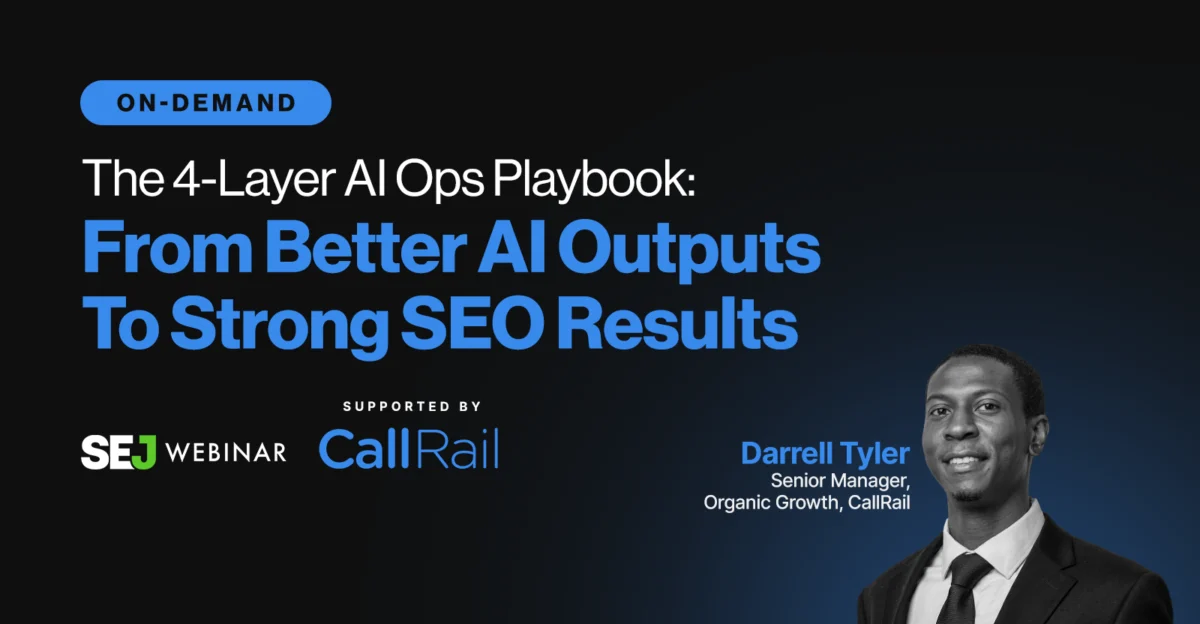
The digital landscape has undergone a seismic shift. In the span of just a few years, generative AI has moved from a novelty to a fundamental pillar of search engine optimization (SEO). Yet, beneath the veneer of increased publishing velocity lies a troubling reality: while nearly every SEO team has adopted AI, almost none have established the operational infrastructure required to sustain it.
In a recent Search Engine Journal (SEJ) webinar, Darrell Tyler, Senior Manager of Organic Growth at CallRail, laid bare a startling industry statistic. Through his extensive engagement with peers across the sector, Tyler found that while approximately 85% of SEO professionals are actively utilizing AI to generate content, a staggering 88% lack any documented system or formal governance to oversee that output. This disconnect—the gap between adoption and architecture—is the primary reason many brands are failing to see meaningful ROI from their AI initiatives.
The Illusion of Efficiency: When AI Becomes a Liability
The current state of SEO content production is characterized by what Tyler describes as "blank slate AI." Because most teams operate without a proprietary foundation, they are essentially asking Large Language Models (LLMs) to write from a void. When an SEO specialist prompts an AI to write about "the benefits of call tracking" without providing specific brand context, the AI pulls from the same general internet data as every competitor.
The result is a homogenization of search results. When your AI-generated content is indistinguishable from your competitor’s, you lose your competitive edge. "If your AI use is identical to your competitor’s AI use, you don’t actually have a strategy or an advantage," Tyler noted. "You just have a subscription."
Beyond the lack of differentiation, this unmanaged adoption leads to "invisible quality atrophy" and "optimization drift." When teams scale content production to hundreds of articles without a unified system, consistency evaporates. Early pieces may perform well, but by the time the team hits their 50th or 100th article, quality often dips as the system begins to optimize for speed and token economy rather than business impact. The result is a library of hundreds of brand-misaligned pages that consume valuable resources to edit and fix, ultimately undermining the very traffic they were intended to capture.
The Four-Layer Framework: Moving from Technician to Architect
To combat the degradation of quality, Tyler proposes a transition from ad-hoc prompting to a structured "AI Ops" framework. This approach treats AI not as a standalone writer, but as a system component that must be integrated into a larger organizational workflow. He breaks this down into four critical layers:
1. The Knowledge Layer (The Source of Truth)
This is the most critical component. It serves as the AI’s repository for brand-specific intelligence. This includes style guidelines, product ontologies, competitive intelligence, and—most importantly—first-party data. By feeding the AI customer stories, call transcripts, and internal reviews, brands move the model away from generic internet generalizations and toward proprietary, expert-level insights.
2. The Workflow Layer
This layer transforms individual capability into an organizational standard. It involves the creation of SOPs, centralized prompt libraries treated like production code, and rigid content templates. By standardizing the "how," teams ensure that every team member produces output that meets the same baseline criteria.
3. The Governance Layer
This is the human-centric component of the framework. It encompasses quality assurance (QA) frameworks, review checkpoints, and continuous feedback loops. As trust in the AI’s output increases, the necessity for heavy-handed oversight may shift, but the mechanism for checking against brand alignment must remain constant.
4. The Application Layer
Interestingly, Tyler ranks the actual LLMs and tools as the least important factor. Models are engines—they are replaceable and will inevitably evolve. By keeping the knowledge and workflow layers independent of any single platform, teams remain "LLM-agnostic." When a more powerful model is released, the team can swap the engine without needing to re-engineer their entire operation.
The Shift in Measurement: Beyond Volume to Outcomes
The most profound implication of this framework is the shift in how SEO teams must define success. Historically, content volume was a proxy for growth. In the age of AI, this is a vanity metric. If a competitor can purchase the same AI subscription, they can replicate your volume, but they cannot replicate the years of iteration and the proprietary knowledge layer you have built.
"The role of the SEO professional is changing," Tyler explains. "We are moving away from drafting from scratch and manual lookup, and toward strategy, system architecture, and knowledge management."
Moving forward, the ROI of SEO must be measured by efficiency, user engagement, and conversion revenue. If the content is not driving business outcomes, the volume of pages produced is irrelevant.
Addressing the Common Pitfalls: A Q&A Summary
During the webinar, Tyler addressed the most pressing questions from practitioners currently struggling to scale their AI efforts.
Q: Is feeding AI my existing website links enough to build a knowledge layer?
Tyler emphasized that this is merely a starting point. Your website content is already public; it is the "insider" context—the brand manifesto, the specific audience pain points, and the nuanced positioning—that creates true differentiation. You must go deeper than what is already indexed by search engines.
Q: How do I handle the fact that a prompt works on ChatGPT but fails on Claude?
Tyler argued that the prompt is only half the battle. If you provide the AI with a deep, robust knowledge layer, the variance between models becomes less significant. The "context" acts as the anchor for the output, ensuring that the result remains balanced regardless of the engine used.
Q: How can I tell if my AI content is actively hurting my site?
Beyond Search Console data, Tyler suggests looking at Google Analytics 4 (GA4). Engagement metrics, such as average engagement time and views per user, offer a window into how readers actually interact with the content. A simple, effective litmus test: have someone outside your organization read the piece. If they struggle to follow the narrative or find it generic, the content is likely not strong enough to compete.
The Bottom Line: Audit Before You Scale
The era of "set it and forget it" AI content is over. To survive in an increasingly crowded search environment, organizations must treat AI integration with the same rigor as any other mission-critical business software.
The first step for any team—before publishing another article—is an honest audit of their maturity level. By mapping out where your team currently stands in relation to the knowledge, workflow, governance, and application layers, you can identify the gaps that are currently suppressing your growth. As Tyler noted, the goal is not to produce more content, but to build a system that ensures every piece of content you produce is a genuine asset to your brand.
For those looking to transition from reactive content creation to proactive system architecture, the path is clear: document your context, define your governance, and stop treating AI like a magic button. It is a tool, and like any tool, it is only as effective as the hands that guide it.


 Ammar Sabilarrohman
 Rifan Muazin