Nana
Nana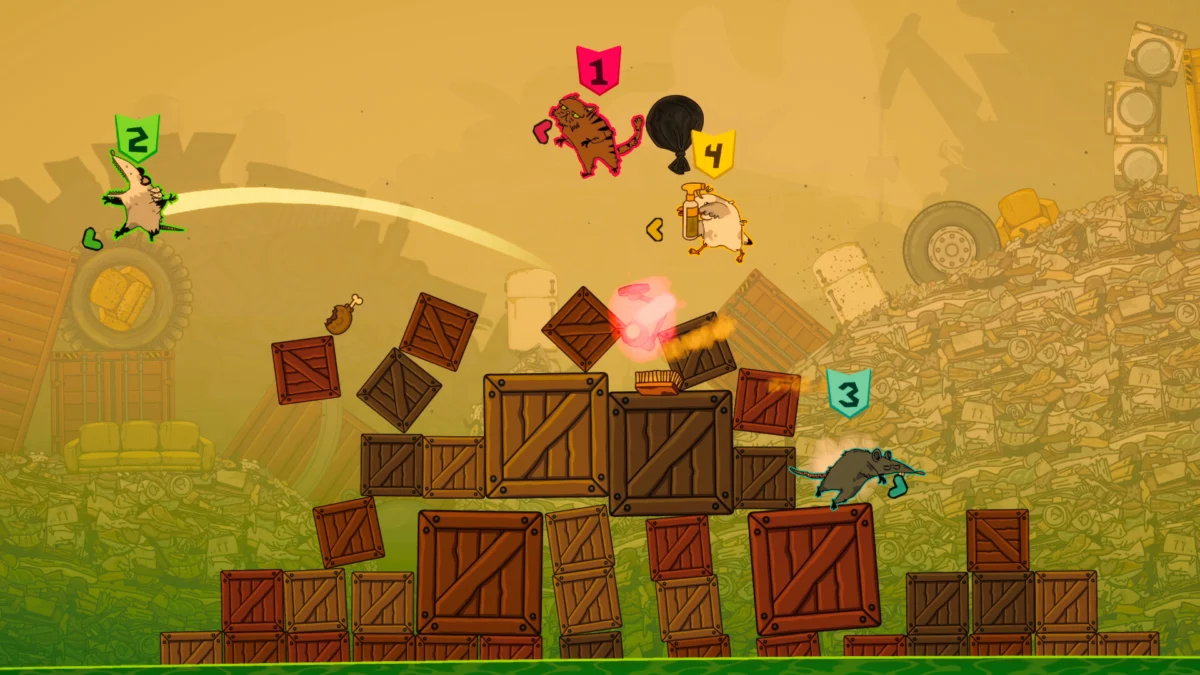
In the ever-evolving landscape of party games, where titles often struggle to balance accessibility with depth, Royal Vermin emerges as a refreshing, albeit chaotic, entry. It is a title that eschews the traditional, precision-heavy mechanics of modern fighters in favor of slapstick physics and environmental volatility. By blending the strategic artillery focus of Worms with the high-octane platforming of Super Smash Bros. and the unpredictable "jank" of physics-based sandboxes, Royal Vermin carves out a niche that prioritizes laughter over technical perfection.
The Genesis of Chaos: Understanding the Core Gameplay
At its heart, Royal Vermin is a game about survival in an environment that is actively trying to kill you. Players control an array of goofy, anthropomorphic critters thrust into crumbling, multi-layered arenas. The objective is simple: be the last creature standing. However, the path to victory is rarely linear.
The controls are intentionally streamlined. By stripping away complex command inputs and lengthy combos, the developers have lowered the barrier to entry significantly. This design philosophy ensures that a player who has never touched a controller can join a session and immediately understand the core loop: move, jump, and interact with the environment. Yet, this simplicity is deceptive. The game’s true complexity lies in the physics engine. Every movement, collision, and projectile throw carries weight, often leading to hilarious, unintended outcomes.
Chronology: From Concept to Couch Co-op Staple
The development trajectory of Royal Vermin reflects a growing trend in indie game design: the shift toward "social-first" gaming.
- Initial Concept Phase: The developers sought to capture the "watercooler moment" dynamic found in retro party games, focusing on procedural stage destruction rather than scripted events.
- Beta Testing and Refinement: Throughout the testing phase, the team realized that the game’s primary strength wasn’t its combat, but its capacity for emergent storytelling—those moments where a player accidentally drops a chandelier on their own teammate, causing a chain reaction that clears the board.
- Launch and Community Reception: Since its release, the game has been embraced by local multiplayer communities. While it has not yet reached the cultural ubiquity of genre titans like Mario Party or Overcooked, it has solidified its position as a reliable "filler" game for groups seeking quick, high-energy entertainment.
Supporting Data: Why "Wonky" Works
When analyzing the success of Royal Vermin, one must look at the psychological appeal of "failure." In most competitive games, losing is a source of frustration. In Royal Vermin, losing is part of the performance.
Data from playtesting sessions suggests that engagement levels remain high even after a player is eliminated. This is largely due to the "Spectator Interaction" mechanic. Even when out of the round, players can often trigger minor environmental shifts or hazards, ensuring that the "dead" players remain active participants in the chaos. This design choice prevents the "spectator slump" common in elimination-style games, keeping the social energy of the room elevated from the first second of the match to the last.
Furthermore, the game’s adjustable difficulty settings serve as a crucial data point for accessibility. By allowing players to modify the speed of environmental collapse or the frequency of stage hazards, the game creates a "level playing field" that permits mixed-skill groups—such as parents playing with children or veterans playing with newcomers—to enjoy a competitive session without one party dominating the other through pure mechanical skill.

Official Perspectives: Design Philosophy and Intent
The developers of Royal Vermin have been vocal about their intention to avoid the "esports trap." In various interviews and blog posts, the team has emphasized that the game was never designed to be balanced in a competitive, tournament-grade sense.
"We wanted to make something that prioritized the story of the match over the statistics of the match," a representative noted during a recent roundtable discussion. "If the game is perfectly balanced, it becomes predictable. If it’s unpredictable, it becomes a memory you share with your friends."
This stance serves as a defense against common criticisms regarding the game’s reliance on luck. While some players have pointed out that a well-placed throw can be negated by a random floor collapse, the development team views this as a feature, not a bug. They argue that the randomness forces players to adapt constantly, preventing "stale" strategies from dominating the game meta.
Implications for the Party Game Genre
The release of Royal Vermin provides several implications for the future of the party game genre:
1. The Death of the "Deep Solo" Expectation
Royal Vermin serves as a stark reminder that not every game needs to be a 100-hour odyssey. By explicitly focusing on local multiplayer, the game avoids the bloated content cycles that plague modern AAA titles. It suggests a future where smaller, "experience-focused" games can thrive by leaning into their limitations rather than trying to be everything to everyone.
2. Accessibility as a Design Pillar
The game proves that simplicity is a form of sophistication. By reducing the reliance on "twitch reflexes," Royal Vermin opens its doors to a broader demographic. This has implications for future developers who wish to capture the casual market, suggesting that the most successful games are those that can be explained in thirty seconds or less.
3. The Visual Language of Fun
The game’s aesthetic—a vibrant, high-contrast, cartoon-inspired art style—is more than just a stylistic choice; it is functional. In a game with multiple moving parts, projectiles, and crumbling platforms, the clear visual cues are essential for maintaining spatial awareness. The expressive, exaggerated animations of the characters provide immediate feedback, allowing players to feel the "impact" of their actions even when the physics are intentionally loose.

Critical Analysis: Where the Game Falls Short
Despite its charm, Royal Vermin is not without its flaws. The lack of robust online matchmaking is a significant barrier for players who do not have a dedicated group of friends for local co-op. In an era where digital connectivity is the standard, the omission of a deep, stable online infrastructure limits the game’s long-term sustainability.
Additionally, the reliance on RNG (random number generation) and physics-based chaos will undoubtedly alienate those who prefer games of skill. There are moments where the game feels less like a battle of wits and more like a gamble. For those seeking a competitive, skill-based brawler, Royal Vermin will likely prove frustrating rather than fun. It is, by its own admission, a "silly" game, and those looking for the rigor of a competitive title would be better served elsewhere.
Final Assessment: Should You Buy In?
Royal Vermin occupies a specific space in the gaming ecosystem. It is not a title that will displace the industry giants, nor is it a game that will be remembered for its technical innovation. However, it succeeds in its primary mandate: it is a conduit for joy.
If your game library is filled with titles that require intense focus and dedication, Royal Vermin offers a necessary palate cleanser. It is the digital equivalent of a board game night—meant to be played, laughed at, and left on the shelf until the next gathering.
For the group of friends who want to engage in some low-stakes, high-chaos competition, Royal Vermin is an essential addition to the rotation. It reminds us that in the world of video games, sometimes the most satisfying victory isn’t the one you earned through perfect execution, but the one you achieved through sheer, chaotic luck.
As the genre continues to shift, games like Royal Vermin remind us that the heart of gaming remains, as it has always been, the shared experience of play. Whether you are a seasoned gamer or a casual participant, the crumbling, cartoonish arenas of Royal Vermin offer a welcome distraction from the serious, often grind-heavy nature of the contemporary gaming landscape. It is, quite simply, a delight.


 Sagoh
Sagoh
 Ammar Sabilarrohman