Ali Ikhwan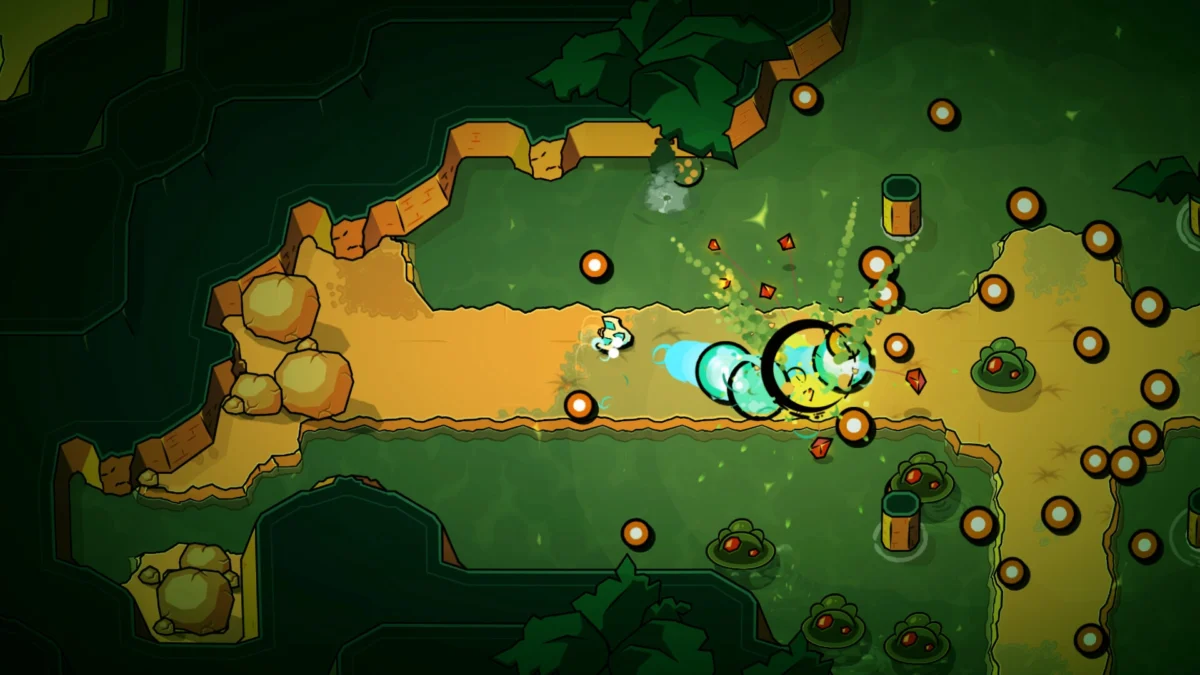
On paper, the premise of Minishoot’ Adventures sounds like a fever dream born from a late-night debate about gaming’s greatest classics. Take the non-linear, exploration-heavy DNA of early Legend of Zelda titles and graft it onto the high-octane, precision-based mechanics of a modern twin-stick shooter. It is a concept that risks feeling like a disjointed experiment; instead, it emerges as one of the most cohesive and delightful indie experiences of the year.
Minishoot’ Adventures is more than just a stylistic mash-up. It is a testament to the power of tight design, where every movement feels intentional and every upgrade serves a distinct purpose. It captures the sense of wonder associated with classic adventure games while maintaining the relentless, adrenaline-fueled pacing of a bullet-hell shooter.
The Core Concept: A World of Sentient Flight
The narrative foundation of Minishoot’ Adventures is deliberately understated. Players assume control of a tiny, courageous ship in a world populated by sentient aircraft living in harmony. This peace is shattered when a mysterious force descends upon their lands, trapping the protagonist’s allies within crystalline prisons.
Rather than relying on verbose exposition or dense lore dumps that interrupt the flow of gameplay, the developers prioritize environmental storytelling. The warmth of the world is conveyed through meticulous animation and distinct regional aesthetics. Each area of the map feels lived-in, and the progression of the story is tied intimately to the player’s ability to liberate their kin and restore balance to the skies. It is a refreshing approach that respects the player’s intelligence, allowing the game’s personality to shine through its vibrant color palette and rhythmic, atmospheric electronic soundtrack.
Chronology of Gameplay Evolution
The brilliance of Minishoot’ Adventures lies in its expertly paced learning curve. The journey begins with simplicity, offering a gentle introduction to the controls that allows players to acclimate to the physics of flight.
The Early Game: Finding Your Wings
In the initial stages, the player is equipped with a modest peashooter. Movement is silky, responsive, and immediately satisfying. The dual-stick control scheme—left stick for navigation, right for omnidirectional firing—becomes second nature within minutes. At this point, the game focuses on teaching the player how to weave through simple patterns and master the art of mobility.

The Mid-Game: The Metroidvania Hook
As the player progresses, the game shifts from a linear shooter to an expansive Metroidvania-style experience. The map unfolds, revealing interconnected biomes. Crucially, the acquisition of new abilities—such as the power to dash over water or shatter previously impenetrable barriers—transforms the world. This "gated progression" is handled with grace; players never feel explicitly blocked, but rather invited to return to previously inaccessible areas once they possess the correct tools.
The Late Game: Becoming the Bullet Hell
By the endgame, the transformation is complete. The once-humble ship evolves into a formidable powerhouse. With upgrades to fire rate, damage, and projectile speed, the player no longer just survives the chaos; they dictate it. Boss encounters, which once felt daunting, become exhilarating dances where the player weaves through complex, screen-filling bullet patterns with practiced ease.
Supporting Data: Mechanics and Progression
The depth of Minishoot’ Adventures is hidden within its systems. While the combat is the primary hook, the exploration mechanics provide the structural integrity that keeps the game from feeling like a repetitive arcade title.
- Exploration Density: The world is riddled with secrets. From hidden caverns to tucked-away heart pieces and map fragments, the game incentivizes thoroughness. Completionists will find the map to be a playground of discovery, where every corner holds a potential upgrade or a challenging optional boss.
- The Upgrade Economy: The leveling system allows players to customize their ship’s performance. While some early upgrades may feel incremental, they collectively contribute to a significant power spike by the mid-game. This creates a rewarding feedback loop where the player feels the direct impact of their investment in stats.
- Boss Encounter Design: The game’s bosses are a masterclass in "readable difficulty." Despite the intensity of the bullet patterns, the encounters remain fair. The inclusion of short respawn timers ensures that failure is a learning opportunity rather than a source of frustration, keeping the player engaged and moving forward.
Professional Analysis: The Synthesis of Two Worlds
The success of Minishoot’ Adventures lies in its ability to solve the fundamental tension between its two core inspirations. Adventure games are typically methodical and contemplative, whereas twin-stick shooters are reactive and frantic.
By grounding the shooter mechanics in a persistent, physical world, the developers have created a sense of place that is often missing from pure bullet-hell games. Conversely, by infusing the adventure structure with shooter mechanics, they have removed the tedious "backtracking" that often plagues Metroidvanias, as the player’s movement speed and combat capability make traversing even the most complex environments a thrill.
The Verdict: A Polished Gem
With a score of 8.5/10, Minishoot’ Adventures is categorized as a "Must-Play" for fans of either genre. Its presentation is clean, ensuring that even in the most chaotic combat scenarios, the player never loses track of their ship or incoming hazards. The art style is inviting, balancing a "cozy" aesthetic with a sharp, high-fidelity look that pops on any screen.

Implications for the Indie Landscape
The release of Minishoot’ Adventures signals a growing trend in the indie scene: the pursuit of "Genre-Fusion Precision." For years, developers have attempted to blend genres, but often fall into the trap of doing two things poorly rather than one thing well. Minishoot’ Adventures defies this trend by ensuring that the foundational mechanics of both the shooter and the adventure game are polished to a mirror shine.
The implications for future developers are clear: players are hungry for titles that respect their time while providing a unique mechanical hook. The game’s success proves that if you can combine two disparate genres with enough care, the result isn’t just a gimmick—it’s a new standard.
Potential Areas for Growth
Despite its excellence, the game is not without minor imperfections. Some players have reported instances of becoming disoriented in larger cave systems, suggesting that for future updates or sequels, a more robust map-pinning or guidance system could enhance accessibility. Additionally, while the early-game power curve is steady, some players might find the initial upgrades slightly underwhelming compared to the explosive power-ups found in the final acts.
Conclusion: Who Should Play This?
Minishoot’ Adventures is an essential title for a wide demographic of gamers. It is the perfect bridge for:
- Zelda Fans: Those who love the dopamine hit of unlocking a new ability and discovering a hidden chamber will feel right at home.
- Shooter Enthusiasts: Players who crave the precision and high-speed tension of Ikaruga or Geometry Wars will appreciate the combat depth.
- Indie Connoisseurs: Anyone who values a game that is "packed with heart" and free of the bloat often found in AAA titles.
In an era where games are becoming increasingly bloated and service-oriented, Minishoot’ Adventures stands as a reminder of the joy of a focused, well-crafted, and complete experience. It doesn’t overstay its welcome, it doesn’t insult the player’s intelligence, and most importantly, it is endlessly fun. Whether you are a casual player looking for a relaxing world to explore or a hardcore gamer hunting for the next challenge, Minishoot’ Adventures is a journey worth taking.


 Sagoh
Sagoh
 Ammar Sabilarrohman