

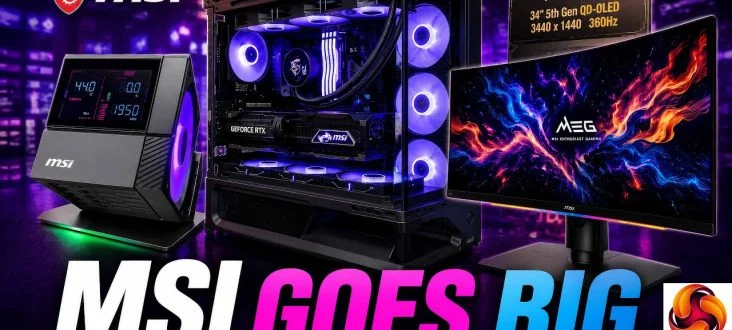
The atmosphere at Computex 2026 was electric, with the MSI booth standing as a testament to the brand’s aggressive expansion across the entire PC ecosystem. From core DIY components and server-grade storage to high-end peripherals and cutting-edge networking, MSI has positioned itself not just as a manufacturer, but as an architect of the modern computing experience.
The following report breaks down the massive influx of hardware announcements, detailing how MSI is leveraging new technologies to redefine performance and reliability for both enthusiasts and enterprise users.
I. Core DIY Components: The Motherboard Powerhouse
MSI’s motherboard lineup at Computex was defined by its commitment to extreme performance and aesthetic flexibility. The highlight was undoubtedly the MEG X870E Unify-X Max, a board designed for the uncompromising overclocker. Equipped with a proprietary OC Engine and an 18-phase power design, the board is engineered to squeeze every ounce of potential from the latest AM5 processors.
The MEG Z890 Godlike continued its award-winning streak, garnering praise for its build quality and feature density. For the mid-to-high-end segment, MSI introduced the MPG B850 Carbon Max WiFi, which bridges the gap between mainstream and enthusiast by integrating PCIe 5.0 for both GPUs and M.2 drives, Wi-Fi 7, and 5G LAN.
On the micro-ATX front, the MAG B850M Mortar Max WiFi W stands out with its clean, all-white aesthetic. Beyond looks, MSI demonstrated the board’s capability to handle AMD’s latest EXPO ultra-low-latency memory profiles in tandem with Kingston Fury DDR5 RAM, signaling a renewed focus on memory stability and speed.
II. Cooling Solutions: From Aesthetics to Advanced Thermal Management
Cooling was a primary focus for MSI this year, with a clear segmentation between liquid and air-based systems.
Liquid Cooling Innovations
The MEG Coreliquid E15 360 leads the liquid cooling category, featuring a massive 6.67-inch 2K AMOLED display and proprietary Laminar Focus fan technology. For those who prefer a balance of performance and subtlety, the MPG Coreliquid P22 360 offers a 2.1-inch display and the user-friendly UNI Bracket mounting system.
MSI also introduced the "Fabric" series—the MAG Coreliquid A23 360 W (featuring a hidden digital display) and the MAG CoreLiquid A13 360 Fabric (a display-less, performance-focused variant). Both units utilize a textured pump cover design that marks a shift toward more sophisticated, furniture-like aesthetics in gaming builds.
Air Cooling and GPU Protection
For air-cooling enthusiasts, the MPG CoreFrozr AP15 introduces a dual-heatsink design crowned with a "DIGI-DISPLAY" module, allowing users to monitor thermal data directly on the cooler.
Perhaps most impressive was the preview of next-generation GPU cooling. MSI showcased a specialized Gaming Trio cooler for the RTX 5090, featuring diamond-copper baseplates and 0.8mm metal fan blades. More importantly, MSI is addressing the fragility of high-end GPUs with a new Safeguard system. This system utilizes a server-grade eFuse for short-circuit protection and monitors the 12V-2×6 connector, proactively reducing power delivery if it detects voltage irregularities—a significant leap in hardware longevity.
III. PC Cases and Power Supply Units (PSUs)
MSI’s chassis division is moving toward modularity and ease-of-use. The MEG Maestro 900R ($699), arriving in Q3, is the flagship model featuring a rotatable motherboard tray, allowing for custom internal layouts.
For the mid-range, the MPG Vixtr 300 PZ series prioritizes builders. It features a detachable PSU bracket and increased cable management space, available in either a panoramic glass ($129) or high-airflow mesh ($139) configuration.
In the power department, MSI has achieved high-efficiency milestones. The MEG Ai1600T PCIE5 boasts 80Plus Titanium and Cybenetics A++ certifications, utilizing SiC MOSFETs for superior power conversion. The MPG Ai1600TS PCIE5 ($499) further integrates the aforementioned GPU Safeguard technology, while the MAG A1000PLS PCIE5 W ($199, Q4) rounds out the high-efficiency Platinum-rated offerings.
IV. Peripheral Ecosystem: Precision and Connectivity
MSI’s peripheral expansion is characterized by a focus on weight reduction and wireless reliability.
- Gaming Mouse: The Forge GM340 Wireless weighs only 57g. Using the PAW3311 sensor and tri-mode connectivity, it offers a competitive 82-hour battery life.
- Audio: The Maestro 500 Wireless headsets promise an impressive 90 hours of playback, signaling a push for "set it and forget it" battery management.
- Keyboards: The Strike 700 8K HE leads with Hall Effect switches and an 8000Hz polling rate. For those seeking premium construction, the Strike Alloy TMR keyboard pairs with the Strike Nexus—a magnesium alloy touch-screen accessory that provides real-time system stats and macro control.
V. Enterprise and High-Performance Storage
MSI is making a serious play for the professional storage market. The Datamag portable SSDs offer magnetic mounting and speeds up to 40Gbps. For the workstation and enterprise sectors, the Spatium M571 DLP PCIe 5.0 SSD delivers staggering read/write speeds of 14,500/11,700MB/s, bolstered by hardware-based power-loss protection.
Furthermore, the new Vortiq enterprise SSD line covers nearly every standard (SATA, U.2, E3.S, E1.S) with capacities reaching a massive 122.88TB, integrating AES-256 encryption and hardware-path protection for data security.
VI. Networking and Monitors
The RadiX WiFi 7 router family—including the BE19000 NAS Lite, BE9400, and BE3600 models—marks MSI’s response to the growing demand for high-bandwidth home networking. With dual 10G ports, these routers are designed to handle the latency requirements of the next generation of online gaming and data-heavy local networking.
Parallel to this, MSI showcased their new Penta Tandem OLED monitor technology, pushing the boundaries of display luminance and color accuracy. These, combined with the new Pro Max series, demonstrate MSI’s dual-pronged strategy of capturing both the professional creative market and the high-end gaming sector.
VII. Implications and Future Outlook
The sheer volume of announcements from MSI at Computex 2026 suggests a company attempting to dominate every vertical of the PC industry. By integrating safety features like the GPU Safeguard and eFuse technology across their high-end components, MSI is directly addressing the "reliability anxiety" that has plagued the industry following high-profile hardware failures in recent years.
Furthermore, the integration of AI-ready desktop systems and holographic-front-panel designs (as seen in their new pre-built units) highlights a shift toward "smart" hardware. MSI is no longer just selling components; they are selling an integrated ecosystem where the motherboard, power supply, and cooling solution communicate to protect the user’s investment.
As we look toward the remainder of 2026, the question is whether the consumer market will embrace this level of premium pricing for added safety and features. However, with the launch of their new Claw gaming handheld and an aggressive refresh of their laptop and desktop lines, MSI has undoubtedly signaled that they intend to remain the standard-bearer for PC innovation for the foreseeable future.
Summary of Key Launch Highlights:
| Category | Product | Key Feature |
|---|---|---|
| Motherboard | MEG X870E Unify-X Max | OC Engine / 18-phase power |
| Cooling | MEG Coreliquid E15 360 | 6.67-inch 2K AMOLED |
| GPU Protection | Safeguard System | eFuse / 12V-2×6 monitoring |
| Storage | Vortiq Enterprise SSDs | Up to 122.88TB capacity |
| Peripherals | Strike 700 8K HE | 8000Hz polling / Hall Effect |
This concludes our coverage of the MSI Computex 2026 keynote. For deeper dives into individual product specifications, please refer to our dedicated sub-sections on monitors and gaming handhelds.









No comments yet. Be the first to join the conversation!