

Introduction: A Bridge Between Eras
In the hallowed halls of PPOW Gallery, the spirit of 1970s New York City—raw, urgent, and unapologetically vibrant—has been meticulously resurrected. Orchid Rain on the Underground, the third solo exhibition by the legendary graffiti artist Chris “Daze” Ellis, is more than a mere retrospective; it is a visceral interrogation of time, memory, and the endurance of the creative spirit. On view through April 25, 2026, the exhibition serves as a profound synthesis of Daze’s five-decade career, blending the kinetic spontaneity of the subway graffiti movement with the refined, disciplined practice of a seasoned fine artist.
The exhibition features a sprawling collection of new paintings, a multi-sensory multimedia installation, and a site-specific mural that transforms the gallery space into a living, breathing archive of urban history. For Daze, the New York of his youth—a city of flickering neon, rattling subway cars, and subterranean subcultures—is not a static relic of the past, but a foundational energy that continues to define the city’s creative pulse.
Chronology: From Subway Tunnels to Gallery Walls
To understand the gravity of Orchid Rain on the Underground, one must look back to the mid-1970s. Born in Brooklyn in 1962, Daze came of age during a period of fiscal crisis and social upheaval that paradoxically acted as a crucible for some of the 20th century’s most significant art movements.
The Formative Years (1975–1980)
As a student at the High School of Art and Design, Daze found himself immersed in a burgeoning counterculture. He was heavily influenced by the pioneers of the graffiti movement—visionaries like Blade, Lee Quiñones, and PHASE 2. These figures did not merely tag property; they transformed the city’s industrial landscape into a canvas of bold, rhythmic typography and complex visual narratives. For a young Daze, the subway car became a moving exhibition space, a way to broadcast identity across the five boroughs.
The Nightlife Renaissance (1980–1985)
By the early 1980s, the energy of the streets began to bleed into the city’s legendary nightlife. Daze became a fixture at iconic venues such as the Lit Lounge, Danceteria, and the Mudd Club. These spaces were the laboratories of the era, where painters, musicians, poets, and performers collided. It was here that Daze began to transition from the transitory nature of graffiti to a more permanent studio practice. These nightclubs functioned as vital "generative sites" where the social and artistic experimentation of the time was distilled into a new, urban-centric aesthetic.
The Professional Evolution (1986–Present)
The subsequent decades saw Daze evolve into a bridge between the "street" and the "institution." While many of his contemporaries faded from the public eye, Daze developed a rigorous practice that combined the gestural urgency of his youth with a deep, intellectual engagement with art history. His trajectory—from illicit subway art to global gallery recognition—mirrors the broader institutional acceptance of graffiti as a legitimate, high-value artistic movement.
Supporting Data: The Convergence of Realism and Abstraction
Orchid Rain on the Underground is defined by a striking tension between opposing artistic traditions. Daze does not merely replicate the past; he interprets it through a complex lens of historical and contemporary influences.
Honoring the Ashcan School and WPA
Daze credits early 20th-century urban realists, such as John Sloan and Reginald Marsh, as significant inspirations. Like these artists, Daze views the city’s infrastructure—its tunnels, stations, and street corners—as the primary theater of human existence. His work acts as a documentary of the mundane, elevating the quotidian life of the commuter to the level of epic portraiture.
Lyrical Abstraction and the Expressive Gesture
Contrasting this realism is Daze’s debt to the masters of lyrical abstraction, including Joan Mitchell and Willem de Kooning. In his latest works, the viewer encounters large, gestural swaths of acrylic and spray paint that create an atmospheric backdrop for his meticulous architectural renderings. This duality—the loose, energetic sweep of the brush versus the sharp, defined line of a subway tunnel—captures the chaotic heartbeat of New York City.
The Gem Spa Landmark
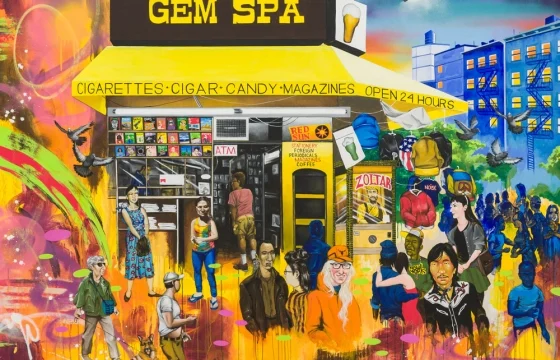
A centerpiece of the exhibition, Gem Spa In the 80s (2025), is a poignant tribute to the iconic St. Mark’s Place candy store. Gem Spa was more than a shop; it was the "nerve center" of the East Village, a gathering spot for literary figures like Allen Ginsberg and Jack Kerouac. In Daze’s painting, the store is populated by ghosts of the city’s cultural history, including critic Carlo McCormick and artist Martin Wong. The work functions as a historical document, capturing the specific, fleeting intimacy of a neighborhood before the onset of rapid gentrification.
Implications: The Botanical Metaphor
Perhaps the most striking element of the exhibition is the recurring motif of flowers. Daze paints technicolor blooms erupting from heaps of urban rubble. These images serve as a powerful metaphor for resilience. By juxtaposing tropical flora with the local flowers found in his current home in upstate New York, Daze suggests a cycle of growth and decay that is constant, even in the most hardened environments.
The title, Orchid Rain, implies a delicate, almost otherworldly phenomenon occurring within the harsh, metallic confines of the "Underground." It suggests that beauty is not a luxury but an inherent, persistent feature of the city, one that survives inequality and destruction. This is an optimistic assertion: that the creative spirit of the city is not a casualty of time, but a recurring, seasonal phenomenon.
Official Responses and Curatorial Context
The PPOW gallery, long a champion of artists who challenge the boundaries of contemporary art, views this exhibition as a crucial intervention. By providing a platform for Daze to integrate a site-specific mural and a multimedia installation, the gallery allows the artist to break the "fourth wall" of the traditional exhibition space.
The installation—a reconstruction of the dance-floor energy of his youth—incorporates authentic subway car seats, a pulsing disco ball, and a curated soundscape of house, hip-hop, and club classics. Curators argue that this immersive approach is necessary to understand the context of Daze’s work. It moves the conversation away from the "object" and toward the "experience." By placing the viewer inside a composite scene of the 1980s, the exhibition forces an encounter with the freedom and creative defiance that originally fueled the graffiti movement.
Conclusion: The Enduring Legacy of the Underground
Orchid Rain on the Underground is a masterful achievement that manages to be both a nostalgic look back and a forward-looking statement on the nature of urban identity. Daze proves that while the physical landscape of New York City is in a constant state of flux, the cultural heartbeat of the city remains unchanged.
For those who lived through the era, the exhibition is an act of preservation. For those who did not, it is an essential lesson in how a city’s subcultures define its history. As the exhibition remains on view through April 2026, it serves as a reminder that the "underground" is not just a place beneath the city streets, but a mindset—a commitment to creativity in the face of indifference. Chris “Daze” Ellis has once again cemented his position as a crucial chronicler of the New York experience, proving that as long as there is rubble, there will be orchids, and as long as there are tunnels, there will be art.










No comments yet. Be the first to join the conversation!