

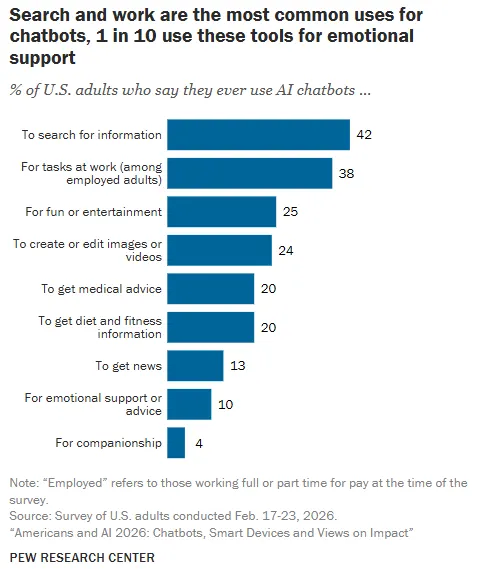
The landscape of artificial intelligence is evolving at a breakneck pace, yet for the average American consumer, the day-to-day reality of AI remains rooted in a surprisingly practical application: search. According to the latest comprehensive study from the Pew Research Center, while the adoption of AI chatbots has surged significantly over the past two years, the "killer app" for these tools remains the humble query, rather than the flashy generative art or complex professional workflows that dominate industry headlines.
As of mid-2026, the artificial intelligence revolution is no longer a niche curiosity reserved for tech enthusiasts. It has become a mainstream utility, integrated into the digital lives of millions. However, the Pew Research data—gleaned from a survey of over 5,000 U.S. adults—reveals a clear disconnect between what developers are prioritizing and how users are actually interacting with these sophisticated large language models.
The Main Facts: A Rapid Rise in Adoption
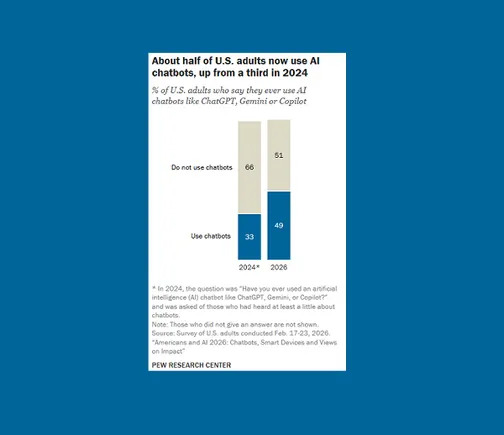
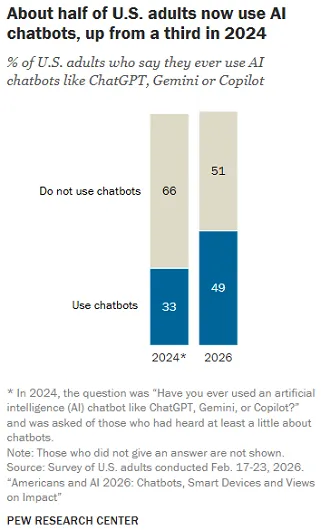
The most striking takeaway from the Pew Research study is the sheer velocity of AI adoption. In 2024, only about 33% of U.S. adults reported using AI chatbots. By mid-2026, that figure has climbed to approximately 50%. This 17-percentage-point jump in two years indicates that AI has successfully moved beyond the "early adopter" phase and firmly into the "early majority" stage of technology diffusion.
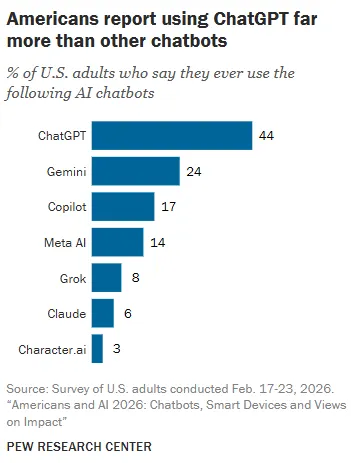
Despite this growth, the market remains highly stratified. OpenAI’s ChatGPT maintains its position as the clear market leader, capturing 44% of the chatbot-using population. While competitors like Anthropic’s Claude, Google’s Gemini, and Microsoft’s Copilot have poured billions into research and development, ChatGPT’s "first-mover advantage" has cemented its status as the synonymous brand for generative AI. It is the Kleenex or Google of the chatbot era, a status that is proving difficult for competitors to dislodge despite frequent feature updates and superior performance in niche benchmarks.
Chronology: The Evolution of the AI Chatbot Market
To understand the current state of the market, one must look at the timeline of the "AI Gold Rush":
- Late 2022 – 2023: The Breakthrough: The public release of ChatGPT triggers a global frenzy. AI shifts from a backend enterprise tool to a consumer-facing phenomenon.
- 2024: The Competitive Pivot: Major tech incumbents, including Google (Gemini) and Microsoft (Copilot), integrate AI into their core search and office suites. Usage begins to climb, with one-third of the American public experimenting with the technology.
- 2025: The Integration Era: AI features begin to permeate social media platforms, image generators, and coding assistants. Companies push "multimodal" capabilities, betting that users want to create images, edit video, and automate complex workflows.
- 2026: The Reality Check: As evidenced by the Pew Research study, the dust settles. Users largely ignore the "creative" features in favor of search efficiency. The market moves from a phase of "novelty" to "utility."
Supporting Data: What Are Users Actually Doing?
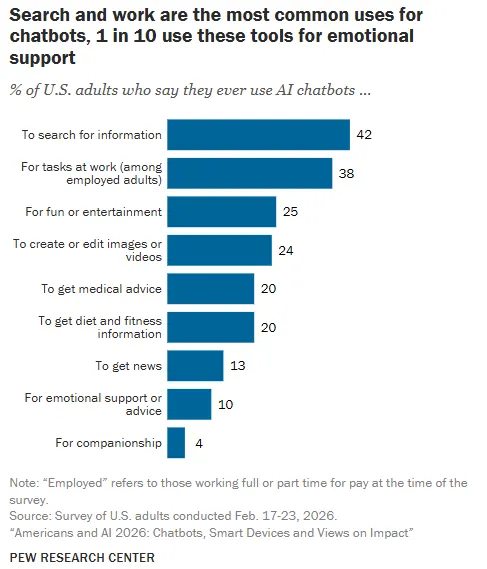
Perhaps the most counterintuitive finding in the Pew report is the low utilization of image and video generation tools. Despite the relentless push by platforms like Meta, OpenAI, and Google to integrate DALL-E, Sora, and other generative visual tools, only 24% of users report using AI to create images or videos.
This creates a puzzling gap in product strategy. Why are tech giants investing so heavily in expensive visual generation capabilities if only a quarter of the user base is interested? The answer may lie in corporate vanity or the pursuit of "multimodal parity," where companies feel forced to match features to stay relevant, even if those features do not drive daily active user growth.
The Hierarchy of Chatbot Popularity:
- ChatGPT (OpenAI): The undisputed leader, commanding 44% of users.
- Gemini (Google): The primary challenger, leveraging the ubiquity of the Google ecosystem.
- Copilot (Microsoft): Deeply integrated into Windows and the Office suite.
- Meta AI, Grok, Claude, and Character.ai: Fighting for the remaining market share, each catering to specific niches—from social media integration (Meta) to conversational personality (Character.ai) and high-level reasoning (Claude).
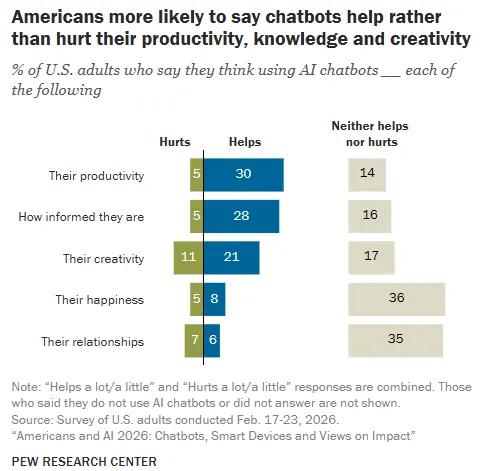
In terms of functional utility, 30% of respondents explicitly stated that AI chatbots improve their productivity and help them stay informed. However, the data confirms that this productivity is currently limited to discovery. Most users are utilizing these tools as a "smarter" version of a traditional search engine, looking for quick summaries or specific data points rather than engaging in deep, iterative creative work.
Official Responses and Industry Implications
The shift toward AI-assisted search has profound implications for the digital economy, particularly for web publishers and the referral traffic model that has sustained the internet for decades.
As Google and other search engines deploy "AI Overviews," they are effectively answering queries directly on the search engine results page (SERP). For publishers, this is a "painful reminder" of the changing nature of the web. If a user gets their answer from an AI summary, they are less likely to click through to a third-party website. This threatens the advertising revenue models of countless independent creators, news outlets, and businesses.
In August of last year, Google pushed back against these concerns, claiming that AI previews do not negatively impact overall referral numbers. The company argued that users who see AI summaries are actually presented with more links on their screens and are more likely to click on a wider range of sources. However, the user behavior data from Pew suggests a different reality: once a user is satisfied with the direct, concise answer provided by the AI, the impetus to "click through" to a source website diminishes significantly.
The Broader Implications: A "Major Shift" or a "Slow Burn"?
The Pew Research findings provide a sobering, necessary perspective on the current "AI Revolution." While the technology is undoubtedly powerful, the data suggests that the broader digital shift is happening more gradually—and in different ways—than the tech industry’s marketing might imply.
1. The Productivity Myth
While AI is being marketed as a revolutionary tool for professional workflows, the reality is that the vast majority of consumers are using it for basic information retrieval. We are seeing a "search-plus" era, where users are supplementing their traditional browsing habits with chatbot summaries, rather than replacing their work processes with AI agents.
2. The Referral Crisis
The decline of the "click-through" model is a looming threat for the open web. If AI continues to act as a gatekeeper of information, the power dynamics of the internet will shift further toward the companies that control the AI models. This could lead to a "walled garden" effect, where information is centralized within a few proprietary systems rather than distributed across the web.
3. The Future of Multimodal Features
The low engagement with image and video generation tools suggests that consumers are not yet ready to replace their creative processes with AI. There is a clear divide between "utility AI" (search, writing, summarizing) and "creative AI" (art, video, design). For the latter to truly take off, the industry may need to focus more on lowering the barrier to entry or integrating these features into workflows that feel more natural to the average user.
4. The Path Forward
Ultimately, the Pew Research data highlights that AI is a tool, not a panacea. Its value at this stage is primarily in the discovery of information. Whether this represents a permanent plateau or merely the early days of a more profound transformation remains to be seen. For now, the "AI shift" is not just about what the software can do; it is about how humans choose to integrate it into their existing, habit-driven digital lives.
As the technology continues to mature, the focus of developers will likely shift from "how many features can we build" to "how can we make these features indispensable." For the average American, the next phase of the AI revolution will likely be defined not by the bells and whistles of generative art, but by the subtle, persistent improvement of their daily search and information-gathering routines.











