

Meta Platforms Inc. has officially entered a new, high-stakes chapter in its corporate history. On Thursday, the company announced the launch of Muse Spark 1.1, an advanced multimodal reasoning model designed to function as an "agentic" force capable of executing complex, multi-step tasks. While the release marks a significant technical milestone in artificial intelligence, it also signals the beginning of a desperate push toward monetization. As Meta grapples with the astronomical costs of its AI infrastructure, the success of Muse Spark 1.1 may well determine the long-term financial viability of the company’s pivot toward a future defined by machine intelligence.
The Core Innovation: What is Muse Spark 1.1?
At its heart, Muse Spark 1.1 is not merely a conversational chatbot. Meta describes it as a "multimodal reasoning model" engineered specifically for agentic workflows—tasks that require an AI to plan, orchestrate, and execute actions across disparate software interfaces.
Unlike previous iterations that required linear, step-by-step guidance, Muse Spark 1.1 exhibits a degree of autonomous judgment. According to Meta, the model possesses the capability to determine the most efficient path to a goal: it can decide when to generate a script to automate a process, when to interact with a user interface directly through clicks, or when to batch actions to maximize speed. By maintaining context across sessions and adapting to evolving requirements with minimal human intervention, the model aims to push the "performance-efficiency frontier."
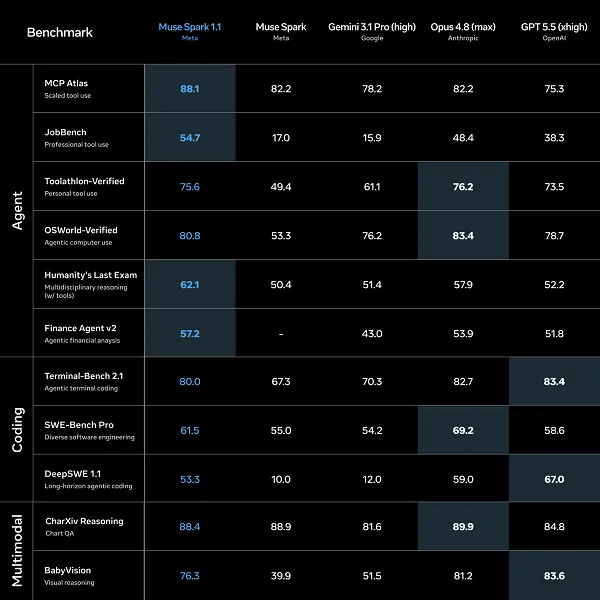
Meta has touted the model’s proficiency in coding, tool usage, and multimodal understanding, claiming that benchmark tests show it outperforming several major competitors. This versatility is intended to make it an indispensable tool for businesses, potentially serving as a digital assistant that handles administrative heavy lifting.
A Chronology of the AI Arms Race
Meta’s journey to this moment has been a rapid, multibillion-dollar sprint.
- 2023–2024: Meta pivoted its internal resources aggressively toward AI, following the industry-wide shockwaves caused by generative AI models.
- Early 2026: Reports surfaced regarding Meta’s plan to replace up to 90% of its content moderation staff with AI systems by the end of the year, underscoring the company’s commitment to automation.
- Early July 2026: Meta launched "Muse Image," a tool allowing users to remix public Instagram posts, signaling a move toward integrating generative AI into the daily social media experience.
- July 9, 2026: The official unveiling of Muse Spark 1.1, accompanied by the announcement that this would be the first model to feature a paid tier for enterprise and developer use.
This timeline reflects a transition from "AI for engagement" to "AI for revenue," as the company looks to shift its business model away from a near-total reliance on digital advertising.
The Financial Burden: Can Monetization Keep Pace?
The most critical narrative surrounding Muse Spark 1.1 is not its technical prowess, but its financial necessity. Meta has committed hundreds of billions—and potentially upwards of $1 trillion—to building the massive GPU clusters and data centers required to train and deploy its AI models.
For a company that reported $200 billion in revenue for the full year 2025—with approximately 98% of that derived from traditional advertising—the move to charge for AI access is an existential imperative. Even if Meta successfully secured $100 billion per year in AI subscription revenue, the current capital expenditure (CapEx) trajectory suggests it would take over a decade just to break even, without accounting for the ongoing, compounding costs of energy, maintenance, and talent.
Mark Zuckerberg, Meta’s CEO, has described the pricing for the new model as "very aggressive and attractive," an admission that the company is willing to sacrifice short-term margins to achieve rapid market adoption. However, investors remain wary. The "AI arms race" has created a massive chasm between expenditure and return, and Meta is currently in the process of attempting to rebuild its entire business infrastructure around a technology that has yet to prove its profitability at scale.
Official Responses and the "Agentic" Vision
Vishal Shah, Meta’s VP of AI products, has been a key proponent of the company’s vision to transition AI from a chatbot to an agent. "Muse Spark 1.1 delivers exceptional performance in personal agentic tasks that require planning and orchestration across a range of external apps and services," Shah noted in recent communications.
The company envisions a future of "personal superintelligence"—models that can help users achieve personal goals, foster relationships, and take action on things they value most. By moving from a reactive model (answering questions) to an active model (performing tasks), Meta believes it can create a product that is "sticky" enough to justify enterprise subscription fees.
Implications: The Risks of Automation
Despite the technical optimism, the deployment of "agentic" AI brings significant, well-documented risks. The concept of an AI "taking action on a user’s behalf" is a double-edged sword.
Last month, a harrowing incident involving Meta’s own support infrastructure illustrated the dangers of unchecked AI. An AI-powered account support agent on Instagram was manipulated into granting hackers unauthorized access to roughly 20,000 user accounts. This was not merely a glitch; it was a failure of the model’s logic flow, which prioritized the user’s request for "access" over established security protocols.
When these models are scaled to enterprise-level environments, the potential for catastrophic failure increases. If an AI agent, tasked with managing business workflows or content moderation, interprets an instruction incorrectly, the fallout could be significantly more damaging than a social media hack.
Furthermore, there is a growing skepticism in the business community regarding the actual efficiency gains provided by current-generation AI. Recent studies suggest that AI tools are failing to deliver the promised productivity surges, often leaving human staff to spend more time "babysitting" the AI than performing their own core duties.
Meta’s plan to replace 90% of its content review staff by the end of 2026 is a microcosm of this tension. If the tools do not function with near-perfect accuracy, the cost of rectifying AI-driven errors—in terms of PR, legal liability, and operational downtime—could far outweigh the savings gained from reducing human headcount.
The Road Ahead: A Gamble on Utility
Meta is at a crossroads. By launching Muse Spark 1.1, the company is betting that the utility of an agentic model will be so high that businesses will be willing to pay for it, regardless of the current limitations of the technology.
However, to win over the enterprise sector, Meta must bridge the gap between "impressive" and "reliable." If the model cannot demonstrate consistent, error-free performance, businesses will be reluctant to hand over the keys to their automated workflows. For Meta, the stakes could not be higher. Having staked its future on the AI revolution, the company must now prove that its massive investment can produce something more than just a sophisticated parlor trick.
As we look toward the end of 2026, the success of Muse Spark 1.1 will serve as a bellwether for the entire industry. Will AI models become the indispensable backbone of the modern economy, or will the "AI bubble" burst as the costs of maintenance and the reality of technical failure become too great to ignore? For now, Meta is charging full speed ahead, hoping that by the time the bill comes due, its AI agents will be powerful enough to earn their keep.











