

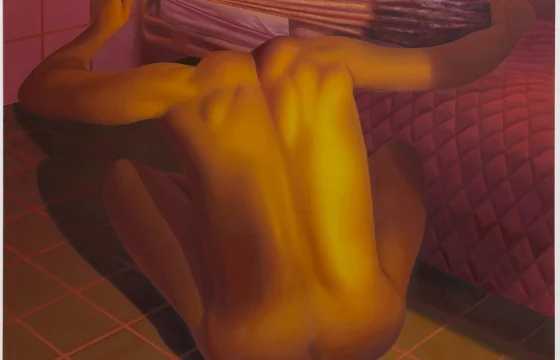
Lyles & King, the contemporary art gallery situated at the heart of New York’s vibrant cultural landscape, is currently hosting a compelling exhibition in its project space featuring new paintings by the Los Angeles-based artist Kate Meissner. On view through April 4, the collection marks a profound shift in the artist’s trajectory, moving from abstract investigations of form toward a visceral, deeply personal examination of the biological imperatives that define the human experience. Through a series of canvases that ripple with color and anatomical suggestion, Meissner interrogates the limits of the human body, specifically focusing on the transformative, often jarring, reality of motherhood.
The Core Narrative: A Study in Elasticity
At the center of this exhibition is a series of works that challenge the traditional iconography of the maternal. Rather than relying on the sentimental or the static, Meissner’s brushwork emphasizes the "elasticity and capacity to metamorphose" inherent in the human form. For Meissner, the body is not merely a vessel; it is a landscape of constant, sometimes violent, negotiation between the self and the biological processes it hosts.
"These works are an exploration of the human body’s elasticity and capacity to metamorphose," Meissner writes in her artist statement. "Informed by my own experience of pregnancy and the birth of my first child last year, these paintings are a meditation on physiological transformation and the body’s underlying animalistic and mammalian nature."
This focus on the "mammalian" is critical to understanding the raw energy of the paintings. By stripping away the domestic polish often associated with depictions of pregnancy, Meissner confronts the viewer with the raw, structural reality of growth and expansion. The compositions are fluid, suggesting a body that is constantly in flux, caught between its former shape and a new, evolving architecture.
Chronology: From Yale to the Global Stage
To understand the weight of this exhibition, one must look at the arc of Meissner’s career. Born in Sacramento, California, in 1995, Meissner’s rise has been meteoric, characterized by a disciplined approach to painting and a rigorous academic background.
The Formative Years
Meissner’s artistic foundation was solidified at Yale University, where she earned her Master of Fine Arts. During her time in New Haven, she developed the technical dexterity that now allows her to render complex, fluid anatomical forms with deceptive ease. Her practice is defined by a tension between precision and abstraction—a trait that has garnered significant attention from both critics and major institutions.
Institutional Recognition
Before her current solo-adjacent project at Lyles & King, Meissner’s work had already been integrated into several prestigious global collections. Her trajectory includes representation in the permanent collections of the Denver Art Museum (Denver, CO), the Xiao Museum of Contemporary Art (Rizhao, CN), The Mer Collection (Madrid, ES), and the Abroms-Engel Institute for the Visual Arts (Birmingham, US). This geographic spread—from the American West to East Asia and Europe—speaks to the universal resonance of her themes.
The Recent Pivot
The birth of her first child last year served as a catalyst for a radical departure in her work. Where previous iterations of her style might have engaged with external structures or formalist experiments, the current exhibition represents a turning point where the internal, biological reality of the artist became the primary subject matter. This shift from the abstract to the intensely personal is, perhaps, the most significant milestone in her decade-long practice.
Supporting Data: The Anatomy of the Exhibition
The paintings currently housed at Lyles & King are characterized by a specific set of visual markers that distinguish them from Meissner’s previous output.
- Color Palette: The works utilize a palette that oscillates between fleshy, organic tones—ochres, deep reds, and bruised purples—and stark, clinical contrasts. This choice of color mimics the internal reality of physiological change, grounding the work in a sense of visceral urgency.
- Structural Distortion: In several pieces, the human form is rendered through distorted lines, suggesting the physical strain of pregnancy. By stretching the frame and pushing the boundaries of traditional perspective, Meissner mirrors the physical expansion of the body.
- Scale and Proximity: The works in the project space are designed to be viewed in proximity. They do not demand the distance of a grand gallery wall; rather, they invite the viewer to get close, echoing the intimacy of the parent-child bond and the clinical scrutiny of the prenatal examination.
Official Responses and Critical Reception
The art world has responded to this exhibition with a mixture of awe and scholarly interest. Critics have noted that while the subject of motherhood is a historical mainstay in Western art, Meissner’s approach is notably devoid of the "Madonna and Child" tropes that have dominated the genre for centuries.
Lyles & King, in providing the project space for these works, has signaled a commitment to narratives that bridge the gap between personal biography and high-art abstraction. By framing the exhibition as a "meditation on the body’s underlying animalistic nature," the gallery has effectively steered the conversation away from sentimentality and toward a more rigorous, intellectual inquiry into what it means to house another life.
"Meissner is not painting a portrait of motherhood," noted one critic during the opening week. "She is painting a portrait of the biological revolution that occurs when the body becomes a shared space."
Implications: The Future of the Maternal Subject in Art
The implications of Meissner’s current exhibition are two-fold: it forces a re-evaluation of the "maternal" in contemporary art, and it highlights the evolving role of the body as a primary site of artistic discourse.
A De-romanticized Motherhood
For too long, the depiction of pregnancy in art has been filtered through a lens of serenity or moralistic duty. By focusing on "animalistic" and "mammalian" characteristics, Meissner effectively strips away the romantic veneer, replacing it with a raw, honest look at the body as an engine of creation. This is a significant contribution to the feminist dialogue in contemporary painting, as it reclaims the narrative of childbirth as a physical, rather than purely emotional, event.
The Body as a Site of Transformation
Beyond the specific context of motherhood, Meissner’s work touches on a larger, universal truth: the body is not a static container. It is a site of constant negotiation, subject to the ravages of time, the pressures of growth, and the inevitability of change. As we move further into a century defined by biotechnological advancement, artists like Meissner are helping to create a visual language for these transformations.
Institutional Longevity
The fact that Meissner’s work is already held in major institutions across three continents suggests that her exploration of these themes is not merely a passing interest but a foundational element of her practice. Collectors and curators are increasingly looking for art that addresses the "human condition" through the lens of lived experience. Meissner’s ability to synthesize this experience with a sophisticated, modernist aesthetic positions her as a pivotal figure in the next generation of American painters.
Conclusion
The exhibition at Lyles & King is more than a display of new paintings; it is a testament to the resilience of the human form and the power of art to translate visceral experience into a shared, universal language. Through her exploration of pregnancy and birth, Kate Meissner has not only documented her own journey but has expanded the lexicon of figurative painting.
As the exhibition continues through April 4, visitors are encouraged to look beyond the surface of the canvases and engage with the structural, biological, and existential questions posed by the work. In doing so, they may find that the "animalistic" nature Meissner describes is not something to be feared or hidden, but a profound testament to the complexity of being alive.
In a rapidly changing world, Meissner’s work serves as a reminder that the most radical transformations often happen within the silent, private architecture of the human body. It is an invitation to witness the metamorphosis, to acknowledge the strain, and to marvel at the capacity of the body to expand, to adapt, and ultimately, to endure.











No comments yet. Be the first to join the conversation!