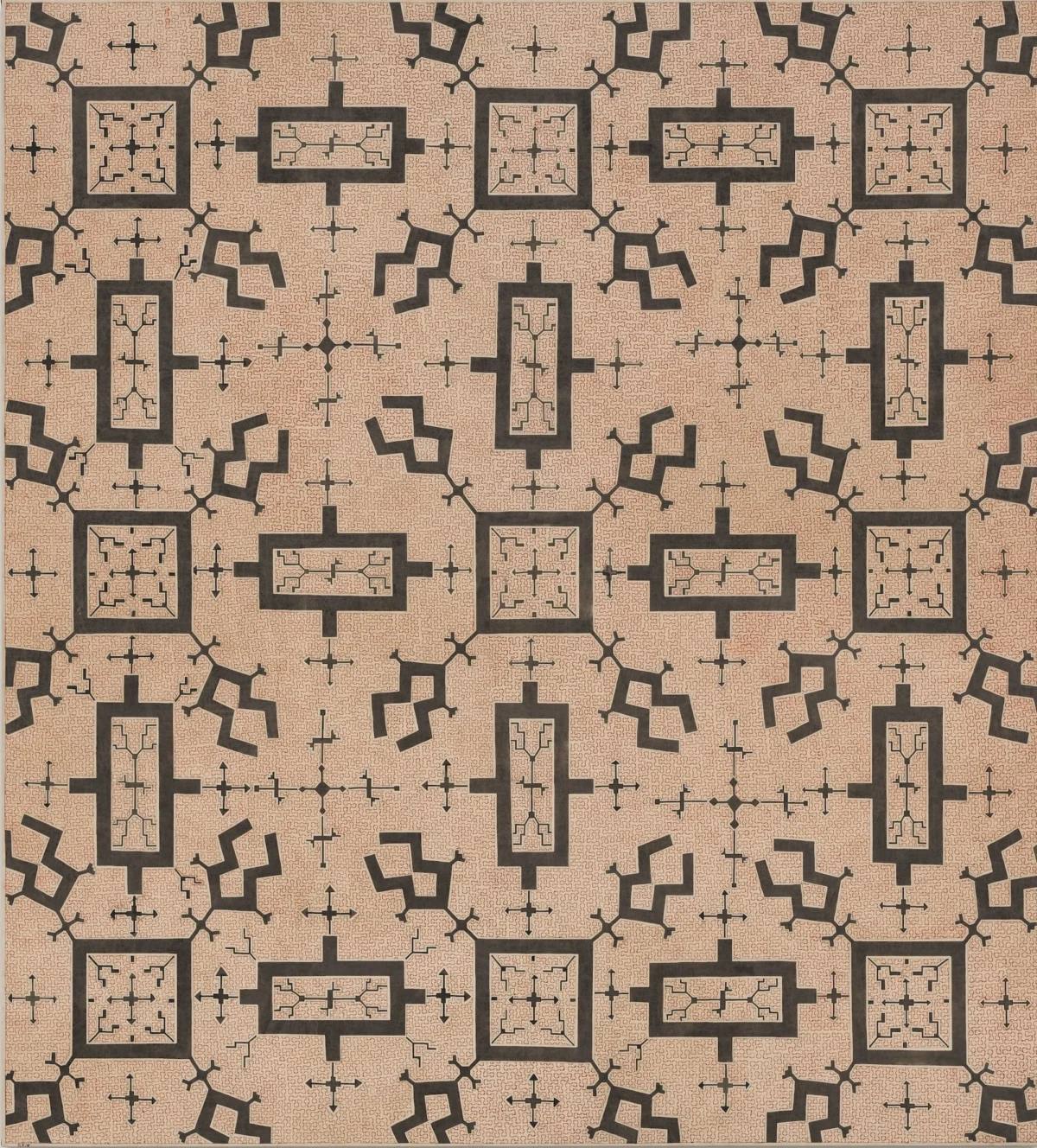
Deep within the verdant, serpentine veins of the Ucayali River basin in the Peruvian Amazon, the Shipibo-Konibo people have cultivated a visual language as complex and enduring as the rainforest itself. For millennia, this Indigenous community has translated the rhythms of their environment into Kené—a masterful artistic tradition defined by intricate, labyrinthine geometric patterns. Today, this ancient practice is being propelled onto the global stage through the work of Sara Flores, an artist whose meticulous compositions bridge the gap between ancestral cosmology and contemporary fine art.
Currently, the international art world is witnessing a long-overdue reckoning with the depth and sophistication of Shipibo-Konibo artistry. Through her exhibition Akinananti at the White Cube gallery and her historic representation of the Peru Pavilion at the 61st Venice Biennale, Flores has become a vessel for a tradition that is as much a spiritual practice as it is an aesthetic one.

The Essence of Akinananti and Kené
The exhibition Akinananti, currently running at White Cube in New York City, serves as a masterclass in the intersection of nature, labor, and philosophy. The term "Akinananti," in the Shipibo language, describes work performed with love, joy, and a sense of shared purpose. It is a concept that encapsulates a lifeway rooted in reciprocity and interconnectedness, where the individual’s well-being is viewed as inseparable from the health of the community and the surrounding ecosystem.
The core of this practice is Kené. Traditionally, these patterns were not merely decorative; they were manifestations of a cosmic order. Created using foraged clay, wild cotton, and pigments extracted from the bark, leaves, and berries of the Amazonian flora, Kené serves as a visual bridge between the physical and spiritual realms. For Flores, the process of creating these works is a meditative act of "person-making"—or joni-ati—a formative practice instilled in her by her mother during her youth in the community of Tambomayo.

A Chronology of Artistic Evolution
To understand the magnitude of Sara Flores’s current global recognition, one must look back at the trajectory of her life, which spans decades of quiet dedication in the shadow of institutional exclusion.
Early Beginnings (1950–1964)
Born in 1950 in the remote community of Tambomayo, Flores was immersed in the tradition of Kené from an early age. Under the tutelage of her mother, she learned the technical rigors of preparing natural dyes and the spiritual significance of the geometric motifs. At the age of 14, these skills were primarily applied to the creation of garments—textiles designed for everyday functional use, imbued with the protective and identifying markers of her culture.

The Decades of Marginalization (1965–2010)
For much of her adult life, Flores’s work was relegated to the category of "folk art," a dismissive label often used by Western institutional curators to categorize and marginalize Indigenous craft. For decades, the mainstream art establishment in Peru and abroad failed to recognize the intellectual and technical complexity of her practice. As Charles Darwent notes in an essay for the Akinananti exhibition, a curator at the Museo de Arte de Lima (MALI) once famously declared, "Folk art is not coming to this museum, ever." This systemic bias kept artists like Flores out of the global art dialogue for years.
The Turning Point and Institutional Recognition (2010–2024)
The tide began to turn as the art world began to decolonize its canon. In a landmark moment for the region, Flores was finally granted an exhibition at MALI, titled Non Nete. It was the first exhibition of an Indigenous artist in the museum’s seventy-year history—a sobering statistic that highlights the systemic barriers she had to overcome. This exhibition served as a catalyst, proving that the geometric sophistication of Kené was not just "folk" craft, but a profound contribution to contemporary abstract art.

Global Presence (2025–2026)
In 2026, Flores reached the pinnacle of her career, representing Peru at the 61st Venice Biennale with the exhibition De otros mundos (From Other Worlds). This marked the first time an Indigenous artist represented the nation at the Biennale, signaling a seismic shift in how international institutions perceive Indigenous sovereignty in the arts.
The Technicality of Transmission
The process of creating Kené is a multi-generational labor of love. Today, Flores collaborates closely with her daughters, ensuring that the technical skills and the philosophical underpinnings of the tradition are passed down. The creation of a single large-scale canvas involves a months-long process of sourcing materials: harvesting specific barks and leaves from the Amazon, boiling them to create precise pigments, and applying them to hand-spun wild cotton with a level of patience that stands in stark contrast to the rapid-fire pace of modern production.

The pedagogical aspect of this art is perhaps its most compelling feature. Flores recounts walks with her mother, who would gather ipobekené leaves and press them against the young girl’s eyelids. The purpose was to help her "better receive the designs," a ritual that underscores the belief that these patterns exist in the world around us, waiting to be perceived by those who have been trained to look.
Official Responses and Curatorial Perspectives
The inclusion of Flores in major institutions like the White Cube has drawn praise from critics and curators alike. The gallery’s official statement highlights that the artist’s work is not merely an aesthetic choice but a "lifeway" that demands a change in how we view the artist’s role in society.

"Sara Flores is not just an artist; she is a custodian of a knowledge system," says one curator associated with the exhibition. "When we look at her work, we are not just seeing lines on a canvas; we are seeing the mapping of a worldview that prioritizes balance, reciprocity, and the fundamental interconnectedness of all living things."
Critics have also noted the "meditativeness" of the works. The sheer scale of her current pieces—some stretching several feet—allows the viewer to be physically engulfed by the geometric intensity. By stretching these patterns onto canvas, Flores has successfully transitioned Kené from a domestic, functional application to a monumental format that demands the viewer’s full intellectual and spiritual attention.

Implications for the Future of Indigenous Art
The success of Sara Flores represents a vital shift in the trajectory of global art history. Her recognition at the Venice Biennale and at White Cube carries several profound implications:
- The Collapse of the "Folk Art" Binary: By placing her work in the context of contemporary abstraction, institutions are finally discarding the hierarchy that separated "fine art" from "Indigenous craft." This allows for a more inclusive and accurate definition of what constitutes high art.
- Environmental Stewardship through Art: The reliance on organic, sustainably sourced materials serves as a quiet protest against the industrialization of the art world. Her work forces a conversation about the relationship between the artist, the land, and the materials, reminding us that art is a product of its environment.
- Indigenous Sovereignty: The fact that an Indigenous artist is representing the Peruvian state on the world’s most prestigious stage is a political statement. It validates the intellectual property of the Shipibo-Konibo people and ensures that the narrative surrounding their art is defined by them, rather than by external colonial structures.
- Collective Mentorship: The collaboration between Flores and her daughters provides a blueprint for the future of artistic practice. By emphasizing the collective nature of production, she challenges the Western, individualistic "lone genius" myth, suggesting that art is more powerful when it is a product of community and intergenerational transmission.
Conclusion
Sara Flores’s journey from the small community of Tambomayo to the white-walled galleries of New York and the historic pavilions of Venice is more than a success story—it is a reclamation. Her work reminds us that the traditions of the Amazon are not static relics of the past; they are living, breathing, and evolving systems of knowledge.

As Akinananti continues to draw visitors through August 14, it offers a rare opportunity to engage with a form of art that asks us to slow down, to look closer, and to recognize the infinite complexity inherent in the natural world. In the geometric lines of a Sara Flores canvas, we find not only the history of the Shipibo-Konibo people but a roadmap for a more sustainable, interconnected, and joyous way of existing in our own worlds. Through her persistence, her vision, and her commitment to the "making of a person," Flores has ensured that the patterns of the Ucayali will continue to resonate for generations to come.