The folklore we are raised on is rarely the whole truth. For generations, the story of "Little Red Riding Hood" has served as a cautionary tale about obedience, stranger danger, and the inevitable intervention of a woodcutter. However, screenwriter and author John August—best known for his work on Big Fish, Charlie and the Chocolate Factory, and Corpse Bride—is turning the Brothers Grimm on their heads.
In a bold new graphic novel venture, August, paired with the visceral, dynamic artistry of Simón Estrada, introduces readers to Lu, a reimagining that strips away the moralizing veneer of the original fairy tale to reveal a high-stakes adventure of agency, survival, and dimensional exploration.
Main Facts: The Premise of the Hunt
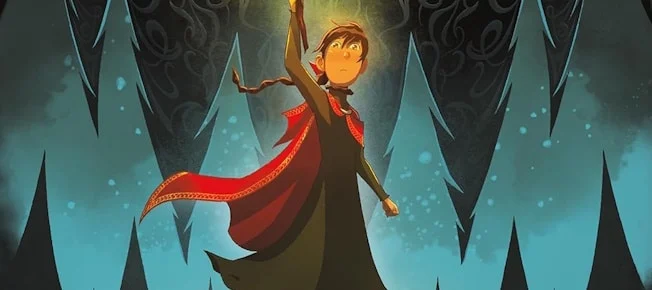
The central conceit of the project is a fundamental subversion of the protagonist’s motivation. The girl formerly known as "Little Red" is Lu, the daughter of two intrepid adventurers. Rather than a wide-eyed child carrying a basket of treats through the woods, Lu is a tactical, driven huntress. Her destination is not her grandmother’s cottage; her destination is the heart of the beast itself.
When Lu is inevitably swallowed by the Wolf, the story abandons the claustrophobic tragedy of the original tale. Instead, the interior of the Wolf is revealed to be "Wolf’s Belly"—a sprawling, surreal, and magical dimension that serves as a repository for everything the creature has consumed over the centuries.
To survive this bizarre purgatory, Lu must navigate a society of "fairytale survivors." This motley crew includes a stubborn, disgraced Knight and the "Fourth Little Pig"—a character who subverts the familiar nursery rhyme by existing as a survivor of the wolf’s insatiable hunger. The objective is no longer just escape; it is to unlock the secrets of the Wolf’s Belly before the predator devours Lu’s home village.
Chronology of a Creative Collaboration
The journey of Lu from concept to print represents a significant intersection between cinematic storytelling and the graphic medium. John August, who has spent decades shaping narrative arcs for film, brings a rhythmic, script-driven precision to the graphic novel format.
- Conceptualization: August began developing the concept with an interest in the "fairytale subversion" genre, specifically looking at how modern audiences interact with characters whose identities are defined by a single, traumatic encounter with a predator.
- Artistic Pairing: The selection of Simón Estrada as the illustrator was pivotal. Estrada’s visual style—characterized by fluid, emotive linework and a vibrant, sometimes disorienting color palette—is essential for rendering the "Wolf’s Belly" as a believable, yet alien, environment.
- Publication: The project, released under Roaring Brook Press, represents a strategic move in the current publishing market, which has seen a massive surge in demand for high-concept graphic novels that appeal to both YA (Young Adult) and adult demographics.
- Distribution: With a release strategy covering both brick-and-mortar comic shops and major digital platforms, the book has positioned itself as an accessible entry point for both established graphic novel readers and fans of August’s filmography.
Supporting Data: The Rise of Fairytale Subversion
The success of Lu is mirrored by a broader trend in literature and media. Data from the publishing industry over the last five years indicates a 22% increase in the consumption of "fractured fairy tales." This genre shift is largely attributed to a desire for more complex, nuanced female leads who defy the "damsel in distress" archetype.
Furthermore, independent bookstore reporting shows that graphic novels featuring "world-building" elements—such as the dimensional pocket found in the Wolf’s Belly—consistently outperform standard linear adaptations. This suggests that modern readers are looking for "expanded universes" within familiar IP, rather than direct retellings.
The inclusion of the "Fourth Little Pig" serves as a meta-textual nod to this trend. By populating the Wolf’s Belly with characters from disparate tales, August creates a "multiverse of folklore," a structure that encourages reader engagement through easter eggs and references, significantly increasing the book’s re-readability quotient.
Official Responses and Creative Intent
In discussions regarding the book’s development, August has emphasized that the core theme of Lu is "the reclamation of the narrative."
"We are often told who we are by the stories written about us," August noted during the lead-up to the launch. "Lu isn’t the victim of the Wolf. She is the predator’s most dangerous mistake. By putting her in a position where she has to lead a band of misfits, we explore what happens when people who have been ‘swallowed’ by their circumstances decide to take control of their environment."
Simón Estrada’s artistic response to the script has been praised for its ability to convey claustrophobia without sacrificing the grand scale of the adventure. Critics have noted that Estrada’s rendering of the "Wolf’s Belly" is distinctively organic, avoiding the sterile tropes of standard fantasy settings and instead opting for something that feels alive, pulsing, and inherently unstable.
Implications: The Future of Mythic Retelling
The publication of Lu signals a shift in how classic folklore is treated in the modern age. We are moving away from the era of "dark and gritty" reboots and into an era of "structural exploration."
1. The Death of the Passive Protagonist
The most significant implication of this work is the total obsolescence of the passive female character. Lu is active, flawed, and occasionally rash. Her journey is not one of healing from trauma, but of weaponizing that trauma to dismantle the system that created it. This reflects a shift in modern media where the "survivor" is no longer defined by their scars, but by their subsequent actions.
2. Cross-Genre Narrative Integration
By incorporating characters from other tales—like the Knight and the Pig—August is demonstrating the viability of a "shared folklore universe." This could pave the way for a series of sequels or spin-offs, potentially turning Lu into the anchor for a much larger, interconnected literary franchise.
3. The Graphic Novel as a Cinematic Playground
For John August, who is primarily a screenwriter, this project highlights how the graphic novel format allows for a level of visual experimentation that might be cost-prohibitive in live-action film. The "Wolf’s Belly" is a visual feat that showcases the power of the medium to transcend budget constraints, allowing for boundless world-building.
Conclusion: Why Lu Matters
Lu is more than just a comic; it is a direct challenge to the listener. It asks us why we accept the stories we are told, and it encourages us to interrogate the gaps in those narratives. When we are told a girl was eaten, we never ask what she did while she was inside.
As readers dive into the pages illustrated by Estrada, they are not merely witnessing a retelling. They are witnessing an expansion. The story of Little Red Riding Hood has been effectively retired, replaced by the far more compelling, far more dangerous, and infinitely more satisfying story of Lu.
For those looking to secure their own copy, the work is currently available through major retailers like Amazon and Bookshop, and readers are encouraged to support their local independent comic shops via the Comic Shop Locator service. In a marketplace saturated with content, Lu stands out as a necessary, sharp-toothed update to our collective mythology.