

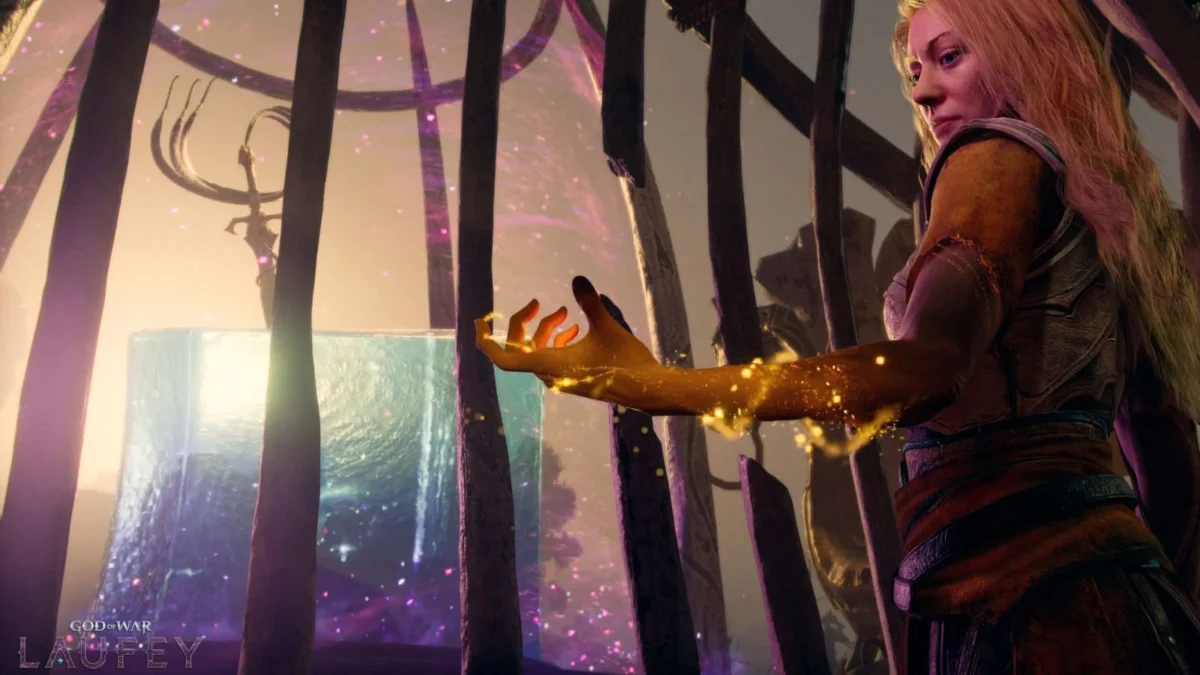
The PlayStation State of Play event held in June 2026 was intended to be a victory lap for Sony’s upcoming software slate. With long-awaited updates on Marvel’s Wolverine, a surprise reveal of Until Dawn 2, and a fresh look at Tomb Raider: Legacy of Atlantis, the showcase was packed with high-octane spectacle. Yet, the entire industry discourse has been hijacked by a singular, surreal, and deeply polarizing addition to the God of War franchise: God of War: Laufey.
While the game promises a deep dive into the backstory of Kratos’s wife, Faye, the announcement trailer was overshadowed by the introduction of a new character that has sent the internet into a tailspin. Meet Phranque (Frank), a sentient, jellified blue cube voiced by The Boys star Jack Quaid. The inclusion of this abstract, geometric entity has sparked a heated debate regarding the tonal consistency of the series, the evolution of motion capture technology, and the future of PlayStation’s flagship franchise.
The State of Play Context: A Showcase of Extremes
To understand the intensity of the Laufey backlash, one must view it within the context of the broader June 2026 State of Play. Sony presented a diverse portfolio that leaned heavily into dark, gritty, and atmospheric storytelling. Until Dawn 2 teased a claustrophobic, supernatural survival-horror experience on a fog-drenched island, while the Wolverine footage showcased a level of visceral combat that fans have come to expect from Insomniac Games.
In this environment of grounded, hyper-realistic aesthetics, the God of War: Laufey trailer arrived like a glitch in the simulation. As the cinematic unfolded, detailing the mythological landscape of the "Everywhen," the sudden appearance of a translucent, wobbling blue cube—dubbed "a curious cosmic cube with an earnest disposition" by Sony’s marketing team—shattered the expectations of a series defined by its brutal, grounded Norse and Greek mythology.
Chronology: From Mythic Tragedy to Geometric Absurdity
The trajectory of the God of War series since its 2018 soft reboot has been one of increasing narrative maturity. By pivoting from the rage-filled hack-and-slash roots of the Greek era to the introspective, fatherhood-focused journey of the Norse era, Sony Santa Monica earned critical acclaim for its grounded character studies.
- 2018–2022: The God of War and Ragnarök era solidified Kratos as a symbol of stoic transformation.
- Early 2026: Rumors of a prequel centered on Laufey (Faye) circulated, with fans anticipating a gritty, combat-heavy exploration of her role in the Giant conflict.
- June 2026 (State of Play): The official announcement trailer for God of War: Laufey is revealed. The tone begins with somber, sweeping orchestral music and high-fidelity visuals of Faye, only to abruptly introduce Phranque, the blue cube.
- Post-Announcement: The immediate reaction from the community is one of visceral confusion. Social media platforms, particularly Bluesky and X (formerly Twitter), erupt with memes, critiques, and "cube-based" fan theories.
The "Phranque" Phenomenon: Performance Art or Technical Excess?
Perhaps the most puzzling aspect of the reveal is the involvement of Jack Quaid. An actor of Quaid’s caliber, known for his ability to blend comedic timing with genuine emotional stakes, seems an odd choice for a character that is, essentially, a geometric primitive.
However, behind-the-scenes footage released by Sony has added a layer of bizarre fascination to the situation. Industry insiders were treated to images of Quaid in a full motion-capture rig, interacting with a physical plastic cube prop. This has sparked intense speculation within the gaming community: Why does a cube need motion capture?
The prevailing theory among analysts is that Phranque may not be a cube for the entirety of the game. Some suggest that the "jellified" state is a result of a magical curse or an artifact of the "Everywhen" realm, and that the character will eventually morph into a humanoid form. If this is the case, Quaid’s mo-cap performance is likely laying the groundwork for a character whose movements and expressions—even in cube form—must feel grounded and intentional.
Official Responses and the Creator’s Ire
The divide in the community is mirrored by a split in the industry’s professional circles. The original creator of God of War, David Jaffe, has been vocal about his dissatisfaction with the new direction. In a widely circulated critique, Jaffe questioned the tonal shift, explicitly stating, "This is not God of War."
Jaffe’s comments highlight a growing tension within the fandom: the struggle between maintaining a legacy of gritty, violent myth-making and the modern desire for "platform-agnostic" experimentation. Sony, however, remains steadfast in its marketing. The official PlayStation blog describes Phranque as a vital companion: "He will do whatever it takes to protect his friends and the creatures of the Everywhen."
This defense suggests that the cube is not a side-quest easter egg or a minor gag, but a narrative cornerstone of the Laufey experience. Whether this represents a bold, creative risk or a desperate attempt to appeal to a wider, younger demographic remains the primary question.
Supporting Data: Community Sentiments
The discourse surrounding Phranque has been nothing short of chaotic. Sentiment analysis of social media threads reveals three distinct camps:
- The "Unhinged" Enthusiasts: This group finds the absurdity refreshing. As one user noted on Bluesky, "Kratos, Atreus, Faye, all literal cube. God of War lore getting unhinged and I’m here for it." This demographic sees the cube as a meta-commentary on the nature of gaming tropes.
- The "Lore-Purists": These fans are deeply concerned about the "de-escalation" of the franchise’s gravitas. For them, a sentient cube is an affront to the established history of the Nine Realms and the weight of Faye’s sacrifice.
- The "Wait-and-See" Skeptics: This group focuses on the technical aspects, curious about how a cube will interact with the game’s combat systems. Will Phranque be a weapon? A traversal tool? An emotional anchor?
Implications for the God of War Franchise
The Laufey announcement serves as a litmus test for the God of War brand. If the game launches and Phranque is revealed to be a deep, narratively satisfying character—perhaps one that evolves from a rigid cube into something more profound—Sony may have succeeded in innovating the series.
However, the implications of this risk are significant. If the cube is viewed as a "jumping the shark" moment, it could alienate the core demographic that has carried the franchise since 2005. The industry is currently watching to see if this is a masterclass in narrative subversion or a cautionary tale about over-complicating a beloved IP.
Furthermore, Jack Quaid’s second appearance in the franchise (following his role as Eis in Sons of Sparta) suggests that Sony is keen on building a recurring "stable" of voice actors, even if the roles they play are as unconventional as a sentient cube. This shift suggests that the God of War universe is moving toward a more experimental, perhaps even surreal, expansion of its mythology.
Conclusion: The Cube That Changed Everything
As we look toward the launch of God of War: Laufey, the conversation remains firmly fixed on the blue, wobbling elephant—or rather, cube—in the room. Phranque has managed to do what few characters have ever achieved: he has completely eclipsed the return of a beloved protagonist in the public consciousness.
Whether we look back on this moment as the birth of a new, weirdly endearing icon of PlayStation history or the point at which the God of War series lost its way, one thing is certain: the industry will be watching the "Everywhen" with bated breath. For now, the cube stays. And whether you love him or hate him, you cannot look away.











No comments yet. Be the first to join the conversation!