Siti Muinah
In an era where the factory-simulation genre has become dominated by sprawling 3D vistas and complex logistics networks, a new challenger is emerging from the depths of procedural generation. Sandustry, developed by Lantto Games and published by Hooded Horse, promises to bring a granular, physics-based revolution to the genre. As the industry prepares for its early access launch on August 13th, players and analysts alike are taking note of its unique approach: treating every grain of material as a simulation-worthy entity.
Main Facts: A New Frontier in Factory Simulation
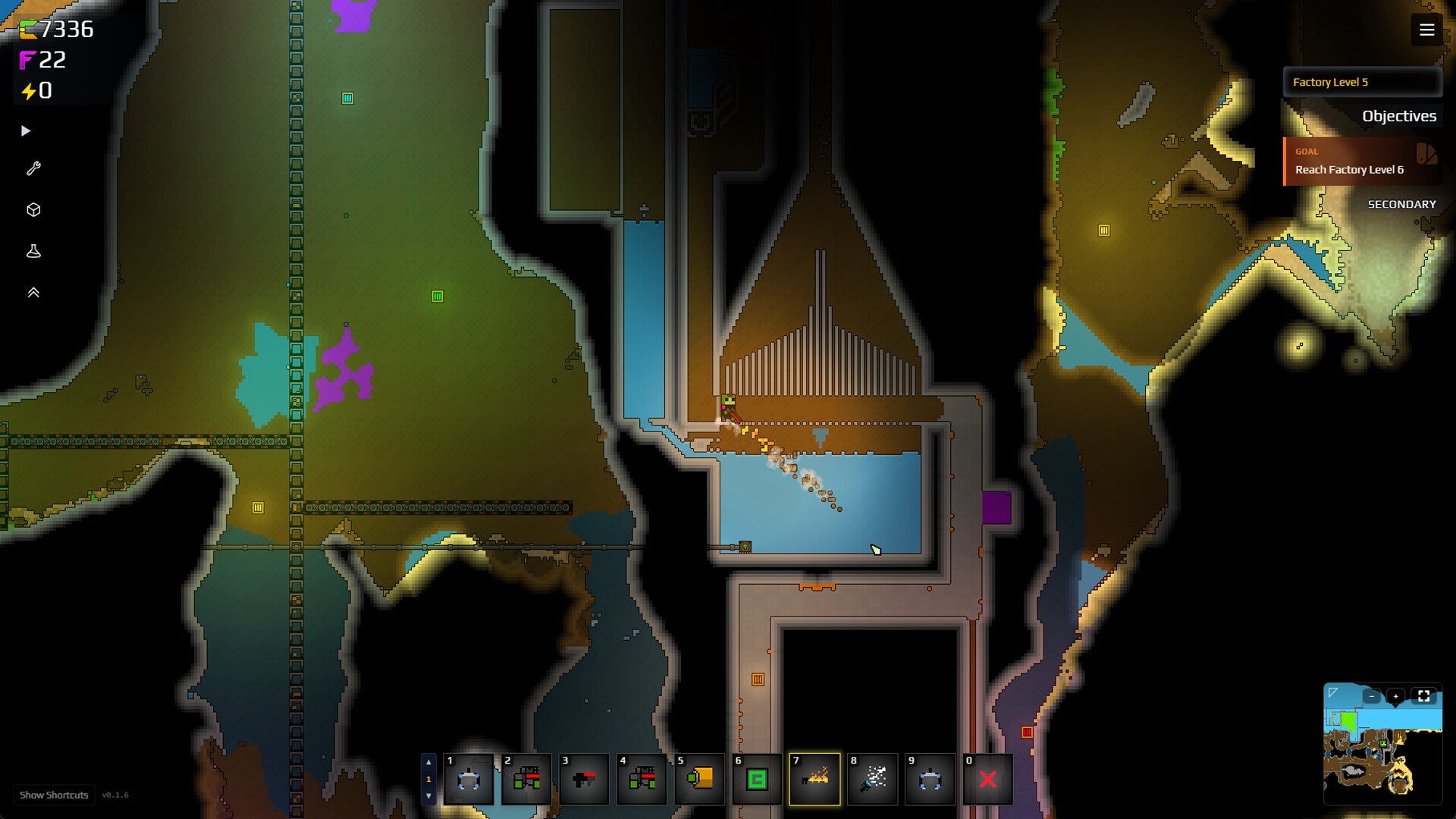
Sandustry is a 2D factory-building game that prioritizes environmental interaction over static resource management. Unlike traditional titles where resources are mere inventory icons, the world of Sandustry is built upon a foundation of individual pixels, each governed by its own physical properties.
The core gameplay loop involves prospecting across a procedurally generated planet, excavating materials, and constructing intricate production chains. The game challenges players to build a factory that is not just efficient, but physically integrated into the environment. From digging deep into the crust to manipulating complex chemical reactions, the game demands that players treat their environment as an active, often volatile, participant in their industrial ambitions.
The title is set for release on Steam, GOG, and the Microsoft Store on August 13th. For those eager to sample the mechanics, a playable demo is currently available on Steam, offering a glimpse into the chaotic potential of the game’s engine.
Chronology: From Concept to Global Launch
The journey of Sandustry represents a steady climb in the indie development space. The project began as a specialized exploration into 2D physics-based simulation, with developer Lantto Games aiming to solve the "static world" problem common in automation games.
- Initial Concept Phase: The development team focused on creating a proprietary engine capable of handling high-density pixel manipulation without sacrificing performance. This period saw the creation of the core thermodynamic model, which allows fluids to transition states based on environmental temperature.
- Early Prototype Testing: Internal builds were shared with a select community, focusing on the feedback loop between mining and automation. The challenge of balancing "fun" with "physics-driven difficulty" became the primary hurdle during this stage.
- Partnership with Hooded Horse: The collaboration with publisher Hooded Horse, known for their focus on deep strategy and simulation titles, provided the necessary support to scale the game’s ambitions and ensure a polished, broad-market release.
- Announcement and Hype Cycle: The official announcement trailer, released in mid-2024, highlighted the game’s potential for mass-scale industrial disaster, sparking comparisons to roguelite titles known for their unforgiving physics engines.
- August 13th Release: The final milestone, marking the transition from development to the Early Access model, allowing the community to influence the final stages of the game’s feature set.
Supporting Data: The Physics of the Pixel
What sets Sandustry apart in a crowded market is its commitment to granular simulation. The game utilizes a proprietary system that tracks individual particles, a rarity in the automation genre.
The Thermodynamic Engine
The game’s internal logic is built upon a robust thermodynamic system. It is not enough to simply pump water from one reservoir to another; players must account for ambient temperatures. The simulation tracks heat transfer through materials, meaning that a factory line can inadvertently cause a lake to boil away into steam. This steam, in turn, follows internal fluid dynamics—rising, condensing, and eventually forming rain clouds that can interact with the factory’s exterior.
Procedural Generation
The game’s world is entirely procedurally generated, ensuring that no two "runs" or factory designs are identical. The terrain generation algorithm accounts for mineral density, water tables, and geological pockets, forcing players to adapt their automation strategies to the specific, often hostile, geology of their seed.
Comparison to Industry Standards
While Factorio remains the gold standard for pure automation, Sandustry aligns more closely with the emergent chaos seen in titles like Noita. In Factorio, you fight against enemies; in Sandustry, you fight against the environment, which is constantly attempting to collapse, flood, or melt your infrastructure.
Official Responses and Developer Insight
In recent correspondence, the team at Lantto Games has emphasized that Sandustry is intended to be a "living" simulation.
"We wanted to move away from the idea of the factory as a static grid," a representative stated. "In Sandustry, the planet is a character. If you drill too deep or fail to manage the heat output of your reactors, the environment will react. We aren’t just giving players conveyor belts; we’re giving them a volatile chemical set."
The developers have addressed concerns regarding the complexity of the physics, noting that while the barrier to entry might feel steeper than traditional automation games, the payoff lies in the satisfaction of solving "physics puzzles" rather than just mathematical ones. They have also confirmed that despite the emphasis on sand and arid environments, water management—and the risks associated with it—will be a cornerstone of the late-game experience.
Implications: The Future of Factory Simulators
The release of Sandustry signals a potential shift in the factory simulation genre toward "Physics-First" design. If Sandustry succeeds in maintaining performance while simulating millions of individual particles, it could force a paradigm shift in how developers approach the genre.
The "Emergent Gameplay" Effect
By moving away from deterministic, grid-based logic, Sandustry opens the door to emergent gameplay. Players will inevitably find ways to weaponize the game’s physics—using steam to power machinery, utilizing molten materials as a structural component, or creating "accidental" irrigation systems. This type of player creativity is what drives the longevity of simulation games.
The Risk of Complexity
However, this ambition carries inherent risks. The "Dark Souls of resources" label, while catchy, implies a high level of frustration. If the simulation is too unforgiving, or if the physics engine produces unpredictable bugs that break player progress, the game may struggle to maintain a long-term player base. The transition from Early Access to full release will be defined by how the developers balance the game’s complex systems with the need for a rewarding, rather than purely punishing, user experience.
Market Positioning
With the backing of Hooded Horse, Sandustry is well-positioned to capture the audience that has already exhausted the content available in the current market leaders. By filling the niche of "chaotic, physics-based automation," it does not necessarily compete with the likes of Satisfactory or Factorio—it complements them.
As we look toward the August 13th launch, the gaming community remains cautiously optimistic. If the developers can successfully navigate the complexities of their own engine, Sandustry might just redefine the limits of what a factory-builder can be, turning the simple act of mining sand into a masterclass in industrial engineering and environmental management. For now, we wait—and perhaps start brushing the sand out of our keyboards in preparation.


 Asro
Asro
 Muslim