

In the modern gaming landscape, success often breeds imitation. We have watched the "Vampire Survivors" effect ripple through the industry, turning humble indie projects into genre-defining titans that spawn a thousand imitators. From the high-tension, claustrophobic corridors of Lethal Company to the visceral, high-stakes psychological warfare of Buckshot Roulette, the pattern is consistent: a novel mechanic strikes gold, and the market follows suit. Perhaps no recent title has demonstrated this trend more effectively than Balatro, the poker-themed roguelike that transformed deck-building into a global obsession.
However, amidst a sea of clones that either lean too heavily into gambling mechanics or lose the thread of the original’s strategic depth, a new contender has emerged that dares to trade chips for dictionaries. Enter Lexispell, a title that marries the addictive, run-based progression of a roguelike with the cerebral rigor of a word game and the tactile, physics-based chaos of a "drop-and-merge" puzzler.
The Core Concept: Where Vocabulary Meets Physics
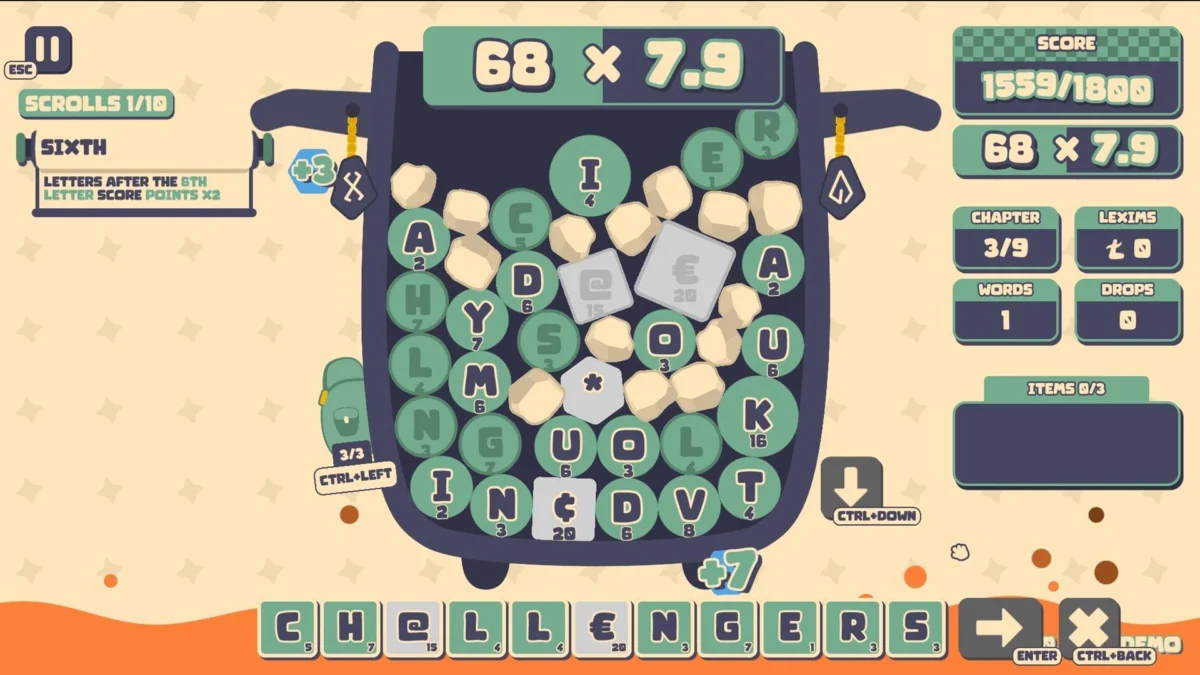
At its surface, Lexispell is a game about linguistic dexterity. But look closer, and you will find a mechanics-heavy experience that demands more than just a passing knowledge of Scrabble. Developed by MrEliptik, the game casts the player in the role of a budding witch. Instead of casting spells with wands, you are brewing them in a cauldron.
The gameplay loop is deceptively simple: players drop letters into a cauldron, much like the viral sensation Suika Game. These letters are subject to physics; they bounce, settle, and stack in unpredictable ways. The objective is to extract words from this jumbled mess. Each letter carries a distinct point value, dictated by its rarity—a ‘Z’ or ‘Q’ will yield significantly more points than a standard ‘E’ or ‘A’.
The complexity scales rapidly as players manipulate the board. If two identical letters collide, they fuse, creating higher-tier, higher-value characters. This "merge-and-match" mechanic forces players to think spatially; you aren’t just looking for the word "CAT"—you are trying to position your ‘A’ so that it might drop into a position that triggers a chain reaction, clearing space and boosting your score multiplier.
A Chronology of the Word-Game Renaissance
To understand Lexispell, one must look at the recent history of the "cozy-but-punishing" genre.
- 2021-2022: The Wordle Explosion: The meteoric rise of Wordle proved that there was a massive, untapped audience for daily, bite-sized word puzzles. It shifted the gaming zeitgeist toward accessibility and social sharing.
- 2023: The Roguelike Pivot: As the novelty of simple word-guessing began to wane, developers began experimenting with "roguelike-ifying" the genre. We saw the rise of games that added persistent upgrades, meta-progression, and difficulty curves to static puzzle frameworks.
- 2024: The Balatro Effect: Balatro arrived, proving that combining a known "house" game (Poker) with rogue-lite "joker" mechanics was a recipe for infinite replayability. Lexispell serves as the natural evolution of this trend, moving away from cards and toward the complexity of the English language.
Supporting Data: The Mechanics of the Scroll System
The true depth of Lexispell lies in its "Scroll" system—the game’s equivalent to Balatro’s Joker cards. These items are the engine of your run, providing the modifiers necessary to survive the game’s later, more punishing stages.
The variety of these scrolls is where the game’s strategic ceiling is established. For instance, there are passive bonuses that reward players for identifying "palindromic" structures or those that capitalize on specific letter shapes. One particularly high-value scroll grants an additional 15 points to your multiplier if you manage to construct an "anadrome"—a word that becomes a completely different word when read backward (e.g., "WARD" becomes "DRAW").
This requires the player to maintain a mental database of vocabulary while simultaneously managing the physical state of the cauldron. It is a dual-tasking challenge that separates the casual word-searcher from the competitive roguelike strategist.
The "Dark Souls of Wordle" Controversy
In the gaming community, the phrase "The Dark Souls of X" has become a cliché—a shorthand for "this game is difficult and makes me feel bad." When applied to Lexispell, however, the comparison is earned through a specific type of cognitive fatigue.
Unlike Wordle, which provides a single, clear goal, Lexispell is a game of constant optimization. The "difficulty" arises from the intersection of time pressure and the finite nature of your board space. You are not just fighting the letters; you are fighting the physics engine and your own limited ability to recall obscure vocabulary under stress.
As one critic noted, "Lexispell is the Dark Souls of Wordle." While the developer may not have intended for the game to be a punishing gauntlet, the procedural generation of letters combined with the rigid scoring requirements creates a "high-skill floor" environment. If you fail to build a strong base of scrolls early in the run, you will inevitably find yourself trapped in a "word-drought," where the letters provided simply cannot form the high-value words required to progress.
Implications for the Indie Market
The success and reception of Lexispell signal a shifting preference in the indie scene. Players are increasingly gravitating toward "micro-strategic" games. These are titles that offer short, high-intensity sessions—perfect for a commute or a lunch break—but possess enough hidden depth to warrant hundreds of hours of mastery.
Furthermore, Lexispell highlights a growing trend of "genre-blending" that is becoming the hallmark of the modern indie developer. By stripping away the visual clutter of high-fidelity graphics and focusing on the purity of the "core loop," games like Lexispell prove that the most engaging gameplay experiences don’t need a multi-million dollar budget. They need a solid, hook-based mechanic and a willingness to challenge the player’s intelligence.
Official Responses and Developer Intent
While MrEliptik has remained relatively understated regarding the game’s "Dark Souls" reputation, the design philosophy is clear: Lexispell is meant to be a game of mastery. In community forums and on the game’s Steam page, the developer emphasizes the importance of learning the scroll synergies.
The community response has been largely positive, with players comparing the "one-more-run" addiction of Lexispell to the early days of Slay the Spire. There is a palpable sense of accomplishment when a player successfully chains a massive word, clears the board, and triggers a synergy that nets them a record-breaking score.
Future Outlook
Is Lexispell a permanent fixture in the gaming canon, or a flash in the pan? The answer lies in the game’s post-launch support. Roguelikes live and die by their variety. To maintain long-term engagement, the developer will need to introduce a steady stream of new scrolls, letter types, and perhaps even daily challenges that unify the player base.
As it stands, Lexispell is a fascinating case study in how to breathe new life into a stale genre. By forcing players to engage with the English language not as a stationary puzzle, but as a dynamic, physical resource, it has carved out a unique niche. It is a game that is as much about the physical space of the screen as it is about the mental space of the player.
For those looking to test their vocabulary under the pressure of a ticking clock and a failing physics engine, Lexispell is available now on Steam. Just don’t expect it to be a relaxing game of Scrabble—you’ll need more than a dictionary to survive the cauldron.












No comments yet. Be the first to join the conversation!